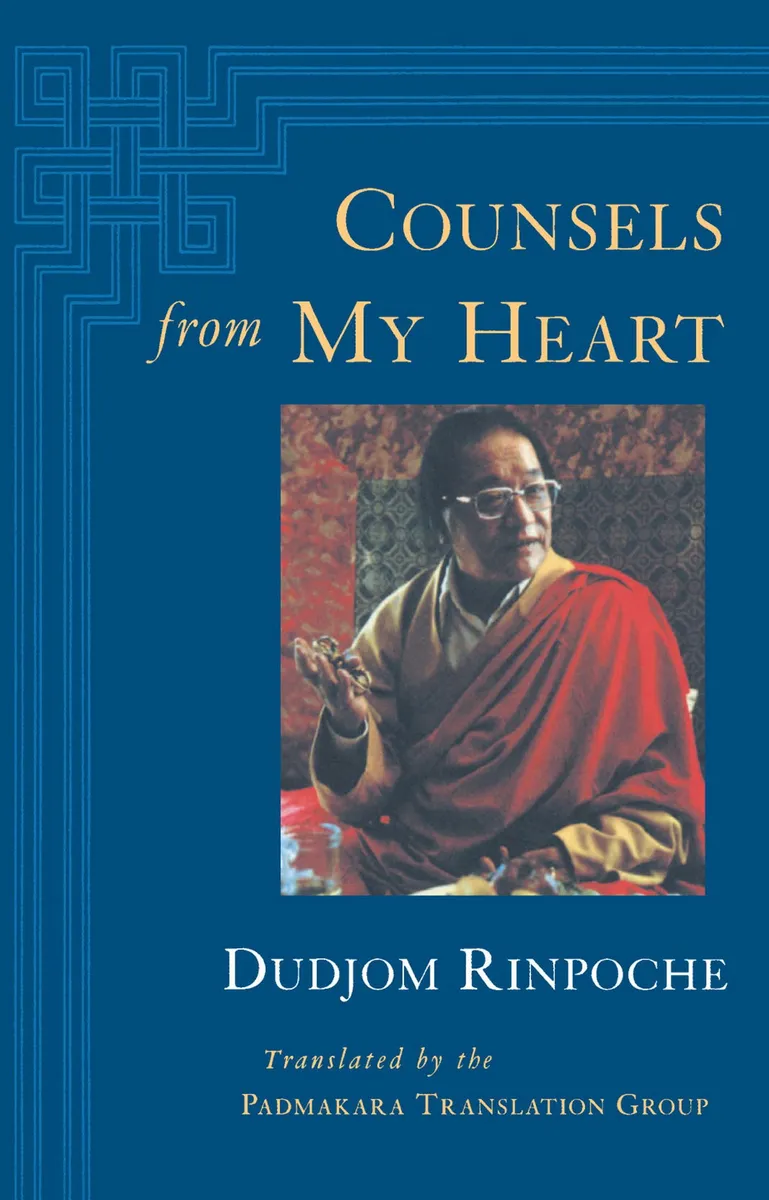
Matter-of-fact about his training and work, he concealed his personal attainments beneath a veil of playful humor.
Finally, for those whose mental horizons and reserves of merit are even greater, and who are ready to receive them, the Buddha set forth the teachings of the resultant vehicle of the Secret Mantra of the Mahayana, which go far beyond the doctrines of the causal vehicles.
When we have taken refuge in the Three Jewels, what should our fundamental attitude be? We should understand that the whole of space is pervaded by living beings; there is not one of them that has not been, at one time or another, our father or our mother. We should recognize that they have been our parents and feel gratitude toward them for the love and kindness they have shown us. We should also realize that all these beings, once our mothers, are sinking in the ocean of the sufferings of samsara. We should cultivate the attitude of bodhichitta, taking the decision to practice the supreme Dharma for their sake. Bodhichitta is thus the fundamental preparation and basis of our practice of the path.
People who have the attitude of the Mahayana think that it is somehow shameful to want liberation only for themselves, when other beings who were once their loving parents are sunk in the ocean of suffering. They are unable to imagine anything worse, and resolve to practice the Dharma in order to be able to lead beings, their parents, to liberation. They are determined to do this regardless of the consequences, and are ready to remain in samsara for as long as it takes to accomplish the task. This is the vast, great-hearted attitude that we too must have.
Why, you may ask, are the Mantra teachings to be kept secret? It is not because of their profundity, but rather to preserve them from people of limited and narrow
attitudes. The path of Secret Mantra has unusual features such as ease, rapidity, great subtlety, and skillful techniques.
Now suppose an ingenious, stout-hearted person comes along and asks the people what they are up to. They will say that if the poisonous plant is allowed to grow, it will be very dangerous. Not only must they cut it down, they must uproot it so that no trace of it is left in the soil. Now, what will be the approach of the clever person? He will agree that the plant must be properly disposed of, but he will know that it is not necessary to go to such lengths to make sure that the plant stops growing. He will point out that the plant can be killed easily by pouring boiling water over its roots. His approach is similar to the way defilements are dealt with according to the Bodhisattvayana. To remove defilements, it is not necessary to go through the same difficulties as the shravakas at the level of adoption and abandonment of actions.
Practitioners of the Great Perfection are aware that there is no such thing as a real, solid defilement to be abandoned. Just as the peacock consumes the poison, with the result that its feathers become more and more beautiful, the practitioner of Secret Mantra does not reject defilements but brings to perfection the enlightened qualities of the kayas and wisdoms. This gives us an idea of the differences between the greater and lesser paths.
In order to be able to practice the Great Perfection, it is essential to be completely convinced, to be absolutely certain, of the view. For this reason, I am going to say a few words about it: the view of the Great Perfection of the Secret Mantra of the Mahayana.
He said that while our view should be that of the Great Perfection, our actions should not get lost in the view. What did he mean? The view is normally understood as the certainty that all phenomena, both of samsara and of nirvana, are empty.
There will come a moment when there is no such thing as benefit or harm, no such thing as happiness or sadness. It is then and only then that we will really have mastered the view. Guru Rinpoche said, “My view is higher than the sky, but my attention to actions and their results is finer than flour.”
Like eagles soaring in space, we should be clearly convinced of the view, but at the same time we should heed the karmic principle of cause and effect, as finely as if we were sifting flour.
The first of these methods is the attitude of bodhichitta. All beings possess the tathagatagarbha, the seed of buddhahood, but this is obscured and veiled.
The second supreme method is to have a mind free from conceptualization, which means to practice without distraction.
The third supreme method is to conclude with dedication. Whatever merit has been generated must be dedicated for the sake of beings, who are as many as the sky is vast. In fact, if we forget to round off our practice with the excellent attitude of bodhichitta, dedicating the merit to others, this merit could be destroyed in a moment of strong anger or defilement.
for us is the vajra hell. The saying goes that practitioners of Secret Mantra either attain buddhahood or go to hell. There is no third alternative. It’s like a snake inside a cane: it must go either up or down. There’s no way out halfway! Think carefully about the benefits and hazards of samaya, and observe it purely and perfectly. To do this, it is crucial to keep a close watch on your mind, a practice in which all the essential points of the teachings are condensed. It is vital to examine and watch your mind.
This ground, which is our spontaneous awareness, has been with us “from the beginning.” It is like a mirror. When someone with a happy face looks in a mirror, the reflection of a happy face appears. When someone with a sad face looks into it, a sad face appears. The primordial ground is just like a mirror. The reflection of a person with a happy face looking into a perfectly clear mirror, the primordial ground, is like Samantabhadra, who awoke to his ultimate nature. Samantabhadra, it is said, “captured the citadel of the primordial ground, awoke, recognized his own nature, and was free.”
The root of delusion is ignorance, and the root of ignorance is ego-apprehension, the idea of “I.” Samsara occurs simply because we do not recognize our true nature. It is on account of this “I,” this clinging to the notion of self, that we conceive of “others.” As a result, we enter into subject-object relationships, and these prevent us from escaping from samsara.
But for us practitioners of the Secret Mantra, only one supreme instruction is necessary, a single antidote that liberates everything. We must acquire a deep conviction regarding the true nature of phenomena. Once again, the root of delusion is ignorance. And what is ignorance? It is clinging to self.
When we arrive at a correct understanding of the mind, we can see that our present thoughts are just like waves on the water. At one moment they arise; at another they dissolve. And that’s all there is to it: the mind is nothing but thoughts. The mind, which is empty, arises as thought, and this is also empty. The stream of consciousness, which is empty, is carried away by thoughts that are likewise empty. This is how the mind falls and remains in the six realms of samsara. It is the mind itself that fabricates samsara, and it does so because it fails to recognize its own nature.
A mind that is not agitated by thoughts concerning the past, present, and future, a mind that is thought-free, is a state that is stunningly vast and open. It is
full of joy. Even when the mind’s nature is recognized, it is impossible to describe. It is empty. It rests in awareness. But this resting in the radiance of awareness does not last long. There is nothing permanent about it, for thoughts will certainly arise, strong and clear.
Whether you experience bliss or clarity, avoid any kind of expectation. Do not think to yourself, “Oh, my meditation is working. I’m making progress. If only I could have more of these experiences!” On the other hand, if you experience a kind of darkness, a thoughtless blankness, clear it away over and over again.
Whatever happens, it is said that you must meditate without hope or fear, doubt or expectation. That’s the main thing.
If you do, there will come a moment when you will see that what is called the Buddha is not different from your own awareness, and that there is nothing to subdue or master other than your own thoughts. The sign that your meditation has hit the mark is that your devotion to the Lama will deepen and your compassion for beings will gain in strength. You will be your own witness and you will gain great confidence in the practice.
2 T he Essence of the Path
3 T he Long Oral Lineage of the Nyingmapas
For life is passing, and there is no certainty about the time of death. Even if you should die tomorrow, you should have confidence and be without regret.
Fortunate are those disciples who at all times keep their samaya and vows as dearly as their lives. They gain accomplishment quickly. Ignorance, the five poisons, doubt, and dualistic clinging are the roots of samsara and the sufferings of the three realms. There is one antidote that removes or liberates everything in a single stroke. It is spontaneous wisdom, the primal wisdom of awareness. Be confident, therefore, in the creation stage: appearances, sounds, and thoughts are but the primordial display of deity, mantra, and primal wisdom.
Take your stand on the ultimate practice of the Heart Essence—samsara and nirvana are the display of awareness.
It is also said that if you do not meditate, you will not gain certainty; if you do, you will. But what sort of certainty? If you meditate with a strong, joyful endeavor, signs will appear showing that you have become used to staying in your nature.
The fierce, tight clinging that you have to dualistically experienced phenomena will gradually loosen up, and your obsession with happiness and suffering, hopes and fears, and so on, will slowly weaken.
If you are able to meditate, completely turning aside from the activities and concerns of this life, it is certain that you will gain the extraordinary qualities of the profound path of Dzogchen. Why wait for future lives? You can capture the primordial citadel right now, in the present. This advice is the very blood of my heart. Hold it close and never let it go!