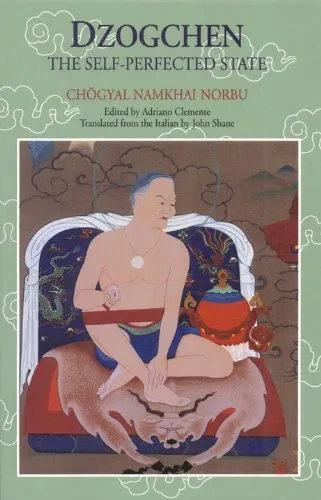
We will discover in the pages of this book what is meant by “relaxation” in Dzogchen, and how it is possible to “practice” without either renouncing anything, or having to commit oneself to any activities that might be incompatible with one’s normal daily life.
The written Dzogchen teachings are divided into three sections: the Series of the Nature of the Mind (sems sde),‘the Series of Primordial Space (klong sde), and the Series of Secret Instructions (man ngag sde).
Chapter
Chapter
Realization is considered to be arrived at in the extinction of the individual’s illusory ego, which is the root of all desires and conflicts.
Vajra means “indestructible,” and refersto the primordial condition of the individual, which is beyond birth and death.
To receive this type of transmission, it is therefore necessary to have the capacity to perceive the subtle dimension of light.The essence of the elements is light, or colour, but this is not a matter of material colours, visible to everyone.
But a realized being, who has purified his or her karma, and has reintegrated the material manifestation into the pure dimension of the elements, spontaneously manifests his or her wisdom through colour and light. To have contact with this pure dimension one needs to develop one’s innate clarity to the highest degree, and to purify the obstacles of karma and of ignorance.
The visual representation of a manifestation of transformation is called a mandala, which is one of the fundamental elements of the practice of tantra. The mandala could be said to be like a photograph taken at the moment of the pure manifestation of the divinity. At the center of every mandala one finds the central divinity, who represents the primordial condition of existence, corresponding to the element of space. At the four cardinal points, represented by the colours of the other four elements, there will be the same number of forms of divinities, symbolizing the functions of wisdom which arise as the four actions.’
The tantric practitioner, however, is aware of how energy functions, and knows that blocking energy can cause disturbances to the body as well as to the mind. He or she does not put the brakes on the flow of energy, does not repress it, but uses it as a means for transformation. To do this, however, requires a highly developed capacity of practice.
Chapter
The most important thing is never to become distracted, maintaining the state of presence in every moment.
Chapter
The master, in Dzogchen, is not just like a friend who helps and collaborates with the disciple; rather the master is himself or herself the path. This is because the practice of contemplation develops through the unification of the state of the disciple with that of the master.
But karma is not in fact a material accumulation, and does not depend on externals; rather its power to condition us depends on the obstacles that impede our knowledge. If we compare our karma and the ignorance that creates it to a dark room, knowledge of the primordial state would be like a lamp, which, when lit in the room, at once causes the darkness to disappear, enlightening everything. In the same way, if one has the presence of the primordial state, one can overcome all hindrances in an instant.
The base, at the level of the individual, is like the space inside a clay vase, which, even though it is temporarily limited by the shape of the vase, is not different from the space outside, surrounding the vase. This void condition which is likeempty space is called the essence, and it is beyond all concepts. But in it there is a continuous clarity that manifests in the individual’s thoughts and the various aspects of energy; this clarity is the state of presence, which is like a sun arising in the sky.
The light of the sun is the manifestation of the clarity of the sky; and the sky is the basic condition necessary for the manifestation of the sun’s light. So, too, in the sky two, three, four, or any number of suns could arise; but the sky always remains indivisibly one sky. Similarly, every individual’s state of presence is unique and distinct, but the void nature of the individual is universal, and common to all beings.
Lastly, we have the example of clouds, which represent the provisional hindrances that impede the manifestation of our primordial state.
Nirvana is not a paradise or some special place of happiness, but is in fact the condition beyond all dualistic concepts, including those of happiness and suffering.When all our obstacles have been overcome, and we find ourselves in a state of total presence, the wisdom of enlightenment manifests spontaneously without limits, just like the infinite rays of the sun. The clouds have dissolved, and the sun is finally free to shine once again.
Part
are to be found the principles of the base, the path, and the fruit, alongside a simultaneous explanation of the way of seeing, the way of practicing, and the way of behaving according to the Dzogchen teachings.
Chapter
Chapter
By the term “vision of experience” what is meant is the manifestation of the results of practice. Through the practice of meditation, for example, there can arise the signs of the internal relaxation of the individual’s five elements. Or, if one is practicing the methods of visualization found in tantrism, one can have experience of visions of such things as mandala or divinities.
In tantrism, for example, the final result of the practice is the transformation of the five passions into the five wisdoms.
This nature is the base, our fundamental condition, which is as clear, pure, and limpid as the capacity that enables a mirror to reflect.
When we practice contemplation, different experiencescan arise for us, but the presence of the state of contemplation never changes. That does not mean that one has to try in some way to cancel out or deny the experiences that may arise, but only that one should not mistake the experiences for the state of contemplation itself.
The experience of the absence of thoughts can imply both actual lack of thoughts, and a state in which thoughts, even if they arise, do not disturb one. This experience, which we can also define as a “void” state of mind, is a natural manifestation of the relaxation of the mind. The experience of clarity is linked to one’s energy, to the aspect of the voice, and can manifest in various ways, through either sensations or visions.
When one practises meditation on the calm state for a long time, for example, one can experience a sensation that one’s body is no longer there, or else a sensation of great pleasure such as that of finding oneself in the middle of a cloud up in empty space.
If a practitioner remains absorbed for days and days in a state of pleasure, or of voidness, without maintaining thepresence of contemplation, this is like falling asleep in an experience. This happens when the experiences are mistaken for one’s true destination.
And then again, sometimes, when we are very agitated, even if we try to relax, we will not succeed in doing so, because we remain completely dependent on all the various circumstances related to our situation.
These grades of realization are based on the level of the purification of subtle obstacles to knowledge achieved by the practitioner. But in the nondual condition there do not really exist levels or stages of realization; from this point of view there is only bhumi, which is the state of knowledge itself.
But the practice of Dzogchen means that one learns to relax whilst all the time maintaining one’s presence in whatever circumstances one finds oneself in. Thus, in a state of total completeness, one remains relaxed and present in relation to all
the infinite manifestations of energy that may arise.
For this reason the mirror is used as an example, because if we look in a mirror we see our own face, and even if we don’t like the way it looks, we have to accept it. This is the only way we can discover something deeper, and to begin to really understand it.
Even if one has, for example, overcome one’s attachment and one’s passions and has gained a certain level of stability in one’s meditation, as long as one can still be caught up in any idea or concept about knowledge itself, one is still automatically shut out of the path to realization. Thus, the way one understands the base is extremely important in Dzogchen.
In the same way, there exist in the teachings thousands of methods, but if one understands the principle of contemplation, it’s not important which of these methods one uses.
Chapter
The practice of Dzogchen may begin with doing fixation on an object, in order to calm one’s thoughts. Then one relaxes the fixation, dissolving the dependence on the object, and one fixes one’s gaze in open space. Then, when one succeeds in making the calm state stable, it is important to work with the movement of one’s thoughts and one’s energy, integrating this movement with the presence of contemplation. At this point one is ready to apply contemplation in one’s daily life.
When the sun rises in the sky its rays inevitably shine out, but the sun doesn’t say, “See how my rays shine!” It’s the people who have been in the dark who define the situation by saying, “Look, now there’s the light of the sun.”
There are no barriers in the true condition of “what is,” and in that condition all tensions are relaxed. Practicing actually means unwinding one’s tensions. We talk a lot about overcoming attachment, but what is the source of it? It actually arises from the tensions that we come to create after we have separated our reality into self and other. Thus the only real way to overcome this attachment is to find oneself in a state of relaxed presence. The fact is that an authentic state of presence is, by its very nature, relaxed.
It is usually very easy for us to become distracted through our passions, our agitated states of mind, our attachments, and so on. Two people who fall in love, for example, in the first glow of their romance can sometimes hardly bear to beapart even for an instant. They don’t realize that they have become distracted and blinded by their passions.
If, then, through this experience the disciple is able to understand the state in which there is no distinction between a terrible smell and the scent of a rose, the dead rat will have sufficed as a means of transmission.
Directly discover your state. Don’t remain in doubt. Gain confidence in self-liberation.’
This is the base. “Not remaining in doubt” means that one must have a precise knowledge of this state, finding the state of the presence of contemplation which is one and the same in all the thousands of possible experiences. This is the path. “Gain confidence in self-liberation” is the fruit.