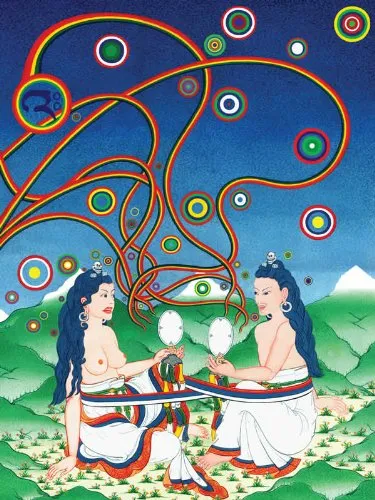
(Love as the original falling)
opening If we allow our boundaries to blur, we become an endless flurry of provocative movements – gestures that express love: in the way a whale surfaces or a shark discovers its depth; the way surf roils in swells of the ocean and waves crash into bright shingle; the way a gull cries; an owl feels night beneath her wings; the wind blows; snow falls; thunder rolls; ice melts; frost glitters; or the sun and moon blaze through the unknown swathe of time.
We always fall in love – we never climb.
We can only share the experience of love if we relinquish our definitions of who we are and what we propose to become.
Love is a divisionless dimension – a centreless play of energy. Where there is no established separation between our inner world and our outer world – we fall in love.
Love is centreless dance. It is the spontaneous self-reflection of the interpenetrating interengulfing quality of reality.
(Vajra-romance and the wisdom-compassion symmetry)
engendering fierce grace We should not be blatant in revealing the visceral fire of our intimate relationships. When we speak of our lovers, we need to be cautious with our words. The knowledge that hovers above and below the surface of mundane expression should be left unspoken. Voluptuous landscapes of feeling should be left to be inferred.
The vision of Vajrayana portrays men and women according to a radical paradigm: women are overtly wisdom, and covertly compassion; men are overtly compassion, and covertly wisdom. Arising from the felt-dimension of this intriguing symmetry, a way of seeing evolves – a way of being, and a way of living with impeccable verve. The energetic context of this mode is the experience of vajra-romance, which manifests as a dramatic method of realising the nondual state.
This kind of fact is not ‘fact’ according to the largely nihilistic ‘facts’ of psychology, psychiatry, or physics—it is a fact of view—a fact in the experience of a yogi or yogini.
Vajrayana fact is therefore not objective according to nihilistic criteria – but neither is it subjective. Vajrayana is not constrained or limited by dichotomous definitions such as subjective or objective. Vajrayana goes beyond concepts of ‘personal illusion’ and ‘group illusion’, into a space where the effect of entering the dimension of view is more important than whether the view is ‘hard wired’ into our fundamental biochemical structure.
Vajrayana is both paradoxical and logical, as we shall discover.
Chaos and pattern; intuition and logic; mystery and rationality – how do these couplets relate to vajra-romance, or to romantic love even as it is commonly understood? What could they signify to men and women falling in love?
Leaving this question temporarily in flux, allows an atmosphere of open-endedness – and this is vital if we are to begin to move away from the concretised constructs on which we customarily rely. It may be frustrating to travel on with a sense of uncertainty, but it is both more exhilarating and more pertinent to our exploration, than to take hold of specific conclusions. It is too early for conclusions of any kind.
Can models exist which are not merely the products of ephemeral historical contexts?
Many times these cultural, religious, or spiritual models become cages in which we trap ourselves, or in which we seek to trap others. Some of these models are highly simplistic, and seem designed to maintain social order according to whatever culture has devised them.
(Models as cages; nondual questioning of all patterns)
Vajrayana prompts the questioning of the patterns of the world, within a nondual understanding. This is vital, because continually evolving new patterns on the basis of previous patterns—when all patterns are questionable by virtue of their unavoidable restrictiveness—is not an option for anyone who wishes to touch the heart of vajra-romance.
Cutting
(The four denials and where nonduality stands)
The desire for happiness and happiness itself are mutually exclusive within any dualistic paradigm, because we attempt to achieve happiness in a manner which undermines the possibility of happiness. From the perspective in which ‘ultimate self-fulfilment’ is the pinnacle of what is possible, the idea of ‘possible’ is fundamentally misleading. When ‘possible’ lies within the framework of an existential utopianism, it is merely a fiction – ‘impossibility’ posing in the empty posing-pouch of ‘possibility’.
If we look at the convex definition of being as wearing particular modes – then concavity consists of being naked in relation to the phenomenal world.
We do not have to define, or even know, what it is to be male or female, because being male or female is simply and intrinsically what we are. There are no criteria to which we have to conform.
If one has the high energy of a healthy romantic relationship, it can prove less difficult than the well-defined practices of Vajrayana found in the drüpthabs.
one simply opens oneself to the poetry of what is suggested in terms of living the view. One simply allows oneself to be caught by surprise by the fact that the world can magically display gender attributes.
experience. Some searingly precise gut-knowledge of body-mind-moment by body-mind-moment needs to erupt within the fabric of our existence before vows of view can be said to have real meaning.
– perfectly, and with fierce grace. It is neither wise nor practical to expose the heart of this reality without first creating a conducive atmosphere in which such perspectives can disport themselves with vivid elegance.
(Convex and concave: vow of view and transmission)
Although Buddhist Tantra includes human sexuality, its parameters are far broader than the perverse phallocentric methodologies which deify physical technique and systematised approaches to love-making.
One cannot intend to fall in love with an arbitrarily chosen person either. The vow of view has more to do with returning to the dimension of transmission. One receives transmission of the view – and then one is prompted to experience according to the nature of the vow of view.
(Nonduality vs. monism, nihilism, and eternalism)
NR Yes. The problem may actually be that you do not know enough about what it is not. The idea of nonduality which is couched in terms of ‘everything is one’ is one of the four denials – monism. There are also dualism, nihilism, and eternalism. Dualistic philosophies tend to posit some sort of basic separation – for example the division between creator and created. Monistic philosophies overcome the problems caused by this type of division by saying that we are all one and part of God. These two approaches can be seen as a pair. The other pair is nihilism and eternalism, which deal with ‘meaning’ or ‘truth’ rather than questions of plurality and singularity. Eternalism holds that everything has meaning – which is to say, that there is a purpose for everything, and that nothing happens which is not part of the varied schemata through which all beings are on the way to liberation. A theistic eternalist would say “God works in mysterious
ways, his wonders to perform”. Theism is either monist or eternalist. Nihilism holds that there is nothing beyond material reality and that existence has no meaning.
nonduality allows meaningfulness and meaninglessness to be simultaneous facets of reality. Meaning arises out of meaninglessness, pattern arises out of chaos – and they are undivided.
KD We mentioned before, the idea of ‘wearing a definition’. That would be convex, in comparison with being naked to the phenomenal world, which would be concave.
NR ‘Convex’ and ‘concave’ are non-emotive terms – and they are also the words used in the Khandro Pawo Nyi-da Mélong Gyüd.