I often observed how effortlessly he would enter the transcendent state of samadhi; each of us present would be bathed in the ineffable peace and bliss that emanated from his God-communion. By a touch, a word, or even a glance, he could awaken others to a greater awareness of God’s presence, or bestow the experience of superconscious ecstasy on disciples who were in tune. A passage in the Upanishads tells us: “That sage who has solely engaged himself in drinking the nectar which is no other than Brahman, the nectar which is the outcome of incessant meditation, that sage becomes the greatest of ascetics, paramahansa, and a philosopher free of worldly taint, avadhuta. By the sight of him the whole world becomes consecrated. Even an ignorant man who is devoted to his service becomes liberated.”
Even when he made reference to himself and his work, it was without any sense of personal accomplishment. Having attained the ultimate realization of God as the true soul-essence of one’s being, he knew no other identity apart from Him.
Those periods of concentration on the literary message he wished to leave to the world were a privileged time for those of us who could be in his presence. He was completely absorbed, completely at one with the truths he was perceiving within and expressing outwardly. “He came into the yard for a few minutes,” recalled one of the monks working on the grounds around Paramahansaji’s retreat. “There was a look of incalculable remoteness in his eyes, and he said to me: ‘The three worlds are floating in me like bubbles.’ The sheer power radiating from him actually moved me back several steps away from him.”
The pantheistic doctrine of the Gita is that God is everything. Its verses celebrate the discovery of the Absolute, Spirit beyond creation, as being also the hidden Essence of all manifestation. Nature, with her infinite variety and inexorable laws, is an evolute of the Singular Reality through a cosmic delusion: maya, the “Magical Measurer” that makes the One appear as many embracing their own individuality—forms and intelligences existing in apparent separation from their Creator.
In samadhi, the cosmic dream delusion terminates and the ecstatic dream being awakens in oneness with the pure cosmic consciousness of the Supreme Being—ever-existing, ever-conscious, ever-new Bliss.
When the little soul is blessed to merge with the vast ocean of blissful Spirit, it takes care not to lose its identity if it wants to come back and chronicle its experiences of the Infinite for the enlightenment of the world.
Master made me meditate on the scriptural truths until I became one with them; then he would discuss them with me.
(It was from him I also learned how to put myself in tune with Christ to interpret his sayings as he wanted them to be understood.)
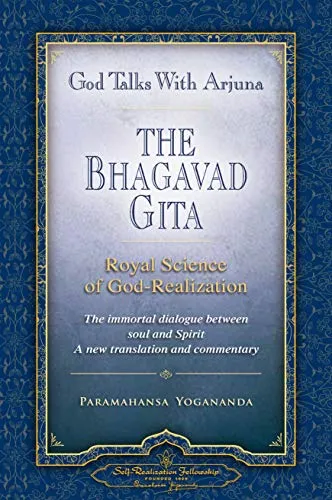
This Bhagavad Gita that I offer to the world, God Talks With Arjuna, is a spiritual commentary of the communion that takes place between the omnipresent Spirit (symbolized by Krishna) and the soul of the ideal devotee (represented by Arjuna).
I became Arjuna’s soul and communed with Spirit; let the result speak for itself. I
This work is not mine; it belongs to them, and to God, Krishna, Arjuna, and Vyasa.
All events and all wisdom are permanently recorded in the superether of omniscience, the akashic (etheric) record. They can be directly contacted by any advanced sage in any clime and age.
the historical background of a battle and the contestants therein have been used for the purpose of illustrating the spiritual and psychological battle going on between the attributes of the pure discriminative intellect in attunement with the soul and the blind sense-infatuated mind under the delusive influence of the ego.
A siddha is a perfected being who has attained complete liberation in Spirit; he becomes a paramukta, “supremely free,” and can then return to earth as an avatara—as did Krishna, Jesus, and many other saviors of mankind through the ages. As often as virtue declines, a God-illumined soul comes on earth to draw virtue again to the fore (Gita IV:7–8). An avatar, or divine incarnation, has two purposes on earth: quantitative and qualitative. Quantitatively, he uplifts the general populace with his noble teachings of good against evil. But the main purpose of an avatar is qualitative—to create other God-realized souls, helping as many as possible to attain liberation.
Students are those who receive only a little
light of truth. But disciples are those who follow completely and steadfastly, dedicated and devoted, until they have found their own freedom in God.
The world, addicted to the senses as the sole means of gratification, can little understand the purity of divine love and friendship that bears no taint of carnal expression or desire.
The symbolism is that of the unity of Spirit and Nature, which when dancing together in creation provides a divine lila, play, to entertain God’s creatures. Sri Krishna, with the enchanting melodies of his heavenly flute, is calling all devotees to the bower of divine union in samadhi meditation, there to bask in the blissful love of God.
Thereafter, he and his brother Balarama were sent by Vasudeva for their education to the ashram of the great sage Sandipani. Of kingly birth, as an adult Sri Krishna fulfilled his kingly duties, engaging in many campaigns against the reigns of evil rulers. He established the capital of his own kingdom in Dwarka, on an offshore island in the western state of Gujarat. Much of his life is intertwined with that of the Pandavas and the Kauravas, whose capital was in north-central India near the present site of Delhi.
We hear of saintly ascetics, or prophets in the woods or secluded haunts, who were men of renunciation only; but Sri Krishna was one of the greatest exemplars of divinity, because he lived and manifested himself as a Christ and at the same time performed the duties of a noble king. His life demonstrates the ideal not of renunciation of action—which is a conflicting doctrine for man circumscribed by a world whose life breath is activity—but rather the renunciation of earth-binding desires for the fruits of action. Without work human civilization would be a jungle of disease, famine, and confusion.
Krishna’s life demonstrates his philosophy that it is not necessary to flee the responsibilities of material life. The problem can be solved by bringing God here where He has placed us. No matter what our environment may be, into the mind where God-communion reigns, Heaven must come. A grasping for ever more money, a plunging deeper into more prolonged work with attachment or blindness, will produce misery. Yet mere outward renunciation of material things, if one still harbors an inner attachment to them, leads only to hypocrisy and delusion. To avoid the pitfalls of the two extremes, renunciation of the world, or drowning in material life, man should so train his mind by constant meditation that he can perform the necessary dutiful actions of his daily life and still maintain the consciousness of God within. That is the example set by Krishna’s life.
The path advocated by Sri Krishna in the Bhagavad Gita is the moderate, medium, golden path, both for the busy man of the world and for the highest spiritual aspirant.
Arjuna excelled all of them in prowess; none could match him. Jealousy and enmity grew among the Kauravas against the Pandus.
Abhasa Chaitanya, reflected Spirit, the eighth offspring, alone remains manifested in this world, working with and energizing the gross tendencies of the mind; yet it maintains an indifference as to the outcome of events.
Ego is noble or degraded only as it expresses its pure nature of divine individuality (soul consciousness expressing through the bodily instrument) or as it entangles itself with the gross inclinations of the sensory mind (see Bhishma in I:8).
Chapter I The Despondency of Arjuna The Significance of Chapter I
When read as the allegory intended by its author, the great sage Vyasa, it introduces the basic principles of the science of Yoga and describes the initial spiritual struggles of the yogi who sets out on the path to kaivalya, liberation, oneness with God: the goal of Yoga.
“What Did They?”—Survey of the Psychological and Spiritual Battlefield
Through honest introspection he analyzes the deeds and assesses the strengths of the opposing armies of his good and bad tendencies: self-control versus sense indulgence, discriminative intelligence opposed by mental sense inclinations, spiritual resolve in meditation contested by mental resistance and physical restlessness, and divine soul-consciousness against the ignorance and magnetic attraction of the lower ego-nature.
Competing on this field are two opposing forces or magnetic poles: discriminative intelligence (buddhi) and the sense-conscious mind (manas). Buddhi, the pure discriminating intellect, is allegorically represented as Pandu, husband of Kunti (the mother of Arjuna and the other Pandava princes who uphold the righteous principles of nivritti, renunciation of worldliness).
Manas is allegorically represented as the blind King Dhritarashtra, sire of the one hundred Kurus, or sensory impressions and inclinations, which are all bent toward pravritti, worldly enjoyment. Buddhi draws its right discernment from the superconsciousness of the soul manifesting in the causal seats of consciousness in the spiritual cerebrospinal centers. Manas, the sense mind, the subtle magnetic pole turned outward toward the world of matter, is in the pons Varolii, which physiologically is ever busy with sensory coordination. Thus, buddhi intelligence draws the consciousness toward truth or the eternal realities, soul consciousness or Self-realization.
The body is the chariot; the soul is the owner of the chariot; intelligence is the charioteer; the senses are the horses.
Similarly, the blind mind on its own neither cognizes nor exerts guidance, but merely receives the impressions from the senses and relays the conclusions and instructions of the intelligence. If the intelligence is governed by buddhi, the pure discriminative power, the senses are controlled; if the intelligence is ruled by material desires, the senses are wild and unruly.
Sanjaya means, literally, completely victorious; “one who has conquered himself.” He alone who is not self-centered has the ability to see clearly and to be impartial.
Primarily, Vyasa is describing a universal battle—the one that rages daily in man’s life.
The past tense of the verb in the first stanza is therefore employed by Vyasa to indicate that the power of one’s introspection is being invoked to review the conflicts of the day in one’s mind in order to determine the favorable or unfavorable outcome.
Expanded Commentary: The Battle of Life
Competing for victory in every encounter are the forces of good and evil. The whole intent of the Gita is to align man’s efforts on the side of dharma, or righteousness.
With the union of sperm and ovum to begin the formation of a new human body, a flash of light appears in the astral world, the heavenly home of souls between incarnations. That light transmits a pattern which attracts a soul according to that soul’s karma—the self-created influences from actions of past lives.
Within the mother’s body, the unborn child struggles against disease, darkness, and periodic feelings of limitation and frustration as the soul consciousness in the unborn child remembers and then gradually forgets its greater freedom of expression during its astral sojourn. The soul within the embryo also has to contend with karma, which is influencing for good or ill the formation of the body in which it is now a resident.
The youth finds himself confronted suddenly with a host of problems that often he has been ill-prepared to meet: temptations of sex, greed, prevarication, money-making by easy but questionable means, pressure from the company he keeps, and social influences. The youth usually discovers he possesses no sword of wisdom with which to fight the invading armies of worldly experiences. The adult who lives without cultivating and employing his innate powers of wisdom and spiritual discrimination finds inexorably that the kingdom of his body and mind is being overrun by the insurgents of misery-making wrong desires, destructive habits, failure, ignorance, disease, and unhappiness.
The psychological conflict for health, prosperity, self-control, and wisdom has to be started anew each day in order for man to advance toward victory, reclaiming inch by inch the territories of the soul occupied by the rebels of ignorance.
❖ The necessity for nightly introspection ❖
The Gita therefore points out in its very first stanza the prime necessity to man of nightly introspection, that he may clearly discern which force—the good or the evil4—has won the daily battle. To live in harmony with God’s plan, man must ask himself each night the ever pertinent question: “Gathered together on the sacred bodily tract—the field of good and evil actions—what did my opposing tendencies do? Which side won today in the ceaseless struggle? The crooked, tempting, evil tendencies, and the opposing forces of self-discipline and discrimination—come now, tell me, what did they do?” The yogi, after each practice of concentrated meditation, asks his power of introspection: “Assembled in the region of consciousness in the cerebrospinal axis and on the field of the body’s sensory activity, eager for battle, the mental sense-faculties that try to pull the consciousness outward, and the children of the soul’s discriminative tendencies that seek to reclaim the inner kingdom—what did they? who won this day?” The ordinary individual, like a skirmish-scarred beleaguered warrior, is all too conversant with the battles.
Symbolically, the kingdom of body and mind rightfully belongs to King Soul and his noble subjects of virtuous tendencies. But King Ego5 and his kinsmen of wicked, ignoble tendencies cunningly usurp the throne. When King Soul arises to reclaim his territory, the body and mind become the battleground. How King Soul rules over his bodily kingdom, loses and then regains it, is the essence of the Gita.
The organization of man’s body and mind reveals, in its detailed perfection, the presence of a divine plan.
As the body develops, this original “seat of life” remains in the medulla oblongata. The medulla is therefore referred to as the gateway of life through which King Soul makes his triumphal entrance into the bodily kingdom. In this “seat of life” is the first expression of the incarnate soul’s fine perceptions, imprinted with the karmically designed pattern of the various phases of life to come.
When deluded and tempted by cosmic delusion or psychological Satan, the soul becomes the limited ego, which identifies itself with the body and the body’s relatives and possessions. The soul, as the ego, ascribes to itself all the limitations and circumscriptions of the body. Once so identified, the soul can no longer express its omnipresence, omniscience, and omnipotence. It
Though ego thinks it rules, it is in reality a prisoner of the body and mind, which in turn are pawns of the subtle machinations of Cosmic Nature.
Every spiritual aspirant, aiming to establish within himself the rule of King Soul, must defeat the rebels, King Ego and his powerful allies. And this is the battle that takes place on the field of Dharmakshetra Kurukshetra.
The three gunas are (1) sattva, (2) rajas, (3) tamas. Sattva, the positive attribute, influences toward good—truth, purity, spirituality. Tamas, the negative attribute, influences toward darkness or evil—untruth, inertia, ignorance. Rajas, the neutral attribute, is the activating quality: working on sattva to suppress tamas or on tamas to suppress sattva, it creates constant activity and motion.
This outer surface of the human body is the scene of continuous sensory and motor activities. Hence, it is fittingly called Kurukshetra, the field of external action where all activities of the outer world are accomplished.
Being the negative or dark quality of Nature, tamas is thus responsible for concealing the true subtle essence of matter under the cover of grossness, and of creating ignorance in man, the perceiver. The predominance of rajas, the activating quality, in this field of Kurukshetra is evidenced in the restlessly active nature of man and in the ever-changing character of the world he strives so ineffectually to control.
Pulled toward grossness by manas, the subtle faculties in these centers emerge outwardly, projecting like the rays of a full-flamed gas light, keeping the sensory and motor faculties active in the human body. Retiring inwardly, pulled by buddhi, the subtle faculties are absorbed in the cerebral region and become merged into one soul consciousness, like the flames of a lowered gas light. This cerebrospinal axis with the six subtle centers is called Dharmakshetra Kurukshetra, field of subtle energies and supramental forces as well as of grosser action.
The dominant attributes of Nature here are rajas and sattva. Rajas, acting on the five subtle elemental vibrations mentioned before, produces the powers of the five organs of action: manual skill (hands), locomotion (feet), speech, procreation, and excretion; it also produces the five specialized currents of prana that sustain the vital bodily functions.
This Dharmakshetra is the abode of the soul. From this realm, the pure soul consciousness in its individualized or incarnate state is the creator and ruler of the threefold bodily kingdom. But when the soul is concentrated within rather than manifesting outwardly, it is one with the absolute Spirit, ensconced on the throne of ever new bliss within the thousand-petaled lotus, in a region beyond circumscription by the three bodies and their subtle causes, and untouched by the creative attributes and activities of Nature.
But in addition to being channels for subtle and gross life energies, the brain and cerebrospinal axis are also spoken of as “the seat of consciousness.” From Dharmakshetra, soul consciousness follows the descent of life energy. Through the spiritual eye, the sun of the soul sends “electric rays” of consciousness down through the cerebrospinal axis into the six subtle centers. Behind the energetic forces in each center is an expression of the divine consciousness of the soul.
The battle of Kurukshetra described in the Gita is therefore the effort required to win the battles on all three portions of the bodily field: ❖ The three battles: moral, psychological, and spiritual
(3) The spiritual battle, fought in deeper yoga meditation on the cerebral plain of Dharmakshetra to overcome the lower states of consciousness and dissolve all egoity and sense of separation from God in samadhi, the victorious union of soul and Spirit in cosmic consciousness. The advanced yogi may rejoice in this blissful achievement of samadhi many times, yet find that he cannot maintain this union permanently. He is drawn down again into ego and body consciousness by his karma—effects of past actions—and by remnants of desires and attachments. But through each triumphant contact with Spirit, the soul consciousness becomes strengthened and more firmly in control of the bodily kingdom. At last, karma is overcome, the lower nature of desires and attachments is subdued, and ego is slain—the yogi attains kaivalya, liberation: permanent union with God. The liberated yogi may then discard his three bodily encasements and remain a free soul in the ever-existing, ever-conscious, ever-new bliss of Omnipresent Spirit. Or if he chooses to descend again from his samadhi into the consciousness and activities of his body, he does so in the sublime state of nirvikalpa samadhi. In this highest state of externalized soul consciousness, he remains in his pure soul nature, untouched and unchanged, with no loss of God-perception, while he outwardly performs whatever exacting duties may be his portion in the fulfillment of the Lord’s cosmic plan. This supernal state of being is the uncontested reign of King Soul over the bodily kingdom.
The King is assisted by his loyal subjects—the lordly discriminative tendencies—in the Parliamentary “House of Lords,” the “upper house” or higher seats of consciousness in the medulla, cervical, and dorsal centers. These are under the influence of Prime Minister Discrimination—buddhi, the intelligence that reveals truth and is attracted to Spirit. In the Parliamentary “House of Commons”—in the “lower house,” or lower seats of consciousness in lumbar, sacral, and coccygeal centers—the common sensory powers of manas (mind or sense consciousness) become obedient to the wise influence of Prime Minister Discrimination and the lordly discriminative tendencies. The ordinary man is primarily under the influence of the sense-conscious mind (manas), that power of repulsion from Spirit which obscures truth and links the consciousness to matter.
Under King Soul, the creative “Mother Nature” in the coccyx is calm and controlled, bringing health, beauty, and peace to the kingdom. At the command of the yogi in deep meditation, this creative force turns inward and flows back to its source in the thousand-petaled lotus, revealing the resplendent inner world of the divine forces and consciousness of the soul and Spirit. Yoga refers to this power flowing from the coccyx to Spirit as the awakened kundalini.
The Sense Princes are all noble and good, in tune with the discriminative, harmonious powers of the soul. The senses thus serve their intended purpose of providing a means whereby the soul, incarnate as the pure consciousness in man, can experience and express itself in the world of matter as well as in the realm of Spirit.
The citizenry of thoughts, will, and feelings are wise, constructive, peaceful, and happy. The masses of conscious, intelligent laborers of cells, molecules, atoms, electrons, and units of creative life sparks (lifetrons, prana) are vital, harmonious, efficient. During the rule of King Soul, all laws regarding the health, the mental efficiency, and the spiritual education of the thoughts, will, feelings, and intelligent cellular inhabitants of the bodily kingdom are carried on under the supreme guidance of wisdom. As a result, happiness, health, prosperity, peace, discrimination, efficiency, and intuitive guidance pervade the bodily kingdom—a pure realm of light and bliss!
King Ego is a dictator; he only wants counselors who are yes-men, and who will do his bidding to keep the bodily kingdom away from King Soul. Ego’s ministers are material desires, emotions, habits, and undisciplined sense inclinations under Prime Minister Ignorance.
That is, when the discriminative intelligence (buddhi) that reveals truth and is attracted to Spirit is overpowered by ego and the accompanying influence of ignorance (maya and avidya), then sense consciousness (mind, manas) predominates—manas being the power of repulsion from Spirit which obscures truth and links consciousness to matter.
In the main tract—the coccygeal center—creative “Mother Nature” is constantly agitated, her formative life energy abused and dissipated by the ungoverned demands of the senses. The Sense Princes are body-identified pleasure-seekers, indulgent and self-centered. Influenced by ignorance, they fall into…
It is a realm of darkness fraught with many fears, uncertainties, and miseries to counteract every…
Comparison of the Senses as Ruled by the Soul and as…
The Optical Estate: When Prince Noble Vision is in charge of the optical estate, man sees only the good in everything. Good objects, nature’s wonders, exquisite scenery, holy faces, spiritual expressions of art, saintly pictures, are photographed as sensations; their motion pictures are shown before the mental inhabitants in the brain (thoughts, will, and feelings) for their instruction, enjoyment, and peace. The motion pictures of Ego’s regime, promoted by Prince Ignoble Vision, give instruction in scenes of conflicts, and ugly places; luring, evil-awakening faces, and…
The Auditory Estate: During the Soul regime, the auditory estate is ruled by Prince Truth-Listener; the sense of hearing loves the voices of beneficial truth, which guide man’s thoughts to the goal of wisdom. Under the Ego regime, Prince Flattery prefers to hear nothing but artificially sweetened, poisonous untruths, leading the thoughts to a false consciousness of self-sufficiency and self-importance, and to a…
The voice of one’s own thoughts, furthermore, tends often to insulate him from reality. He excuses his faults, and hides so far as possible the serious psychological tumors within him, instead of exposing them to the healing knife of analysis and self-discipline. Flattery from others and the comforting whispers of his own rationalizing thoughts strike sweetly on his sense of hearing. Human wisdom is often carried a prisoner in the hands of poisonous flattering words. Many persons willingly sacrifice their time, money, health, reputation, and…
Better it is to live in hades with one harsh-speaking wise man than to dwell in heaven with ten sweet-mouthed liars! Fools turn a heaven into hades; a wise…
Many benefits accrue to those who listen quietly to kind criticism. Admirable the man who is able to receive harsh but true criticism, hearing it with a sincere smile and a sense of gratitude that…
“Master,” he cried exultantly, “your enemy—the constant fault-finder—is dead!” “Oh, I feel helpless!” the saint’s eyes filled with tears. “I am heartbroken; my best spiritual critic is gone!” One should ask himself, therefore, on many…
It is not only sweet words of flattery that the ego loves to hear, but also praise for accomplishments and…
All these will be buried in the grave of oblivion, unless in their echo one hears—as does the soul—the Divine Lover’s voice, and recognizes therein…
The Olfactory…
When the sense of smell is enslaved, it loses its natural attraction to simple foods that are good for the body, and develops a special attachment to the odors of meats, rich desserts, denatured preparations—foods that are injurious to the body. Debased Smell may even find…
The Gustatory…
Under the Ego regime, Prince Greed creates an unnatural craving for overcooked, devitalized, and injurious foods. The taste thoughts and body cells become vitiated, subject to indigestion and sickness. Prince Greed also…
Prince Greed aims to lure him into trouble by sending psychological spies to delude his powers of self-control by whispering: “Eat a little more today; never mind what will happen to you one year hence.” “Eat more today; you can quit overeating tomorrow.” “Never mind yesterday’s little warning of indigestion: just think how delicious tonight’s dinner is!”
Every day, before each meal, the aspirant to God-realization should say to himself: “Prince Greed and his taste-spies have been engaged in battle for a long time with Prince Right-Eating; which side has been winning?” If a man finds that Greed has been the victor, he should summon his armies of self-control, train them in spiritual resistance, and command them to show themselves worthy soldiers before the enemy, Greed, who relentlessly advances in hope of man’s destruction. The sincere beginner in the spiritual path never eats without first reflecting that his action is reinforcing the power of one, or the other, inward army. One must weep, while the other rejoices! One is man’s friend; the other, his enemy.
The Tactual Estate: Under the Soul regime, the bodily sense of touch as Prince Peaceful Sensation loves moderation in climate, food, and the real necessities of life. He loves the warmth of sun and the sensation of a cool breeze. Healthy and wholesome bodily habits—promptness…
Under Ego’s control, however, Prince Sensuous Touch makes the body attached to comforts and luxuries, and to sensuous feelings that rouse sexual desire. Anything not soothing causes great agitation in the thoughts and cells, and rouses fear of hurts and exertion. The body…
The Estate of…
Soul-awakening songs, peace-producing, heart-melting speech, vital words of truth, educate and inspire the thoughts and the cell-inhabitants of the body toward divine…
There is tremendous creative power behind the words of one who always speaks truth. But he must also be in attunement with the pure heart quality of feeling and the soul quality of wisdom to know in any given instance “What is truth?”—a question that even Jesus refused to…
only sadistic persons under the egoistic Prince Cruel-Dishonest Speech enjoy shooting arrows into the Achilles’ heel or point of vulnerability that is present, in one form or another, in every human being. It is also wrong to tell a man of his faults if he has not sought such criticism. And it is despicable to gossip and spread unkind rumors. The voice is a valuable God-given power to be used to soothe, comfort, instruct,…
Under Ego’s rule, the hands are busy, almost automatically, in performing misdeeds—grasping for more possessions, taking more than one’s share, thieving, murdering, striking out in anger or revenge—all actions that make for the…
Prince Virtuous Steps also loves wholesome exercise to invigorate the cellular citizens of the body, and never shirks his responsibility to provide the necessary mobility for the other noble princes. Under Ego’s rule, the bodily footsteps are urged toward places of noxious amusements—gambling dens, bars, liquor shops, suggestive movies—and to…
Under Soul’s guidance, the sex impulse in man may also be transmuted into the creation—on a purely spiritual plane—of noble ideas, of artistic masterpieces, of soul-revolutionizing books. Under the Ego regime, Prince Promiscuity lives in unbridled passion. The bodily kingdom is kept constantly excited and restless with morbid impulses of sex temptation. The insatiable lust imparted to the thought-citizens makes them sense slaves, subject to moodiness, depression, irritability; the cellular inhabitants suffer debility, ill health, and premature old age and death.
The sex impulse is the single most physically magnetic power that pulls the life and consciousness down from Spirit in the higher centers in the brain, out through the coccygeal center into matter and body consciousness.
The seeker after Self-realization is therefore urged by yoga to take command of this rebel force: married couples should practice moderation, with love and friendship predominating; the unmarried should abide by the pure laws of celibacy—in thought as well as in act. They are blessed who are victorious over the sexual instinct. Because suppression may only increase one’s difficulties, yoga teaches sublimation.
by seeking good company, by proper diet (eating little or no meat and taking more fresh fruits and vegetables),
adultery, aberrant behavior—indulgences the modern world calls “free love.” Slavery to sex is seldom based on love, and it is never “free.” Condemnation by religious moralists, however, does little more than create feelings of guilt in the so-called “sinner”; or cause him either to turn against religion or, more commonly, to justify his behavior by associating with those of comparable standards—the availability of whom is never lacking.
but the inscrutable laws of Nature, through which God upholds His creation, are ever unaltered by man’s determinations. The simple fact is, man enslaves himself in bonds of karmic fetters whenever he transgresses any sacred code of nature; and then when suffering results, he woefully cries, “Why me, Lord?” Understanding is the art of untying the Gordian knots bound by ignorance.
The attraction between man and woman, when based on true love and not sensual obsession, is the effort of the soul to regain its normal harmony.
No matter how many times in one life or in many incarnations King Ego appears to be in complete domination of the bodily kingdom, he cannot rule for eternity. But if King Soul once gets firm control of man’s kingdom, he rules forever. This is owing to the blessed truth that sin and ignorance are only temporary veils of the soul; wisdom and bliss are its essential nature.
A wicked man, an artist, a businessman, a dogmatist, an intellectual, a talkative do-nothing, a man of Self-realization, are all self-made. Very few human beings, however, use exclusively their God-given power of free choice in making themselves the persons they want to be.
Every person should be able to act freely, guided only by the highest wisdom, uninfluenced by any undesirable prenatal habit. The influence of prenatal good habits is not harmful, of course, but it is best to perform good actions chiefly through the inspiration of the present free choice of the soul.
It is pain and sorrow that impel man—all too late—to inquire into the cause of his present condition.
No action, inner or outer, is possible without the energizing power of will. Will power is that which changes thought into energy.
increase actions that are initiated solely by wisdom-guided free choice, emancipated from all karmic, habitual, and environmental influences.
The saints call this foe “man’s greatest enemy,” because it is desire that ties the soul to endless rounds of rebirths in the realm of delusion. So another important battle the soul must win consists in rising above all personal desires—whether for money, mental power, physical health, possessions, name, fame—whatever binds the soul to matter and makes the consciousness forgetful of God.
Desirelessness does not mean an ambitionless existence. It means to work for the highest and noblest goals without attachment. The desire to destroy poverty and ill-health, for example, is a laudable one, and to be encouraged. But, after winning riches and health, one must still rise above all material conditions of the body to ultimately reach Spirit.
“But seek ye first the kingdom of God, and His righteousness; and all these things shall be added unto you.”12
even the greatest material desires become insipid—not through indifference, but through comparison with the all-satisfying, all-desire-quenching God-Bliss. Many people unsuccessfully strive for a material goal all their lives, failing to realize that if they had put forth one-tenth of the concentration used in seeking worldly things into an effort to find God first, they could then have had fulfillments of not only some, but all of their hearts’ desires.
The spiritual aspirant therefore learns to conquer in all battles in order to make the kingdom of life free from every cause of darkness, so that God’s perfect presence therein may be perceived.
An ideal diet should generally consist chiefly of fruits, vegetables, grains, milk and milk products. He should exercise and have plenty of fresh air and sunshine; practice self-control of the senses; and employ techniques to relax body and mind. Overindulgence in the senses (especially sex), overeating, wrong eating, lack of exercise, lack of fresh air, lack of sunshine, lack of cleanliness, habitual worry, nervousness and stress, ungoverned emotions—all help to destroy the body’s natural immunity to disease.
By exercise and fresh air, the tissues, cells, and red and white corpuscles become charged with fresh prana-laden oxygen. The system of Energization Exercises, which I discovered and developed in 1916, is a most beneficial, simple, and nonstrenuous method for recharging the body consciously with life-giving prana. This stimulation and electrification of the tissues, cells, and blood helps to immunize them against disease. When vitality is low—that is, when the life force in the body is insufficient or not functioning properly—the body becomes susceptible to invasion of all kinds of diseases and disorders.
A man is not yet a master if he is still engaged in the ordinary life-battles—those of sensory temptations, desires, habits; identification with the physiology and limitations of the body; restlessness of mental doubts and complexes; and soul ignorance.
The consciousness of this ordinary man is subject to fears about death, poverty, disease, and innumerable other ills. He is bound by attachments to name, social standing, family, race, and possessions.
The soul must dissolve all sense of identification with duality—both the good and the bad conditions that limit the body and all material life. For instance, disease is a state of sailing the boat of life over stormy seas. Health is a state of skimming over a gently stirred Sea of Being. Wisdom is the state of realizing one’s native soul-independence of all matter; no longer clinging to the fleshly boat of a maya-tossed surface existence, the liberated consciousness of man plunges boldly into the Sea of Spirit. So long as man concentrates wholly on the changing waves of the alternates of this world of relativity, so long will he forget to reidentify himself with the underlying changeless sea of all-protecting Spirit. Only in soul-realization does he get away from the superficial flux and attain the changeless state: one in which health and disease, life and death, pleasure and pain, and all pairs of opposites appear merely as waves of change, rising and falling on the ocean-bosom of Changelessness.
The conquest of the soul’s calmness over the ego’s restlessness advances in four stages: (1) Always restless, never calm. (2) Part of the time restless, part of the time calm. (3) Most of the time calm, occasionally restless. (4) Always calm, never restless. These states are elaborated as follows:
Even the novitiate meditator quickly finds that he is able to draw upon the spiritual power and consciousness of the inner world of soul and Spirit to enlighten his bodily kingdom and activities—physical, mental, and spiritual. The more adept he becomes, the greater the divine influence.
With newly awakened discrimination, the yogi is able to free his consciousness from egoistic attachment to his earthly possessions and his little circle of friends.
The ordinary human being is the loser by attachment to a few persons and things, all of which he must forsake at death.
Fifth: When the yogi can quiet his heart at will, he enters superconsciousness.
but he has passed beyond the subconscious sleep-state of mental awareness into superconsciousness. Such conscious sensory-motor sleep bestows on the yogi a joy greater than that of a million ordinary dreamless sleeps; greater than that of any sleep a man might experience after many days of enforced sleeplessness!
of sight, smell, sound, taste, and touch; and the soul holds five inner searchlights that reveal God and the true nature of creation.
When in superconscious meditation the heart is calmed, and the yogi can stimulate at will the spiritual center of the medulla or point between the eyebrows, he can control the inner and outer searchlights of perception. When he switches off the lights of the gross senses, all material distractions vanish. Then the ego automatically turns to behold, through the reinforced inner searchlights held by the soul, the forgotten beauty of the inner astral kingdom. The heart-quieted yogi in superconsciousness becomes able to see visions and great lights; to hear astral sounds; and to become identified with a vast dimly lighted space—alive with glimpses of beauties hitherto unknown. In the external conscious state, man does not see God’s active manifestation as the beautiful Cosmic Energy that is present in every point of space, and that constitutes the luminous building blocks of every object; he perceives only the gross dimensional forms of human faces, of flowers, and of other beauties of nature. The soul coaxes man to turn his attention-searchlights inward to behold, through its astral vision, the ever-burning, ever-changing, multicolored lights of the fountain of Cosmic Energy playing through the pores of all atoms. The physical beauty of a face, or of nature, is fleeting; its perception depends on the power of the physical eyes. The beauty of Cosmic Energy is everlasting,
Beholding this panorama, the yogi can never again be foolishly attached to the changeable objects of bedimmed beauty in nature, nor expect any everlasting beauty from earth.
Death will destroy the buds of youth; cataclysms will demolish the grandeurs of this earth, but nothing can destroy the splendor of the astral cosmos (and of the still finer ideational world from which emanates all cosmic artistry). The astral atoms assume wonderful forms of light at the mere command of the imagination of one in this subtle realm, and disappear when he so wishes. They wake again, in an ever new garb of beauty, at his call. In superconsciousness, the physical body, which once seemed so solid and vulnerable, takes on a new dimension composed of energy, light, and thought—a marvelous combination of currents emanating from the elemental creative vibrations of earth, water, fire, air, and ether in the subtle cerebrospinal centers. The yogi who moves his consciousness to the coccyx or earth center feels all solid matter to be composed of the atomic and subatomic energy of life force, prana. When the yogi draws his consciousness and energy to the sacral or water center, he experiences all liquid forms to be composed of rivers of electrons of the subtle life force. When the yogi retires to the lumbar or fire center, he sees all forms of light as made of the cosmic “fire” of prana.
When the yogi retires into the medulla center, and into the point between the eyebrows, he knows all matter, energy, and intelligent prana to be composed of thought force.
Only the yogi whose knowledge is based on experience, not on imagination—the yogi who can withdraw his consciousness as well as his life force from the body by quieting the heart, taking them through the cerebrospinal centers to the point between the eyebrows—is developed enough to say: “All matter is thought.” Unless consciousness and energy reach the medullary plane, all matter will be experienced as solid, real—quite different from thought no matter how fervently one intellectualizes otherwise. Only upon reaching the medullary plane (through Self-realization acquired by years of yoga practice with the aid of the guru) is one enabled truly to proclaim that all matter is merely the condensed thoughts or visualized dreams of God. And only when one goes beyond superconsciousness to cosmic consciousness can one demonstrate the dream-thought nature of matter.
Certainly he can march without fatigue; hasn’t he good meat in his stomach? We are tired; the fruits we ate were all digested long ago!” The master sensed this criticism, but said nothing until the group arrived at a cottage where a blacksmith was making nails from molten iron.
“Come, son,” he remarked encouragingly, “eat and digest! To me all foods—meat or molten nails—are identically the same; they are Spirit!”16 A necessary warning to students is this: “Do not think you are spiritually advanced just because you have heard a lecture or read a book on cosmic consciousness, or because you fancy yourself to have attained it, or even because you have experienced astral visions (entertaining and enlightening, but still in the domain of matter).” You can know all matter to be thought only when you are able to withdraw life force and consciousness to the medullary plane, and can enter the spiritual eye—doorway to the highest states of consciousness.
This, then, is the battle of consciousness that every man must fight—the war between the human consciousness that beholds the alternately pleasurable and suffering lives of mortals in delusive, changeable matter, and the cosmic consciousness of the soul, beholding the kingdom of all-powerful, ever-blissful Omnipresence!
Amazing changes take place within an ordinary man when King Soul and his noble courtiers of intuition, peace, bliss, calmness, self-control, life-force control, will power, concentration, discrimination, omniscience, rule the bodily kingdom!
The yogi who has won the battle of consciousness has overcome the misguided ego’s attachment to human titles, such as, “I am a man, an American, with so many pounds of flesh, a millionaire of this city,” and so on, and has released the prisoner of his attention from all limiting delusion.
In the superman, the inwardly reversed searchlights of perception reveal to the yogi the hiding place of the ever beautiful, ever joyous Spirit in all creation. Entering the door of the spiritual eye, he ascends to Christ consciousness (union with God’s omnipresence in all creation) and cosmic consciousness (union with God’s omnipresence in and beyond all creation).17 The man of cosmic consciousness, never feeling himself as limited to a body or as reaching only to the brain, or only to the cerebral-lotus light of a thousand rays, instead feels by true intuitive power the ever-bubbling Bliss that dances in every particle of his little body, and in his big Cosmic Body of the universe, and in his absolute nature as one with the Eternal Spirit beyond manifested forms.
In reality, he is the soul, individualized ever-existent, ever-conscious, ever-new Bliss, the pure reflection of Spirit, endowed with cosmic consciousness. Never a victim of imaginary perceptions, fanciful inspirations, or “wisdom” hallucinations, the superman is always intensely conscious of the Unmanifested Spirit and also of the entire cosmos in all its bewildering variety.
Living in the world, he is not of the world. He is aware of hunger, thirst, and other conditions of the body, but his inner consciousness identifies itself, not with the body, but with Spirit. The advanced yogi may own many possessions, but will never sorrow if all things are taken away. If he happens to be materially poor, he knows that, in Spirit, he is rich beyond all dreams of avarice. The spiritual man performs all right actions of seeing, touching, smelling, tasting, and hearing without feeling any mental attachment. His soul floats on the foul waters of dark earthly experiences—of man’s sad indifference to God—like an unsoiled lotus arising from the muddy waters of a lake.
but the superman experiences all such sensations in the brain. He can distinguish between pure sensation and the reaction on it of thought. He perceives sensations, feelings, will, body, perception—everything—in thought, as mere suggestions of God as He dreams through man’s consciousness.
He sees the motion picture of the cosmos going backward and forward on the screen of his consciousness: he knows in this way that time and space are dimensional forms of thought, displaying cosmic motion pictures, dreams that are constantly new, infinitely varied—and true-to-touch, true-to-sound, true-to-smell, true-to-taste, and true-to-sight.
Being one with God, he dreams within his cosmic consciousness all the divine dreams of cosmic creation. The superman’s body is the universe, and all things that happen in the universe are his sensations.
Through the searchlights of the astral powers of vision, sound, smell, taste, and touch, and through the even finer causal perception of pure intuition, he beholds the territory of omnipresent Cosmic Consciousness.
He enjoys in all creation the fragrance of Bliss; and inhales the sweetness of astral atom-blossoms, blooming in the cosmic garden. He tastes the astral nectar of liquid cosmic energy, and sips the fluid honey of a tangible joy, existing in the honeycomb of electronic space. No longer is he lured by material food, but lives by his own divine energy. He feels his voice vibrate, not in a human body, but in the throat of all vibrations, and in his body of all finite matter. He listens to his voice of creative cosmic Aum, conjoined with the song of Spirit, singing through the flute of atoms, and through the shimmering waves of all creation; and he desires to hear naught else. He feels his blood of perception run through the veins in the body of all finite vibratory creation. Having conquered the touch-sense of material-comfort desires of the body, the divine man feels the sensations of all matter as expressions of God’s creative cosmic energy playing upon his cosmic body, in a bliss unmatched by any physical pleasure of touch. He feels the smooth glide of the river over the breast of the earth. He feels the home of his Being in the ocean of space, and perceives the swimming waves of island universes on his own sea bosom. He knows the softness of the petals of blossoms, and the tenderness of the love in all hearts, the aliveness of youth in all bodies. His own youthfulness, as the ageless soul, is everlasting.
He cognizes all past and future, but lives in the eternal present. For him, the conundrum of the why of being is resolved in the singular realization: “From Joy we have come. In Joy we live and move and have our being. And in that sacred perennial Joy we melt again.”
Dreams of incarnations play on the delusive screen of individuality; but in reality, never for a moment is man separate from God. We are His thought; He is our being. From Him we have come. In Him we are to live as expressions of His wisdom, His love, His joy. In Him our egoity must melt again, in the ever-wakeful dreamlessness of eternal Bliss.
defeating the opposition of mental restlessness and sense attractions.
“O Arjuna, each night ask your impartial introspection (Sanjaya) to reveal to your blind mind (Dhritarashtra):
Tell all My future devotees to keep each night, like you, a mental vigil-diary in order to assess their daily inner battles, and thereby to better resist the forces of their blind mental impulses and to support the soldiers of discerning wisdom.”
between temperance and greed; between self-control and lust; between honest desire for necessary money and inordinate craving for gold; between forgiveness and anger; between joy and grief; between moroseness and pleasantness; between kindness and cruelty;
The Opposing Armies of the Spiritual and Materialistic Forces
and spoke as follows: “Sanjaya (the impartial introspection of Arjuna, the devotee) revealed: “‘After beholding the armies of the Pandavas (the discriminative qualities) in array for psychological battle (ready to fight the sense tendencies), King Duryodhana (material desire, royal offspring of the blind sense-mind) conferred solicitously with his preceptor Drona (samskara, the impressions left by past thoughts and actions, which create a strong inner urge for repetition).’”
Fearful of losing the mental and bodily kingdom, Material Desire seeks to reinforce himself by consulting his preceptor Drona, representing samskara, the impressions made on the conscious and subconscious mind by past thoughts and actions.
The name Drona comes from the Sanskrit root dru, “to melt.”18 Therefore, Drona implies “that which remains in a melted state.” A thought or physical act once performed does not cease to be, but remains in the consciousness in a more subtle or “melted” form as an impression of that gross expression of thought or action. These impressions are called samskaras. They create strong inner urges, tendencies, or propensities that influence the intelligence to repeat those thoughts and actions. Oft-repeated, such impulses become compelling habits.
The good discriminative tendencies of the soul’s pure intelligence (buddhi) and the wicked mental tendencies of the sense mind (manas) had both learned from Inner Tendency, Drona, the battle arts of wielding, respectively, the weapons of soul-revealing wisdom, and of truth-obscuring sense consciousness.
Just as a bird turns its head to focus one eye at a time on a given object, so Drona, the samskara- or habit-guided intelligence, uses one-sided vision and supports the dominant tendencies. This Drona, inner urge, joins the wicked mental tendencies (Kurus) when they are predominant in a man. Therefore, unless samskara, or the sense-habit inclination, is purified by wisdom, it will be found to be a follower of Duryodhana, or King Material Desire.
is Desire’s power that lures man to follow the path of sense pleasure rather than the path of soul happiness. The ordinary person, knowing nothing of the intoxicating Joy flowing from meditational practices, unwittingly reconciles himself to sense pleasures. But as soon as meditation awakens discriminative qualities, so that the devotee tastes the true joys of the inner world of Spirit, King Material Desire becomes alarmed and begins to reinforce his position by summoning Drona—recalling to man’s mind the pleasures of past sense indulgences. King Material Desire, acting alone in the shape of a series of new desires, is easily overcome by an act of judgment, but Material Desire that is supported by Habit is hard to eject merely by discrimination. Therefore, the battle strategy of King Material Desire is to try to overcome discriminative tendencies by presenting alluring memories of the joys of past bad habits. Devotee, beware! As soon as the spiritual aspirant tries to meditate and to rouse the powers of self-control and discrimination, he will find King Material Desire tempting him in several ways.
You have worked hard, take a little sleep first…Go ahead, get these things off your mind, then you can meditate.” Too often, the time for “then” never comes. Even the resolute devotee who resists these lures and sits to meditate will be invaded by pernicious inner urges of past habits of restlessness, mental lethargy and sleepiness, and spiritual indifference. The aspiring devotee should be aware of these dangers, which are merely tests easily mastered if one is forewarned by wisdom.
By constant self-indulgence, the ordinary person remains sense-ensnared. He finds himself limited to enjoyments connected only with the surface of the flesh. This sense pleasure yields a fleeting happiness, but shuts off the manifestation of the subtle, more pure and lasting enjoyments—the taste of silent blessedness and the innumerable blissful perceptions that appear whenever the meditating yogi’s consciousness is turned from the outer sensory world to the inner cosmos of Spirit. The transient, misleading physical sense emotions are a poor substitute for heaven!
By such habits man becomes like a machine, a human automaton, fueled with food, automatically performing tasks sluggishly and unwillingly, without joy or inspiration, and partially shutting down its activities by sleep—only to repeat, on the following day, the same routine. The Bhagavad Gita commands man to avoid this mere “existence.”
even during the performance of those mechanical actions that must enter into all human lives. Discontent, boredom, and unhappiness are the harvest of a mechanical life; whereas the infinite spiritual perceptions gained in meditation whisper joyously to man countless thrilling inspirations of wisdom that enlighten and enliven every aspect of his life.
and loss of desire to seek the unending ever-increasing happiness of the true nature of the soul felt in meditation. Mental peace and happiness are forfeited when sensory passions displace soul perceptions. Can they be considered as other than fools who drown their souls’ inimitable happiness in mires of sensory enslavement, indulged in against the warnings of reason and conscience? That entrapment by delusion is what is at issue in the Gita. Pure enjoyments of the senses, experienced with spiritual discrimination and self-control, are not enslaving to a man of Self-realization. Pure sense pleasures are known to the yogi after he has won by meditation the true contact of God.
Material Desire and the evil protégés of Drona-urge will be driven out pell-mell.
“Behold the mighty army of the Pandavas (the discriminative forces entrenched in the spinal centers) all poised for battle under the direction of thy disciple (the calm inner light of intuitive awakening, disciple of the ‘Drona’ past habit of meditation). This son of Drupada (born of the ‘Drupada’ dispassion for material enjoyment resulting from deep spiritual ardor and divine devotion) was trained by thee to be skillful in psychological wars. He now stands against us! a powerful general of the Pandava army (a leader of the occult soldiers of discrimination).”
This son, Dhrishtadyumna, rose out of the sacrificial fire as a celestial warrior, shining with a great brilliance and endowed with confident courage. During the war of Kurukshetra, it was at the hand of Dhrishtadyumna that Drona was finally slain. It has already been established that Drona represents samskara or past habit-tendency.
In the beginning, the devotee finds that his fervent spiritual desire and his inner inclinations, or samskaras, seem to be friends. But when samskara manifests its material sense tendencies, spiritual desire spurns that company. Then habit retaliates and seeks to take revenge on the devotee’s spiritual ardor by making it a prisoner of past habits and latent tendencies roused to thwart him. Until the devotee is strongly established in his spiritual life, he will first be confronted with his bad habits. Shunning these, he will suddenly find that his cherished sovereign freedom is still not wholly free, but imprisoned by heretofore latent samskaras that bind his discriminative free will.
Good powers, trained by habit, are able to destroy their brother disciples, material desires and their evil powers, which, too, are habit-trained. But ultimately the yogi rises above the influence of all habits and relies solely on the soul’s pure discriminative faculty, intuition, to guide all actions. It is the pure discriminative light of intuition alone, divine realization, that has the power to slay Drona, or habit.
From this we get, “bold or confident splendor,” which can be defined as Calm Inner Light, truth-revealing intuition, which is bold and confident because it is unerring; it is the only power that can destroy habit. It is the inner light of increasing realization in meditation, evolving ultimately into samadhi, that destroys all bondage of samskaras.
In time of need, this Calm Inner Light is seen or felt by the meditating devotee, guiding, supporting, and encouraging his meditative efforts.
It is a consoling thought for man that, no matter how strong the powers of evil habit and material desire are at any given moment, soldiers of good habits of this life and of past incarnations exist, ever ready to give battle. These good samskaras, the good impressions of divine perceptions left by past habit actions, are the occult soldiers, the rear guard, of King Soul. These warriors remain hidden behind the psychological armies of discrimination, eager to rush forward and display their prowess if the battle seems about to be won by the evil sense-soldiers of Material Desire.
The man who is always restless and who never meditates believes that he is “all right” because he has become accustomed to being a sense slave. He realizes his true plight as soon as spiritual desire awakens in him and he tries to meditate and be calm; he then naturally meets fierce resistance from the bad habits of mental fickleness.
As he meditates longer and prays ardently for inner help, he sees that the calm conviction of intuitive perception, the veteran occult general of awakening Inner Light, emerges from the superconsciousness to be the active guide for the forces of discrimination.
When the habits of restlessness try to usurp the throne of his consciousness, these occult soldiers offer effective resistance. The occult soldiers appear at the scene of a psychological battle on two occasions only: first, when the advance soldiers of discrimination have been routed by the soldiers of sense lures; secondly, when the discriminative soldiers, through the trumpet call of meditation, have asked the aid of the occult forces.
if the battle takes place before the throne of consciousness has been completely usurped by King Material Desire.
One, therefore, must make the most of his spiritual inclination while the forces of his willingness-to-meditate are strong. It is good to start meditation at an early age; or, failing that, to start meditation on a regular daily schedule as soon as the mental discriminative inclination develops.
But even though they are prisoners in the hands of restlessness, if they persist in struggling to calm themselves, they will become aware that hidden occult soldiers—the redoubtable, sturdy, intuitional powers—are trying to emerge from the superconsciousness to offer spiritual aid.
Expanded Commentary: The Symbolic Forces of Soul Qualities
The physical world is in reality nothing more than inert matter. The inherent life and animation in all forms, from atoms to man, come from the subtle forces of the astral world.
The difference between lifetrons and electrons is that the former is intelligent and the latter is mechanical. The electricity shining in a bulb does not grow a bulb. There is only a mechanical relation between the bulb and the electricity burning in
As the physical body has a brain, spinal cord with nerve pairs forming plexuses at the cervical, dorsal, lumbar, sacral, and coccygeal regions, and a many-branched peripheral nervous system, so the astral body has an astral brain of a thousand rays (the thousand-petaled lotus), an astral spine with subtle centers of light and energy, and an astral nervous system whose myriad luminous channels are called nadis.
The astral nervous system channels the flow of life or prana in its five differentiated forms that in the physical body manifest as crystallization, circulation, assimilation, metabolism, and elimination. The main astral spine of light, the sushumna, has within it two other luminous spines. The sushumna, or outer covering of light, controls the gross function of the astral lifetrons (those associated with all the functions carried on by the seven astral spinal centers with their five vibratory creative elements—earth, water, fire, air, and ether) that create and sustain the physical body. The sushumna extends from the muladhara chakra, or coccygeal center, to the brain.
Within the sushumna is the second astral spine called vajra, which provides the powers of expansion, contraction, and all activities of motion of the astral body. The vajra extends upward from the svadhishthana chakra, or sacral center. Within the vajra is hidden the chitra astral spine, which controls the spiritual activities (those related to consciousness). The activities of these three astral spines are controlled primarily by the astral brain or sahasrara of a thousand rays.
The causal body has a spiritual brain of wisdom, and a spiritual spine called the brahmanadi. The brahmanadi has no covering of light as does the threefold astral spine; it is made of a strong current of consciousness. The brahmanadi is commonly described as inside, or the inside, of the chitra astral spine. This is at once both a fact and a misnomer. The brahmanadi, being the “spine” of the causal body, which is thought vibrations or consciousness, can only be described in relative terms as being “inside” or covered by the three astral spines, which in turn are covered by the spine of the physical body. The “forms” of the three bodies and their “spines” are a matter of degree of grossness superimposed on one another, with the finer obscured by the grosser, though not obstructed by it.
The physical, astral, and causal bodies are knitted together at these centers, uniting the three bodies to work together: a physical vehicle, empowered by astral life, with causal consciousness providing the power to cognize, think, will, and feel. The causal brain is a reservoir of cosmic consciousness, the ever-existing, ever-conscious, ever-new bliss of Spirit, and of Its individualized expression, the soul.
As this consciousness descends through the causal cerebrospinal centers, it manifests as wisdom in the causal cerebrum, intuition in the causal medulla, calmness in the causal cervical center, the consciousness behind the power of life force in the causal dorsal center, the consciousness or power of self-control in the causal lumbar center, the power of adherence in the causal sacral center, and the power of restraint in the causal coccygeal center.
Pure blissful intelligence, or wisdom, becomes discrimination. Discrimination distorted by the limitations of sense impressions becomes the blind whim-led mind. Expressing even more grossly, mind becomes life without cognizing power. Life becomes inert matter.
These stages of expression are referred to in yoga as sheaths or koshas. All creation is encased in one or more of five koshas. These are screens of delusion, each of which, in descending order, obscures to a greater degree the real Cause and Essence of all creation, God.
In ascending order, from matter to Spirit, the five natural evolutionary stages of life are results of these five sheaths. When one by one the sheaths are unfolded, there is a corresponding manifestation of a progressively higher expression of life.
or the bliss sheath is revealed. This is the state of the divine man, with just a thin veil of individuality between himself and God.
the correct practice of meditation, the accomplished yogi, through pranayama, or life-force control, “unfolds” the life-energy sheath (pranamaya kosha). He finds that this life energy is the link between matter and Spirit. With mastery of the life force he realizes the true nature of matter (the annamaya kosha) as a delusive objectification of Spirit.
The cultivation of the discriminative qualities by right spiritual action and yoga meditation gives him ultimately the ability to roll back the intellect sheath to reveal the fine bliss sheath (anandamaya kosha), which is the causal-body covering of his soul with its faculty of pure all-knowing intuition and wisdom. Unfolding the bliss sheath in deepest meditation, the yogi merges his soul in blissful oneness with God.
In ascending order, the significance of the five Pandavas is as follows:
Sahadeva: Restraint, Power to Stay Away From Evil (Dama, the active power of resistance, tenacity, by which restless outer sense organs can be controlled); and the vibratory earth element in the coccyx center, or muladhara chakra.
Nakula: Adherence, Power to Obey Good Rules (Sama, the positive or absorbing power, attention, by which mental tendencies can be controlled); and the vibrating water element in the sacral center, or svadhishthana chakra.
Arjuna: Self-Control; and the vibratory fire element in the lumbar center. This center, the manipura chakra, bestows the fire-force of mental and bodily strength to fight against the vast onslaught of the sense soldiers. It is the reinforcer of good habits and actions; the habit trainer.
We see further why this center allegorically represents Arjuna, the most skilled of all the Pandava army, when we consider its dual function. It is the pivotal or turning point of the devotee’s life from gross materialism to finer spiritual qualities.
When the devotee’s consciousness has gone very deep in meditation, traversing the physical consciousness and the primary states of the astral soul-encasement, he finds in the inmost astral spine (the chitra) at the lumbar center or manipura chakra, the opening from the astral body to the finer soul covering of the causal body. This is the common opening of the brahmanadi, or causal spine with its centers of divine consciousness, leading through the chitra, vajra, and sushumna.
Bhima: Power of Vitality, soul-controlled life force (prana); and the vibratory creative air (or prana) element in the dorsal center, or anahata chakra. The
Yudhisthira: Divine Calmness; and the creative vibratory ether element in the cervical center, or vishuddha chakra. Yudhisthira, the eldest of the five offspring of Pandu (buddhi, or pure intellect) is fittingly portrayed as the king of all discriminative faculties, for calmness is the principal factor necessary for any expression of right discernment. Anything that ripples the consciousness, sensual or emotional, distorts whatever is perceived. But calmness is clarity of perception, intuition itself.
is the immutable calmness that discerns all things without distortion. It is the power of being able to plan the overthrow of an enemy passion. It is the power of attention, continued attention on the right object. It governs the span of attention, and the penetration of attention. It is the power of inference of the effects of wrong actions, and the power of assimilation of goodness through calmness. It is the power of comparison between good and evil; and common sense in perceiving the virtue of reinforcing a friend and destroying an enemy (as of the senses and habits, for example).
This Higher Intelligence is the master and teacher, and the lower mental intellect is the disciple; the Higher Intelligence advises the lower vitiated self on how to uplift itself in accord with the eternal verities, and in fulfillment of its inherent God-given duty.
The untold thousands of nadis (astral nerve-conductors of prana), the electromagnetic forces of the astral and causal bodies, their interaction on consciousness, all serve to operate the atomic, cellular, and chemical activities, and the states of consciousness, of the gross physical body and mind. But being of another dimension, they strain the resources of the language of man and fit uncomfortably in the limited confines of a three-dimensional sphere.
India’s great sage Patanjali, whose date is a matter of conjecture by the scholars,27 understood that the Bhagavad Gita was the “Song Celestial” by which the Lord wanted to unite the soul of His ignorant and wandering children with His own Spirit.
While the Gita describes in allegory the process of realizing God, Patanjali speaks of the scientific method of uniting the soul with the undifferentiated Spirit in such a beautiful, clear, and concise way that generations of scholars have acknowledged him as the foremost exponent of yoga.
Patanjali begins his Yoga Sutras with the definition of yoga as “the neutralization of the alternating waves in consciousness” (chitta vritti nirodha—I:2). This may also be translated as “cessation of the modifications of the mind-stuff.”
Vritti (literally ‘whirlpool’) refers to the waves of thought and emotion that ceaselessly arise and subside in man’s consciousness. Nirodha means neutralization, cessation, control.” Patanjali continues: “Then the seer abides in his own nature or self” (I:3). This refers to his true Self, or soul. That is, he attains Self-realization, oneness of his soul with God. Patanjali explains in sutras I:20–21: “[The attainment of this goal of yoga] is preceded by shraddha (devotion), virya (vital celibacy), smriti (memory), samadhi (the experience of God-union during meditation), prajna (discriminative intelligence). Its attainment is nearest to those possessing tivra-samvega, divine ardor (fervent devotion and striving for God, and extreme dispassion toward the world of the senses).” From these sutras we have the first six metaphysical soldiers, which stand in readiness to aid the yogi’s battle for Self-realization:
1. Yuyudhana—Divine Devotion (…
From the Sanskrit root yudh, “to fight,” Yuyudhana means literally “he who has been fighting for his own benefit.” The metaphorical derivation: Yudhaṁ caitanya-prakāśayitum eṣaṇaḥ abhilaṣamāna iti—“One who has an ardent desire to fight to express spiritual consciousness.” It represents the…
Creation is a result of repulsion, a going away from God—an externalization of Spirit. But inherent in matter is the force of attraction. This is the love of God, a magnet that ultimately pulls creation back to Him. The more the devotee is attuned to it, the stronger the pull becomes, and the sweeter the purifying effects of the yogi’s divine devotion. Yuyudhana, Divine Devotion, fights the…
2. Uttamaujas—Vital Celibacy…
The literal meaning of Uttamaujas, the Mahabharata warrior, is “of excellent valor.” The common interpretation given to Patanjali’s virya is heroism or courage. But in yoga philosophy, virya also refers to the creative semen, which, if instead of being sensually dissipated is transmuted into its…
The vital essence, when mastered by the yogi, is a principal source of his spiritual strength and moral fortitude. The vital essence, the sense mind, the breath, and prana (the life force or vitality) are closely interrelated. Mastery of even one gives control over the other three also. The devotee who employs scientific yoga techniques to control simultaneously all four forces quickly reaches a higher state of consciousness. Uttamaujas, Vital Celibacy, lends its power to the devotee to defeat the…
3. Chekitana—Spiritual Memory…
Chekitana means “intelligent.” From its Sanskrit root chit come the derivative meanings, “to appear,…
Patanjali’s smriti means memory, divine and human. It is that faculty by which the yogi recalls his true nature…
- Virata—Ecstasy (Samadhi) When the five Pandavas were exiled from their kingdom by Duryodhana, the conditions were that they must spend twelve years in the forest and that in the thirteenth year they must live undiscovered by the spies of Duryodhana. Thus it was that the Pandavas spent the thirteenth year in disguise in the court of King Virata. The metaphorical significance is that once material desires as habits take complete control, it requires a cycle of twelve years to rid the bodily kingdom of the usurpers. Before the rightful discriminative qualities can regain their kingdom, the devotee must draw those qualities from his experiences in samadhi meditation, and then be able to hold on to them while expressing through the physical body and senses. When the discriminative qualities have thus proven their power, they are ready for the metaphysical battle to reclaim their bodily kingdom. Thus, Virata…
The metaphorical derivation: Viśeṣeṇa ātmani rājate iti—“One who is wholly immersed in his inner Self.” Under the influence or rule of samadhi, the devotee himself is…
- Kashiraja—Discriminative Intelligence (Prajna) The word Kashiraja derives from kāśi, “shining, splendid, brilliant,” and rāj, “to reign, to rule, to shine.” It means to reign with light, or in a splendid or brilliant way;…
This ally of the Pandavas represents Patanjali’s prajna, discriminative intelligence—insight or wisdom—which is the principal enlightening faculty in the devotee. Prajna is not the mere intellect of the scholar, bound by logic, reason, and memory,…
6. Drupada—Extreme Dispassion (…
Patanjali says, as cited earlier, that the goal of yoga is nearest (that is, is reached most quickly by) those who possess tivra-samvega. This intense dispassion is not a negative disinterest or deprived state of renunciation. The meaning of the word rather encompasses such an ardent devotion for attaining the spiritual goal—a feeling that stirs the devotee into positive action and mental intensity—that longing for the world is transmuted naturally into a fulfilling desire for God.
The next Pandava allies represent the essentials of yoga. These yogangas, or limbs of yoga, have come to be known as Patanjali’s Eightfold Path of Yoga.
7. Dhrishtaketu—Power of Mental Resistance (Yama)
Dhrishtaketu represents that power within the devotee which has the right judgment to attack with courage—that is, the mental power to resist—evil inclinations toward immoral behavior. It thus represents Patanjali’s yama, moral conduct. This first step of the Eightfold Path is fulfilled by observing the “thou shalt nots”—abstaining from injury to others, falsehood, stealing, incontinence, and covetousness.
8. Shaibya—Power of Mental Adherence (Niyama)
Shaibya, Power of Mental Adherence, provides the yogi with an army of positive spiritual self-discipline to defeat the battalions of evil misery-producing ways and the effects of past bad karma.
9. Kuntibhoja—Right Posture (Asana)
The body must be still and unmoving, without strain or tension. When mastered, the correct posture or asana becomes as expressed by Patanjali, “steady and pleasant.”
One whose chief action is to fight to manifest divine consciousness.” The life force is the link between matter and Spirit. Flowing outward it reveals the spuriously alluring world of the senses; reversed inward it pulls the consciousness to the eternally satisfying bliss of God. The meditating devotee sits between these two worlds, striving to enter the kingdom of God, but kept engaged in battling the senses.
Yudhamanyu, Life-Force Control, is the invaluable warrior in the Pandava army that disarms and renders powerless the sense army of the blind mind.
- Purujit—Interiorization (Pratyahara) Purujit, translated literally, means “conquering many,” from puru (root pṛī), “many,” and jit (root ji), “conquering; removing (in meditation).”
the functions of which are governed by the astral powers in the subtle cerebrospinal centers.
Purujit, Interiorization, provides the yogi with that steadiness of mental calm that prevents the prenatal habits of the sense army from causing sudden scattering of the mind on the material world.
- Saubhadra, i.e., Son of Subhadra (Abhimanyu)—Self-mastery (Samyama)
iti—“One whose intensely concentrating mind shines everywhere,” i.e., lights or reveals everything; makes manifest the illumined state of Self-realization. Abhimanyu, Self-Mastery, is that great Pandava warrior whose victories enable the yogi to hold back the onslaught of the restless, delusive consciousness of ego, senses, and habits and thus to remain longer and longer in the state of divine soul consciousness—both during and after meditation.
13. Sons of Draupadi—Five Spinal Centers Awakened by Kundalini
him. Man’s inclination toward material
In the Yoga Sutras, I:24, Patanjali says: “The Lord (Ishvara) is untouched by klesha (troubles), karma (action), vipaka (habit), and ashaya (desire).” In the Yoga Sutras, II:3, klesha, or troubles, is defined as fivefold: avidya (ignorance), asmita (ego), raga (attachment), dvesha (aversion), abhinivesha (body attachment).
1. Kripa—Individual Delusion (Avidya)
When the yogi’s mind is negatively free from attachments (sensory entanglements and distractions), it becomes positively concentrated on cosmic wisdom. At this stage he withdraws his mind and life force from the physical sensory and motor nerves, and thence from the astral sensory powers, and gives them as oblations unto the seven fires of the spine. Through this yajna of purification, the yogi ultimately attains the final state of unity with Divinity, the omnipresent Cosmic Fire. When the life force that is withdrawn from the senses is concentrated in the thousand-petaled lotus in the brain, that powerful effulgence burns out all samskaras (habits, impulses, and all other effects of past actions) lodged in the subconsciousness and superconsciousness of the brain, bestowing on the devotee freedom from all past karmic fetters.
His limited egoistic consciousness and body identification are gone; the dissolution of the ego permits the full view of soul consciousness.
the sages made no effort to attach their own dates and stamp of personality to their literary works. They knew that their brief spans were only temporarily important as flashes of the great infinite Life; and that truth is timeless, impossible to trademark, and no private possession of their own.”—Autobiography of a Yogi