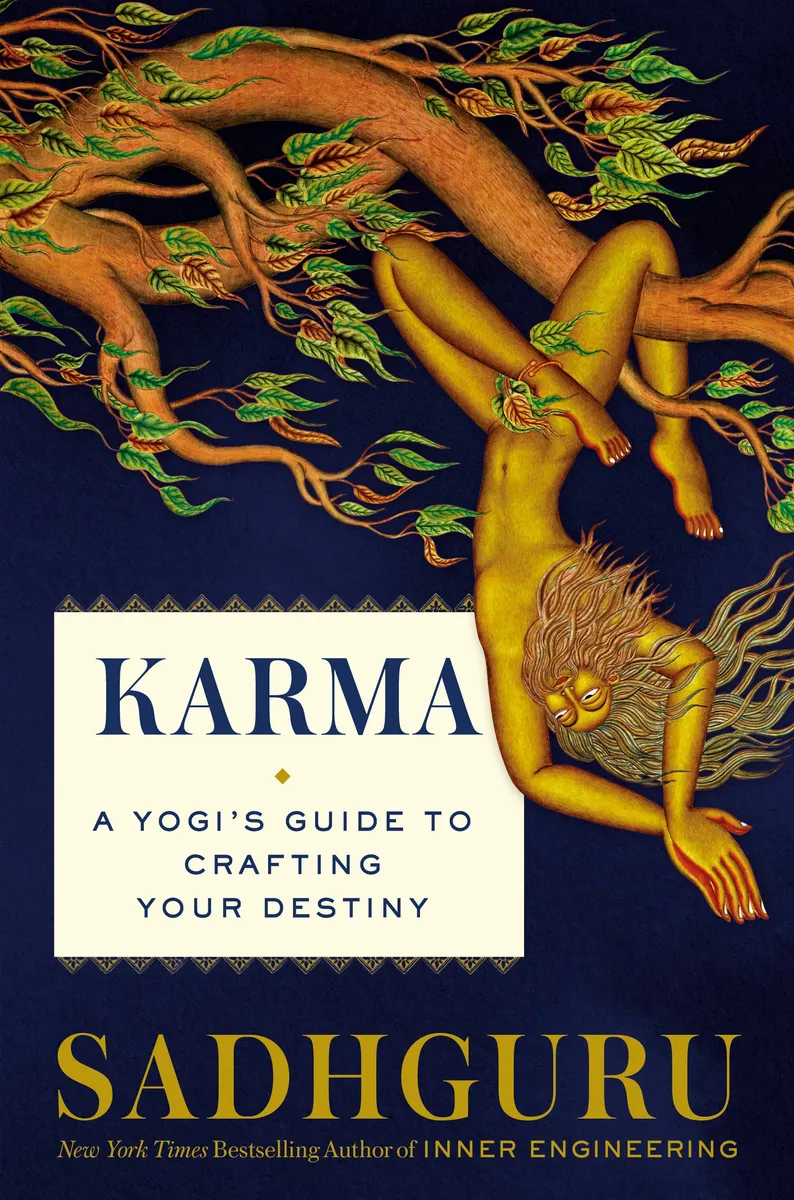
How did this Sanskrit term enter every single language in the world? How do we account for its extraordinary popularity, its capacity to endure across the centuries?
In the process, it seeks to restore the word karma to its original transformational potential. It hopes to peel off accretions of misunderstanding and look at karma in all its pristine power and with all its explosive resonance.
Part One
A Note to the Reader
The word sadhguru, as I often point out, means an uneducated guru. An uneducated guru does not come from accumulated scriptural information, but from a moment-to-moment inner knowing. I come, therefore, from a place of direct experience, not secondhand knowledge.
Spiritual seekers usually want to shed their karma, but it is important to remember that karma is not our enemy. It is not necessary to eliminate all karma to lead a life of well-being.
One: Karma: The Eternal Enigma
SUTRA #1 Karma is about becoming the source of one’s own creation. In shifting responsibility from heaven to oneself, one becomes the very maker of one’s destiny.
Most people are passive pawns in the ride, clueless about how the machinery works, the source of its octane, how to manage its direction or its velocity, or, above all, who their chauffeur is. They talk of free will, liberty, and independence. But they have little or no control over their lives. Their destiny is something they create unconsciously.
In actual fact, karma has nothing to do with reward and punishment. It has nothing to do with some despotic life auditor up in the sky, working with primitive devices of carrot and stick. It has nothing to do with a benign god up in the heavens. Nothing to do with divine retribution. Nothing to do with virtue and sin, good and evil, God and Mr. Lucifer. Karma simply means we have created the blueprint for our lives. It means we are the makers of our own fate. When we say “This is my karma,” we are actually saying “I am responsible for my life.”
Instead, karma is action on three levels: body, mind, and energy. Whatever you do on these three levels leaves a certain residue or imprint upon you.
Over time, this enormous volume of sense impressions begins to assume a certain distinctive pattern within you. This pattern slowly shapes itself into behavioral tendencies. A cluster of tendencies hardens over time into what you call your personality, or what you claim to be your true nature.
You are not aware of how these tendencies develop. But what you consider to be “myself” is just an accumulation of habits, predispositions, and tendencies you have acquired over time without being conscious of the process.
If they had created their personality consciously, they would have crafted themselves quite differently.
In other words, karma is like old software that you have written for yourself unconsciously.
Once that software is written, your whole system functions accordingly. Based on the information from the past, certain memory patterns keep recurring. Now your life turns habitual, repetitive, and cyclical.
As time goes on, you turn into a puppet of your accumulated past.
The karmic mechanism is ceaseless. Every mental fluctuation in you creates a chemical reaction, which then proceeds to provoke a physical sensation. This sensation, in turn, reinforces the chemical reaction, which then strengthens the mental fluctuation. Over time, your very chemistry is determined by a series of unconscious reactions to sensory and mental stimuli.
We now know that the human being is a psychosomatic organism—that whatever happens in the mind immediately imprints itself on the body as a chemical process.
So for every minute mental fluctuation, there is a certain type of chemical reaction and sensation. You may not even be aware of it unless the sensations become acute. All these sensations register and over time become the blueprint of your unconscious mind. You are therefore a living repository of karmic memory on levels you are not aware of.
This is a vicious cycle. If you touch the firmament of your mind just once, the resulting ripples are enough to keep going for lifetimes. The mind is a process that picks up momentum without any assistance from you.
This is because the cycle from mental fluctuation to chemical reaction to sensation (which then, in turn, produces a chemical reaction that leads again to a mental fluctuation) has gathered momentum. Over time, this has a cumulative impact on cellular and genetic memory, as well as on the energy system.
You feel like one big mess because you are punching your psychological keyboard randomly all the time.
But when you play the CD, you do not experience the disk; you experience the music. Karma is similar. You are not actively experiencing your energetic or mental or physical body. You are only facing the music! And you cannot stop it. You are experiencing your karmic impressions and imprints all the time. And you cannot bring these to a halt.
The Tedium and Tyranny of Karma The level at which the compulsiveness of karma operates may surprise you. When you walk into an auditorium or conference room, the seat you choose may seem like a decision you made freely. But often a level of karmic compulsion is involved.
Externally, it may be a new day. You may have a new job, a new home, a new life partner, a new baby. You may even be in a new country. But, internally, you are experiencing the same cycles—the same internal oscillations, the same behavioral shifts, the same mental reactions, the same psychological tendencies.
Even as you extol the values of independence, everything about you—not just the way you look or feel or think, but even the way you sit or stand or walk—is determined by your past patterns. Do not forget that in addition to being unconscious and compulsive, karma is also deeply cyclical. The karmic information within your system is encoded in different kinds of cycles. The largest cycle is the solar cycle, because everything—animate and inanimate—in this solar system is deeply influenced by the sun. Our planet is no exception. The solar cycle is a period of 4,356 days (nearly 12 years). Someone who lives according to the solar cycle leads a life of great health, well-being, alignment, and minimal friction.
If your life runs in three- or six-month cycles, you are in a serious state of psychological imbalance. The same inner upheavals or life situations will keep recurring every few months. If your life is determined by a twenty-eight-day cycle—the lunar cycle, which is also the shortest one—you could well be considered deranged or psychotic. The word loony, as you know, is linked to the word lunar, and this is no coincidence.
You might have noticed that the more successful you become, the more frustrated you get, because somewhere unconsciously you sense that you are simply going around in circles. You may have learned to ride the cycle, but you are not free from it.
You may not be able to change your past action and the mental and emotional karma you accumulated, but you no longer slide into short-spin cycles. You no longer wear your karma as a skin-tight garment; you learn to wear it loosely. You hold it at a distance.
The problem is that people do not realize just how tenacious karma is. You could meet with an accident and die, but your karma is not destroyed. You could break your head and blow all your brains out, but the karma continues!
But the accumulation of karma essentially happens on the levels of the first three bodies: physical, mental, and energetic. Therefore, even if you break your body and your mind, your life energy continues to bear the karmic imprint, like a computer hard disk. The backup systems are so efficient that even if you lose your body or your mind, you still do not lose your karma. However, it does not matter what volumes of karma you have, the moment you start stepping into the subtler dimensions of the etheric and bliss bodies, your karma cannot touch you. The law of cause and effect can operate only on the physical, mental, and energy levels. Beyond that, it has no impact.
It won’t be long before technology finds a way to start recording information on pure energy itself. This may not yet have manifested in modern technology, but eventually it will happen. I say this not out of any technological knowledge but because I know how the inner mechanism works. And the atomic and the cosmic, the individual and the universal, mirror each other on every level.
In short, karma operates on many different planes. You cannot shake it off with physical illness or accident, dementia, psychosis, or death. You will notice that even those who are mentally ill do not behave similarly. Their karmic structure may be out of control, but it still governs the way they behave. Unless you loosen the grip of karma, there is no way out.
It is the sense of not living life at full throttle, not understanding its purpose, its beginning or its end, its direction or the source of its propulsion. It is the age-old human resentment of powerlessness, of limitation.
The Smell of Bondage
These imprints configure themselves into tendencies. These tendencies have been traditionally described in India by a wonderfully apt word: vasana. Literally, vasana means smell.
Depending upon the type of smell you emit, you attract certain kinds of life situations to yourself. Think of a flower. A flower has a certain kind of vasana.
Here the word smell does not imply an odor. There is no value judgment attached to the word. It simply means that if you exude a particular kind of vasana, existence will ensure you land up in certain places at certain times.
This works in subtle ways. You may not be aware of it, but in wakefulness and sleep, you are performing karma.
On the other hand, I ran into the room to protect my snake, anxious that my companion would be thrown out! My parents’ vasana produced aversion; my vasana produced attraction.
My sense of kinship with them is an ancient vasana that I carry. I have always been comfortable around these exotic creatures.
The snake is an incredibly perceptive creature and is instinctively drawn to higher levels of energy. This is why Adiyogi (Shiva), the first yogi, is always depicted in traditional iconography with a snake around his throat. In all those cultures in which people have delved into extrasensory perception, the snake plays a pivotal role. The traditional veneration of snakes, cows, and crows in India is based on the awareness that these creatures represent an advanced stage of existential development.
Yet another reason for this vasana is the connection between the snake and the kundalini, the coiled energy that lies at the base of the human spine (which yoga consciously harnesses for spiritual development). The kundalini energy has been described as “serpent energy” because of its similarity to the snake in terms of a shared pattern of movement and stillness.
consecrate a powerful energy form called the Dhyanalinga (a unique structure in which all seven chakras, or energy centers, are operating at their optimal capacity), I needed to draw very fierce and intense disciples around me to assist with this project. Now that this mission is complete, I have altered my vasana completely. Because the need for that kind of concentrated energy work is over, I draw other kinds of people to me. I am probably unrecognizable to the people who knew me then, because I am a different person. Depending on the nature of the work, I adjust the tone of my vasana. This may be puzzling to some. But this is the way every spiritual master operates.
Many people talk freedom but they secretly fear it. They feel secure in bondage.
this way, people acquire vasanas unconsciously, often believing they are choosing freedom when they are actually choosing enslavement.
Now, these monks led quiet, isolated lives and had done nothing of consequence in the outside world. But they had left behind such a profound imprint that I could tell everything about their lives and their spiritual practices.
This is the nature of the right kind of inner energy work. It is imperishable. Every individual’s energies carry a certain fragrance. The physical body falls back to the Earth; however, the residue of each one of our thoughts, actions, and, above all, our energies lingers on. This imprint can last for millennia after our time. The more conscious the energy work, the more enduring it is.
SADHANA A simple way to become aware of your vasana is to try to stay away for a length of time from that which you like, long for, love, or consider to be most precious. The intensity of the pangs you go through when you stay away tells you something about the nature and depth of your vasana.
You will see that your experience of food or love or life generally becomes that much more profound.
This deceptively simple exercise can mark the beginning of a tremendous inner shift.
Consciousness is not a matter of behavior. It is the nature of existence. Compulsiveness, however, is behavioral. The moment you wait before you engage in a compulsion, you are aligning yourself with the conscious nature of existence. Over time, this helps weaken the compulsive nature of your behavior.
Two: Volition: The Basis of Karma
SUTRA #2 Ultimately, life is neither suffering nor bliss. It is what you make it.
Because although karma denotes action of body, mind, and energy, it is not about action alone. The man who went to the prostitute did not pile up as much karma as his friend because he did not make a calculation. His friend, on the other hand, secretly wished he was with her but believed that by going to the discourse he would get one step closer to heaven. That calculation meant an acquisition of more karma. Ironically, the man who thought about how to shed karma actually ended up accumulating it!
The moment you view everyone with love, your intention is automatically inclusive. Regardless of what blunders you may commit in the name of love, the karma still does not accumulate beyond a point. Your intention makes all the difference. If you say something prompted by love, and another person gets hurt, that is his karma, not yours.
The accumulation of karma is determined by your intention, not merely by its impact on someone else.
Your life simply organizes itself in order to fulfill your inclinations. Karma is not a punishment or reward; it is just the process by which life tries to fulfill itself.
Once you energetically try to influence someone else for your own benefit, it is the worst possible karma. The karma generated by energy-based actions goes deeper than any other kind of action.
The operative word here is identification. If you were not identified with this sense of separateness, you would not be accumulating karma. If your identification were all-inclusive, that would be the end of the karmic cycle!
The endless oscillation between like and dislike, attraction and aversion, further hardens their sense of separateness. Over time, likes and dislikes freeze into a personality and produce more karma.
What he was pointing to was the importance of operating out of a state of inner fulfillment rather than inner hankering. Once this is accomplished, your life becomes an expression of bliss, not a pursuit of it. Your desire does not evaporate; instead, it becomes conscious. Your desire is no longer the unconscious fuel for your personal identity. It is the conscious tool by which you function. You will now desire the well-being of the entire planet.
How can one “dis-identify” with desire? How can there be desire without individuality, intention without identity?
Unfortunately, most people do not have the necessary stability to remove themselves from the activity they are performing. They are unable to act without a personal agenda. This is the crippling limitation they have imposed on themselves. It happened.
When your actions are no longer about you, when they are simply based on the demands of the situation, when narrow self-interest no longer fuels your volition, you have reached the end of karmic production. Your liberation is assured.
Since their involvement is selective, they fall into the trap of entanglement.
Unfortunately, we suffer this fluidity, this phenomenal gift of freedom.
Avoidance Accelerates Karmic Accumulation
Since the endless oscillation between like and dislike creates karma, philosophies of avoidance and detachment have begun to grow popular. We have seen how Gautama the Buddha’s teaching of desirelessness has been misinterpreted. All these philosophies and misinterpretations spring from a single impulse: to avoid karma.
All the life-denying philosophies of detachment have developed because of the human fear of entanglement.
Instead, they frequently lead to greater karmic accumulation.
Suppression simply means you are experiencing life half-heartedly. To live fully is to allow yourself to experience something totally.
If you avoid any experience—whether pain or pleasure, sorrow or joy—it is big karma. But if you go through the experience without resisting it, the karma dissolves. This is why Krishna in the great Indian epic the Mahabharata says that hesitation is the worst of all crimes. Today, in the name of civilization and etiquette, educated people often do not experience any of their emotions fully. They cannot cry fully. They cannot laugh loudly. Over a period of time, frustration sets in and they turn joyless.
You will see that simpler people who allow themselves to laugh and cry uninhibitedly as the impetus arises are often much freer. They work out their karma by experiencing each emotional state fully. Living totally does not mean just having a good time. It means experiencing anything that comes your way fully and intensely. The very process of life is the dissolution of karma. If you live every moment of your life totally, you dissolve an enormous volume of karma.
Your karma is not in what is happening to you; your karma is in the way you respond to what is happening to you.
Do you really want to spend the rest of your life discussing free will and destiny?
If you have mastery over your very life energies, a hundred percent of your life and destiny could be in your hands.
I should add a caveat. If you dig deep enough into life, you can change even the nature of the seed. But that takes a level of yogic accomplishment that is beyond the scope of this book. So that is a story we won’t get into here.
Many of your capabilities are still unconscious, so you do not have complete control over the kind of circumstances you attract.
Suffering has to be freshly baked every day. In other words, your karma cannot turn into suffering without your cooperation. Once you are aware, that is the end of your suffering.
So the source of your misery is not your past actions. The source of your misery is how you’re processing the imprint of the past now. You may be carrying around a sackful of stinking garbage. Either you can smear yourself with it and get terribly miserable, or you can make good manure out of it and create a wonderful garden.
These people may be regarded as pillars of society, paragons of virtue, but their ideas or their way of living can spread suffering for generations after them. In their ignorance, they are contaminating not only their own lives but also those of their unborn offspring.
The kind of grace you are fortunate enough to receive in your lifetime can also affect the lives of those before and after you.
If you go to a movie as a viewer, you may enjoy the entertainment—you may laugh, cry, eat your popcorn, and come out. But filmmakers view the whole drama differently. They know how the film is made; they know the craft behind it. A mere moviegoer will never understand how the film was created. The same is true of life.
The aim should be to make yourself in such a way that you enslave the divine, not the other way around!
THREE Karma as Memory SUTRA #3 There is only one crime against life: to make believe that you are something other than life.