(Arcana as living ferments that stimulate spiritual life)
An arcanum is that which it is necessary to “know” in order to be fruitful in a given domain of spiritual life.
An arcanum is a “ferment” or an “enzyme” whose presence stimulates the spiritual and the psychic life of man. And it is symbols which are the bearers of these “ferments” or “enzymes” and which communicate them—if the mentality and morality of the recipient is ready, i.e. if he is “poor in spirit” and does not, suffer from the most serious spiritual malady: self-complacency. Just as the arcanum is superior to the secret, so is the mystery superior to the arcanum. The mystery is more than a stimulating “ferment”.
Learn at first concentration without effort; transform work into play; make every yoke that you have accepted easy and every burden that you carry light! This counsel, or command, or even warning, however you wish to take it, is most serious; this is attested by its original source, namely the words of the Master Himself: “My yoke is easy, and my burden is light” (Matthew xi, 30). Let us examine in succession the three parts of this formula, in order to penetrate the Arcanum of “active relaxation” or “effort without effort”. Firstly—learn at first concentration without effort—what is this in a practical and theoretical sense? Concentration, as the faculty of fixing maximum attention on a minimum amount of space (Schiller said that he who wants to complete something of worth and of skill, “der sammle still und unerschlafft, im kleinsten Punkt die grösste Kraft”, i.e. that “quietly and unceasingly he directs the greatest force upon the smallest point”), is the practical key to all success in every domain.
(Concentration without effort: the first arcanum of practice)
Patanjali, in his classic work on yoga, formulates in his first sentence the practical and theoretical essence of yoga—the “first arcanum” or the key of yoga—as follows: Yoga citta vritti nirodha (Yoga is the suppression of the oscillations of the mental substance, Yoga Sutras 1.2) —or, in other terms, the art of concentration. For the “oscillations” (vritti) of the “mental substance” (citta) take place automatically. This automatism in the movements of thought and imagination is the opposite of concentration. Now, concentration is only possible in a condition of calm and silence, at the expense of the automatism of thought and imagination.
The “to be silent” therefore precedes the “to know”, the “to will” and the “to dare”. This is why the Pythagorean school prescribed five years silence to beginners or “hearers”. One dared to speak there only when one “knew” and “was able to”, after having mastered the art of being silent—that is to say, the art of concentration.
There are nevertheless two sorts of concentration to be distinguished, which are essentially different. The one is disinterested concentration and the other is interested concentration. The first is due to the will free of enslaving passions, obsessions and attachments, whereas the other is the result of a dominating passion, obsession, or attachment. A monk absorbed in prayer and an enraged bull are, the one and the other, concentrated. But the one is in the peace of contemplation whilst the other is carried away by rage. Strong passions therefore realise themselves as a high degree of concentration. Thus, gluttons, misers, arrogant people and maniacs occasionally achieve a remarkable concentration. But, truth to tell, it is not a matter of concentration but rather obsession in connection with such people. True concentration is a free act in light and in peace. It presupposes a disinterested and detached will. For it is the condition of the will which is the determining and decisive factor in concentration. This is why yoga, for example, demands the practice
of yama and niyama (yama—the five rules of moral conduct; niyama—the five rules of mortification) before the preparation of the body (through respiration and posture) for concentration and the practice of the three degrees of concentration itself (dharana, dyana, samadhi—concentration, meditation and contemplation).
It is therefore useless to strive to concentrate oneself if the will is infatuated with something else. The “oscillations of the mental substance” will never be able to be reduced to silence if the will itself does not infuse them with its silence. It is the silenced will which effects the silence of thought and imagination in concentration. This is why the great ascetics are also the great masters of concentration. All this is obvious and stands to reason. However, what occupies us here is not just concentration in general but particularly and especially concentration without effort. What is this? Look at a tightrope walker. He is evidently completely concentrated, because if he were not, he would fall to the ground.
(The Magician: consciousness as calm water reflecting the infinite)
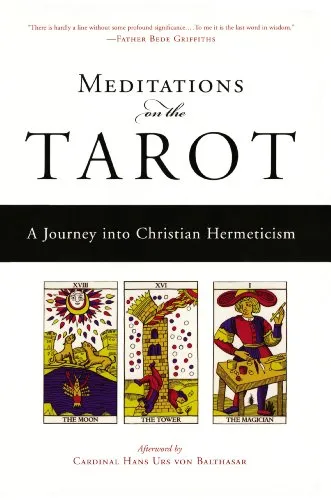
The Magician therefore represents the state of concentration without effort, i.e. the state of consciousness where the centre directing the will has “descended” (in reality it is elevated) from the brain to the rhythmic system, where the “oscillations of the mental substance” are reduced to silence and to rest, no longer hindering concentration. Concentration without effort—that is to say where there is nothing to suppress and where contemplation becomes as natural as breathing and the beating of the heart—is the state of consciousness (i.e. thought, imagination, feeling and will) of perfect calm, accompanied by the complete relaxation of the nerves and the muscles of the body. It is the profound silence of desires, of preoccupations, of the imagination, of the memory and of discursive thought. One may say that the entire being becomes like the surface of calm water, reflecting the immense presence of the starry sky and its indescribable harmony. And the waters are deep, they are so deep! And the silence grows, ever increasing…what silence! Its growth takes place through regular waves which pass, one after the other, through your being; one wave of silence followed by another wave of more profound silence, then again a wave of still more profound silence…Have you ever drunk silence? If in the affirmative, you know what concentration without effort is.
Then you will have not only concentration without effort, but also activity without effort. It is precisely this that comes to expression in the second part of our formula; transform work into play The changing of work, which is duty, into play, is effected as a consequence of the presence of the “zone of perpetual silence”, where one draws from a sort of secret and intimate respiration, whose sweetness and freshness accomplishes the anointing of work and transforms it into play. For the “zone of silence” does not only signify that the soul is, fundamentally, at rest, but also, and rather, that there is contact with the heavenly or spiritual world, which works together with the soul. He who finds silence in the solitude of concentration without effort, is never alone. He never bears alone the weights that he has to carry; the forces of heaven, the forces from on high, are there taking part from now on. In this way the truth stated by the third part of the formula: make every yoke that you have accepted easy and every burden that you carry light, itself becomes experience. For silence is the sign of real contact with the spiritual world and this contact, in turn, always engenders the influx of forces. This is the foundation of all mysticism, all gnosis, all magic and all practical esotericism in general. All practical esotericism is founded on the following rule: it is necessary to be one in oneself (concentration without effort) and one with the spiritual world (to have a zone of silence in the soul) in order for a revelatory or actual spiritual experience to be able to take place. In other words, if one wants to practise some form of authentic esotericism—be it mysticism, gnosis, or magic—it is necessary to be the Magician, i.e. concentrated without effort, operating with ease as if one were playing, and acting with perfect calm. This, then, is the practical teaching of the first Arcanum of the Tarot. It is the first counsel, commandment or warning concerning all spiritual practice; it is the aleph of the “alphabet” of practical rules of esotericism.
Just as the latter proceeds from concentration without effort, i.e. puts unity into practice, so does the attendant theory consist in the basic unity of the natural world, the human world and the divine world. The tenet of the basic oneness of the world plays the same fundamental role for all theory as that of concentration for all practice. As concentration is the basis of every practical achievement, the tenet of the basic unity of the world is the same with regard to all knowledge—without it no knowledge is conceivable.
Thus the Magician is a typological symbol; he reveals to us the prototype of the MAN OF SPIRIT. Whilst the Biblical accounts of Adam and Eve, Cain and Abel, and if you wish, also, the schisme d’Irschou of Saint-Yves d’Alveydre (cf. Mission des Juifs, vol. ii, Paris, 1956, pp. 191ff.) are, on the other hand, myths; they reveal the archetypes which manifest themselves endlessly in history and in each individual biography—they are mythological symbols pertaining to the domain of time. These two categories of symbolism, based on analogy, constitute through their mutual relationship a cross:
This faculty constitutes an essential part of the realisation of the task that the Master charged his disciples with: “Truly, I say to you, whoever does not receive the kingdom of God like a child shall not enter it” (Mark x, 15). The little child does not “work”—he plays. But how serious he is, i.e. concentrated, when he plays! His attention is still complete and undivided, whereas with he who approaches the kingdom of God it becomes again entire and undivided. And this is the Arcanum of intellectual geniality: the vision of the unity of beings and things through the immediate perception of their correspondences—through consciousness concentrated without effort. The Master did not want us to become puerile; what he wanted is that we attain the geniality of intelligence and heart which is analogous—not identical—to the attitude of the child, who carries only easy burdens and renders all his yokes light.
The “true” and the “desired” must, according to him, find their synthesis in the “beautiful”, for it is only in the beautiful that the Spieltrieb renders the burden of the “true” or the “just” light and raises at the same time the darkness of instinctive forces to the level of light and consciousness (cf. Friedrich Schiller, Letters on the Aesthetic Education of Man; trsl. E. M. Wilkinson and L. A. Willoughby, Oxford, 1967, pp. 331-332, note). In other words, he who sees the beauty of that which he recognises as true cannot fail to love it—and in loving it the element of constraint in the duty prescribed by the true will disappear: duty becomes a delight. It is thus that “work” is transformed into “play” and concentration without effort becomes possible.
Spirit must become divine Breath in place of arbitrary, personal activity, and Water must become a perfect mirror of the divine Breath
instead of being agitated by disturbances of the imagination, passions and personal desires. Reintegrated consciousness must be born of Water and Spirit, after Water has once again become Virginal and Spirit has once again become divine Breath or the Holy Spirit. Reintegrated consciousness therefore becomes born within the human soul in a way analogous to the birth or historical incarnation of the WORD: Et incarnatus est de Spiritu Sancto ex Maria Virgine. (by the power of the Holy Spirit the Word became incarnate from the Virgin Mary)
(Two mystical ways: absorption vs. the gift of tears)
Thus the outer characteristic of those who choose the other mystical way, that of the God of love, is that they have the “gift of tears”. This is in keeping with the very essence of their mystical experience. Their union with the Divine is not the absorption of their being by Divine Being, but rather the experience of the breath of Divine Love, the illumination by Divine Love, and the warmth of Divine Love. The soul which receives this undergoes such a miraculous experience that it cries. In this mystical experience fire meets with FIRE. Then nothing is extinguished in the human personality but, on the contrary, everything is set ablaze. This is the experience of “legitimate twofoldness” or the union of two separate substances in one sole essence. The substances remain separate as long as they are bereft of that which is the most precious in all existence: free alliance in love. I have spoken of “two substances” and “one essence”. Here it is necessary to really grasp the significance of these two terms—substance (substantia) and essence (essentia), whose exact distinction is today almost effaced. However, at one time these two terms denoted two distinct categories not only of ideas but also of existence and consciousness itself.
And this is why all those who have chosen the way of depersonalisation are unable to cry and why they have dry eyes for ever. For it is the personality which cries and which alone is capable of the “gift of tears”. “Blessed are those who mourn, for they shall be comforted” (Matthew v, 4).
(Mysticism, gnosis, and magic: their roots and distinctions)
The essence of pure mysticism is creative activity. One becomes a mystic when one dares to elevate oneself—i.e. “to stand upright”, then even more upright, and ever more upright—beyond all created being as far as the essence of Being, the divine, creative fire. “Concentration without effort” is burning without smoke or crackling fire. On the part of the human being it is the act of daring to aspire to the supreme Reality, and this act is real and effective only when the soul is serene and the body completely relaxed—without smoke and crackling fire. The essence of pure gnosis is reflected mysticism. Gnosis signifies that that which takes place in mysticism has become higher knowledge. That is, gnosis is mysticism which has become conscious of itself. It is mystical experience transformed into higher knowledge.
Mysticism is the source and the root of all religion. Without it religion and the entire spiritual life of humanity would be only a code of laws regulating human thought and action.
Gnosis without mystical experience is sterility itself. It is just a religious ghost, without life or movement. It is the corpse of religion, animated intellectually by means of scraps fallen from the table of the past history of humanity.
The talent of the artist consists in this: that he can render objective—or project—his ideas and feelings so as to obtain a more profound effect on others than that of the expression of ideas and feelings by a person who is not an artist. A work of art is endowed with a life of its own. When
This respiration is the state of soul that the apostle Paul designated as “freedom in God”. It is a new way of breathing. One freely breathes the divine breath, which is freedom. The Lord is Spirit, and where the Spirit of the Lord is, there is freedom. (II Corinthians iii, 17)
The practical meaning of the “heaven-earth” balance is that of cooperation with grace.
Eternal bliss—“heaven”—is, in contrast, the state of soul which is filled with boundless hope. This is not a blissfulness which lasts for an infinite number of years; it is the intensity of hope which gives the quality “eternal”. Similarly, it is the intensity of despair which imparts to the state of soul designated “hell” the quality “eternal”.
He did so because he had found the “inner way”, the experiences and realisation of which surpass in value the experiences and realisations of magic, theurgy, necromancy and artificial magnetism:
(The spiritual world as beings, not principles — and the Christian chakra mantras)
They are certainly real, but their reality is not that of an existence separate from beings, i.e. that of metaphysical entities populating a world or plane—a world of laws, principles and ideas—proper to themselves. The spiritual world is not a world of laws, principles and ideas; it is a world of spiritual beings—human souls, Angels, Archangels, Principalities, Powers, Virtues, Dominions, Thrones, Cherubim, Seraphim and the Holy Trinity: the Holy Spirit, the Son and the Father.
Now, the following “mantras” or Christian formulae are those which relate to these centres: I am the resurrection and the life – the eight-petalled lotus; I am the light of the world – the two-petalled lotus; I am the good shepherd – the sixteen-petalled lotus; I am the bread of life – the twelve-petalled lotus; I am the door – the ten-petalled lotus; I am the way, the truth and the life – the six-petalled lotus; I am the true vine – the four-petalled lotus.
The Devil
One should not arrive at an intuition of evil, since intuition is identification, and identification is communion.
It is thus that Dostoyevsky released into the world certain profound truths of Christianity, and, at the same time, certain secret practical methods of evil. This is above all the case in his novel The Possessed.
the two principles of evil, subjective and objective, the seducing principle and the hypnotising principle, have so taken possession of the consciousness of Anthroposophists that there is hardly a single thing which would not fall under the category of being Ahrimanic or Luciferic. Science is Ahrimanic in so far as it is objective; Christian mysticism is Luciferic in so far as it is subjective. The East is under the domination of Lucifer, because it denies matter; the West is under the domination of Ahriman, because it has created a material civilisation and tends to materialism. All machines—including the apparatus of radio and television—incorporate Ahrimanic demons. Laboratories are the fortresses of Ahriman; theatres—and churches, some believe—are the fortresses of Lucifer. And so on. Anthroposophists are led to classify thousands of facts from the point of view of the category of evil which is revealed through them—which suffices to occupy them for the whole day.
The result is a lame wisdom without wings, deprived of creative élan, which only repeats and comments to satiety what the master, Dr. Rudolf Steiner, said. And yet Rudolf Steiner has certainly said things of a nature to awaken the greatest creative élan!
What, therefore, is the set of ideas that is evoked, to begin with, by the Card?…ideas, I would like to say, of a nature having a practical spiritual significance, i.e. aiming at a practical arcanum of Hermeticism as a synthesis of mysticism, gnosis and magic. Does it have to do with the cosmic metaphysics of evil, or the history of the rebellion of a part of the celestial hierarchies under the direction of the “ancient dragon” who “swept down a third of the stars” (Revelation xii, 3-4)? Is it related to the entity of whom Ezekiel spoke when he said:
(The fifteenth arcanum: demon generation and slavery to one’s own creations)
The theme of the fifteenth Arcanum of the Tarot is one of the generation of demons and of the power that they have over those who generate them. It is the Arcanum of the creation of artificial beings and of the slavery into which the creator can fall—becoming a slave of his own creation.
In order to be able to grasp this Arcanum, it is necessary firstly to take account of the fact that the world of evil consists not only of fallen entities of the celestial hierarchies (with the exception of Seraphim) but also of entities of non-hierarchical origin, i.e. entities who, in the manner of bacilli, microbes and viruses of infectious diseases in the domain of biology, owe their origin—to express it in the terms of Scholastic philosophy—neither to the primary cause, nor to secondary causes, but rather to tertiary causes, namely to arbitrary abuse on the part of autonomous creatures.
These latter entities are demons whose soul is a special passion and whose body is the totality of “electro-magnetic” vibrations produced by this passion. These artificial demons can be engendered by human communities—such are many of the monstrous “gods” of the Phoenicians, Mexicans, and even Tibetans of the present day. The Canaan Moloch who demanded the bloody sacrifice of the first born, mentioned so often in the Bible, is not a hierarchical entity—either of good or of evil—but rather an evil egregore, i.e. a demon created artificially and collectively by human communities infatuated with the thrill of fear. The Mexican Quetzalcoatl is a similar instance of this. There, also, it was a matter of a demon created and worshipped collectively.
The training consists of three parts: the creation of tulpas (magical creatures) through concentrated and directed imagination, then their evocation and, lastly, the freeing of consciousness from their hold on it by an act of knowledge which destroys them—through which it is realised that they are only a creation of the imagination, and therefore illusory. The aim of this training is therefore to arrive at disbelief in demons after having created them through the force of imagination and having confronted their terrifying apparitions with intrepidity.
(Tulpas, egregores, and thought-forms that outlive their makers)
“Those who died were killed by fear. Their visions were the creations of their own imagination. He who does not believe in demons would never be killed by them.” I was much astonished when the anchorites replied in a peculiar tone of voice: “According to that it must also follow that a man who does not believe in the existence of tigers may feel confident that none of them would ever hurt him even if he were confronted by such a beast.”…and he continued: “Visualising mental formations, either voluntarily or not, is a most mysterious process. What becomes of these creations? May it not be that like children born of our flesh, these children of our mind separate their lives from ours, escape our control, and play parts of their own? Must we not also consider that we are not the only ones capable of creating such formations?
One must know how to protect oneself against the tigers to which one has given birth, as well as against those that have been begotten by others.” (Alexandra David-Neel, Magic and Mystery in Tibet, London, 1967, pp. 146-148)
Man is himself the creator of his heaven and hell, and there are no demons except our own follies. Minds chastised by truth are corrected by that chastisement, and dream no more of disturbing the world (Ritual, ch. xxii). (Eliphas Lévi, Transcendental Magic. Its Doctrine and Ritual; trsl. A. E. Waite, London, 1968, pp. 322-323, 410)
For, in accordance with his experience of them, Eliphas Lévi saw in demons—such as incubi and succubi, the Leonard masters presiding over witches’ sabbaths, and the demons of the possessed—only creations of human will and imagination, projecting, individually or collectively, their content into the malleable substance of the “astral light” and thus engendering demons, which are therefore engendered in Europe in exactly the same way as the Tibetan tulpas!
Engendered subjectively, they become forces independent of the subjective consciousness which engendered them. They are, in other words, magical creations, for magic is the objectification of that which takes its origin in subjective consciousness.
Demons that have not arrived at the stage of objectification, i.e. at that of an existence separate from the psychic life of their parents, have a semi-autonomous existence which is designated in modern psychology by the term “psychological complex”. C. G. Jung regarded these as parasitic entities, which are to the psychic organism what, for example, cancer is to the physical organism. A psychopathological “complex” is therefore a demon,
(Silence as the supreme magical commandment against engendering demons)
To be silent is more than to keep things secret; it is more even than to guard oneself from profaning the holy things to which a respectful silence is owed. To be silent is, above all, the great magical commandment of not engendering demons through our arbitrary will and imagination; it is the task of silencing arbitrary will and imagination.
The scale of temptation therefore corresponds to that of spiritual advancement: temptation is progressively spiritualised as man becomes more spiritual. The temptations of “Principalities and Powers” (archai kai exousiai) which the spiritually advanced have to face are incomparably more subtle than those for a beginner.
But we must not always rely on the Angels to fight for us; they help us only at the beginning, when we ourselves are commencing. With the progress of time, we should arm ourselves for combat. Before we learn to do battle, so that we will consider giving ourselves up to the battles of the Lord, we are succoured by the “princes”, by Angels. Initially, we receive the provision of celestial bread…as long as we are children, we are nourished by milk; when we begin to hold to the word of Christ, we live as children under the authority of tutors and procurators. But when we have tasted the sacraments of celestial militia, when we have nourished ourselves on the bread of life, listen how the apostolic trumpet invites us to combat! It is with a loud voice that Paul cried to us, saying; “Take the whole armour of God, that you may be able to withstand the wiles of the devil.” He no longer permits us to hide ourselves under the wings of our nurse; he invites us to the fields of battle. “Gird yourself,” he says, “with the breastplate of righteousness, and the helmet of salvation, and the sword of the Spirit, and above all the shield of faith, with which you can quench all the flaming darts of the evil one” (Ephesians vi, 13-17). (Origen, In libro Judicum, homily vi, 2; ed. Baehrens, pp. 498-500)
…it is at the time they (i.e. beginners) are going about their spiritual exercises with delight and satisfaction, when in their opinion the sun of divine favour is shining most brightly on them, that God darkens all this light and closes the door and spring of the sweet spiritual water they were tasting as often and as long as they desired. For since they were weak and tender, no door was closed to them, as St. John says in the Apocalypse (Rev. iii, 8). God now leaves them in such darkness that they do not know which way to turn in their discursive imaginings; they cannot advance a step in meditation, as they used to, now that the interior sensory faculties are engulfed in this night. He leaves them in such dryness that they not only fail to receive satisfaction and pleasure from their spiritual exercises and works, as they formerly did, but also find these exercises distasteful and bitter. As I said, when God sees that they have grown a little, he weans them from the sweet breast so that they might be strengthened, lays aside their swaddling bands, and puts them down from his arms that they may grow accustomed to walking by themselves. (St. John of
the Cross, The Dark Night I, viii, 3; trsl. K. Kavenaugh and O. Rodriguez in The Collected Works of St. John of the Cross, London, 1966, p. 312)
For the effect of the latter is not like that of the former: those of Satan result in dryness of spirit, in a tendency to self-esteem, to accept and make much of visions; and in no degree whatever do they produce the gentleness of humility, and love of God. Again, the forms of the diabolic visions do not remain impressed on the soul with the sweet clearness of the others, neither do they endure, yea, rather, are immediately effaced, except when the soul attaches itself to them: in that case the importance attached to them causes them to be remembered naturally, but with great dryness of spirit, and without the fruit of humility and love, which issue out of the good visions, whenever they recur to the memory…The effects of these (latter) visions in the soul are quietness, enlightenment, joy like glory, sweetness, pureness, love, humility, inclination, or elevation of the mind to God, sometimes more of one, sometimes more of another…(St. John of the Cross, The Ascent of Mount Carmel II, xxiv, 6-7; trsl. D. Lewis, London, 1906, pp. 201-202)
You cannot engender a “demon of pure love” or an “egregore of universal love” because the quality of will and imagination required to this end is not held together as a formation centred in itself, but forms an alliance—one of “radiating movement”—with the activity of the world of spiritual hierarchies. The psychic and mental energy of love would never give rise to the formation of an individualised psychic or “astral” entity; it would immediately put itself wholly at the disposal of the celestial hierarchies, saints, and God. Therefore, although one can certainly engender demons, one cannot engender artificial Angels.
It is similarly so with talismen and relics. Talismen are depots of magical energy; they are under the law of quantity. In contrast, relics are windows open to heaven; they are under the law of quality, i.e. the more energy they give out, the more they become capable of giving out. They are inexhaustible as sources of energy. They are not depots for, or accumulators of, energy; rather, they are generators or sources of energy.
Consecrated water, for example, does not “lock up” the blessing—or the force of will and imagination of the priest who blessed it—but the blessing “hovers” above it. It re-establishes—through the sacred magic of analogy put into practice—the primordial relationship which existed between water and the spirit of God on the first day of creation, when “the spirit of God was moving over the face of the waters” (Genesis i, 2). Therefore, consecrated water is not water which has become a depot for the beneficial force of consecration, but rather it has been rendered susceptible to the presence of heaven. And a few drops of it are very effective for chasing demons away, as borne out by authentic witnesses across the centuries.
(How to combat demons: light of consciousness as the only weapon)
Now, here we arrive at an important question: Once artificial demons are generated, how does one combat them, and how does one protect oneself and rid oneself of them? Firstly, how does one combat them? Good does not combat evil in the sense of destructive action. It “combats” it by the sole fact of its presence. Just as darkness gives way to the presence of light, so does evil give way before the presence of good.
Light drives out darkness. This simple truth is the practical key to the problem of how to combat demons. A demon perceived, i.e. on whom the light of consciousness is thrown, is already a demon rendered impotent. This is why the desert fathers and other solitary saints had so much experience with demons. They cast their light on them.
A demon rendered impotent is a deflated balloon.
How does one protect oneself and rid oneself of demons? It follows from the foregoing that clarity of thought and Tightness of moral attitude are both necessary—and also sufficient—in order to supply the light which renders demons impotent. Nevertheless, one needs rest—time during which one is left in peace by demons, i.e. time during which they are absent.
In order to assure this, one has to resort to sacred magic. Tradition, centuries of experience, teaches us what is necessary in order to protect oneself from the approach of demons—or, if one senses them approaching, what to do in order to drive them away—and gives the following practical advice: make the sign of the Cross towards the north, south, east and west, each time saying the first two verses of Psalm 68 (from David): Let God arise, let his enemies be scattered; let those who hate him flee before him! As smoke is driven away, so drive them away; as wax melts before fire,
let the wicked perish before God!
Thus, Satan does not accuse Job of sin committed but of a potential sin. And he sets to work so as to actualise it. They are “laboratory experiments”, so to say, that he makes with Job in order to prove his prosecution thesis.
These examples—Job’s “Satan” and Tobias’ demon—are in themselves sufficient to understand the nature of the entities of hierarchies of the left and the way in which they operate, and likewise show how one struggles against them. They are critical spirits, i.e. prosecutors, and one can vanquish them only by convincing them—under “laboratory conditions”, so to say—that the accusation lacks foundation, which is exceptional and difficult. For their accusation is usually the result of work done with indefatigable zeal, and with a very lucid and very well informed intelligence—save for the intimate human domain of moral conscience, which is not accessible to them.