(Spiritual hubris confronted: the dark side of God arrives at midlife)
My fascination with the Light, my eager optimism concerning outcomes, my implicit trust concerning others, my commitment to meditation and a path of enlightenment—all were no longer a saving grace, but a kind of subtle curse, a deeply etched habit of thinking and feeling that seemed to bring me face to face with its opposite, with the heartbreak of failed ideals, with the plague of my naiveté, with the dark side of God.
In analyzing this dream, I realized that I had never taken the shadow seriously. I had believed, with a kind of spiritual hubris, that a deep and committed inner life would protect me from human suffering, that I could somehow deflate the power of the shadow with my metaphysical practices and beliefs.
But the dark side appears in many guises. My confrontation with it at midlife was shocking, uprooting, and terribly disillusioning. Intimate friendships of many years seemed to turn brittle and crack, bereft of lifeblood and its elasticity. My strengths began to feel like weaknesses, standing in the way of growth rather than promoting it.
At forty I descended into depression, living in what Hermann Hesse once called a “mud hell.”
The thread of my life pulled; the story unraveled. And the ones I had despised and disdained were born in me—like another life, yet my life, its mirror image, its invisible twin.
And I knew why Goethe said that he had never heard of a crime of which he did not believe himself capable. I was capable of anything.
(What the shadow contains and how ego and shadow develop together)
Each of us contains both a Dr. Jekyll and a Mr. Hyde, a more pleasant persona for everyday wear and a hiding, nighttime self that remains hushed up much of the time. Negative emotions and behaviors—rage, jealousy, shame, lying, resentment, lust, greed, suicidal and murderous tendencies—lie concealed just beneath the surface, masked by our more proper selves. Known together in psychology as the personal shadow, it remains untamed, unexplored territory to most of us.
At the same time, we bury in the shadow those qualities that don’t fit our self-image, such as rudeness and selfishness. The ego and the shadow, then, develop in tandem, creating each other out of the same life experience.
Many forces play a role in forming our shadow selves, ultimately determining what is permitted expression and what is not.
The shadow acts like a psychic immune system, defining what is self and what is not-self. For different people, in different families and cultures, what falls into ego and what falls into shadow can vary. For instance, some permit anger or aggression to be expressed; most do not.
According to Jungian analyst Liliane Frey-Rohn, this dark treasury includes our infantile parts, emotional attachments, neurotic symptoms, as well as our undeveloped talents and gifts. The shadow, she says, “retains contact with the lost depths of the soul, with life and vitality—the superior, the universally human, yes, even the creative can be sensed there.”
We cannot look directly into this hidden domain. The shadow by nature is difficult to apprehend. It is dangerous, disorderly, and forever in hiding, as if the light of consciousness would steal its very life.
(Projection, humor, and the six daily ways we meet the shadow)
We project by attributing this quality to the other person in an unconscious effort to banish it from ourselves, to keep ourselves from seeing it within. Jungian analyst Marie-Louise von Franz suggests that projection is like shooting a magic arrow. If the receiver has a soft spot to receive the projection, it sticks. If we project our anger onto a dissatisfied mate, our seductive charms onto a good-looking stranger, or our spiritual attributes onto a guru, we hit the target and the projection holds. From then on the sender and receiver are linked in a mysterious alliance, like falling in love, discovering a perfect hero, or a perfect villain.
John Sanford points out that people who lack a sense of humor probably have a very repressed shadow. It’s usually the shadow self who laughs at jokes. English psychoanalyst Molly Tuby suggests six other ways in which, even unknowingly, we meet the shadow every day: In our exaggerated feelings about others (“I just can’t believe he would do that!” “I don’t know how she could wear that outfit!”) In negative feedback from others who serve as our mirrors (“This is the third time you arrived late without calling me.”) In those interactions in whch we continually have the same troubling effect on several different people (“Sam and I both feel that you have not been straightforward with us.”) In our impulsive and inadvertent acts (“Oops, I didn’t mean to say that.”) In situations in which we are humiliated (“I’m so ashamed about how he treats me.”) In our exaggerated anger about other people’s faults (“She just can’t seem to do her work on time!” “Boy, he really let his weight get out of control!”)
Usually it recedes just as quickly, because meeting the shadow can be a frightening and shocking experience to our self-image.
For this reason we may quickly shift into denial, hardly noticing the murderous fantasy, suicidal thought, or embarrassing envy that could reveal a bit of our own darkness.
The range of what we think and do is limited by what we fail to notice. And because we fail to notice that we fail to notice there is little we can do to change until we notice how failing to notice shapes our thoughts and deeds.
The inner demand for a descent into the underworld can be overridden by outer concerns, such as the need to work long hours, distractions by other people, or antidepressant drugs, which damp our feelings of despair.
Meeting the shadow calls for slowing the pace of life, listening to the body’s cues, and allowing ourselves time to be alone in order to digest the cryptic messages from the hidden world.
(The collective shadow: projection, scapegoating, and cultural repression)
The collective shadow—human evil—is staring back at us virtually everywhere: It shouts from newsstand headlines; it wanders our streets, sleeping in doorways, homeless; it squats in X-rated neon-lit shops on the peripheries of our cities; it embezzles our monies from the local savings and loan; it corrupts power-hungry politicians and perverts our systems of justice; it drives invading armies through dense jungles and across desert sands; it sells arms to mad leaders and gives the profits to reactionary insurgents; it pours pollution through hidden pipes into our rivers and oceans, and poisons our food with invisible pesticides.
While most individuals and groups live out the socially acceptable side of life, others seem to live out primarily the socially disowned parts.
The hypnotic power and contagious nature of these strong emotions are evident in the universal pervasiveness of racial persecution, religious wars, and scapegoating tactics around the world.
Projection also may help explain the immense popularity of horror novels and movies. Through a vicarious enactment of the shadow side, our evil impulses can be stimulated and perhaps relieved in the safety of the book or theater.
It was on the same mountainside above Delphi that the Greeks annually celebrated their famous bacchanal revels, orgies that glorified the forceful, creative presence of the nature god Dionysus in human beings.
Marie-Louise von Franz acknowledges the relationship between the devil and the personal shadow when she says, “The principle of individuation is actually related to the devilish element,
Nothing To Excess
Only a people who knew excess, he says, could have lived by such a maxim. Only those who knew their capacity for lust, greed, rage, gluttony, and for all things excessive—who have understood and accepted their own potential for inappropriate extremes—can choose to regulate and humanize their actions.
The scenarios might look like this: When we feel excessive desire, we push it into the shadow, then act it out without concern for others; when we feel excessive hunger, we push it into the shadow, then overeat, binge and purge, trashing our bodies; when we feel excessive longing for the high side of life, we push it into the shadow, then we seek it out through instant gratification or hedonistic activity such as drug and alcohol abuse. The list goes on.
(Shadow-work: what it heals and how to begin)
OWNING THE SHADOW The aim of meeting the shadow is to develop an ongoing relationship with it, to expand our sense of self by balancing the one-sidedness of our conscious attitudes with our unconscious depths.
Through shadow-work, a term we coined to refer to the continuing effort to develop a creative relationship with the shadow, we can: achieve a more genuine self-acceptance, based on a more complete knowledge of who we are; defuse the negative emotions that erupt unexpectedly in our daily lives; feel more free of the guilt and shame associated with our negative feelings and actions; recognize the projections that color our opinion of others; heal our relationships through more honest self-examination and direct communication; and use the creative imagination via dreams, drawing, writing, and rituals to own the disowned self.
The shadow goes by many familiar names: the disowned self, the lower self, the dark twin or brother in bible and myth, the double, repressed self, alter ego, id. When we come face-to-face with our darker side, we use metaphors to describe these shadow encounters: meeting our demons, wrestling with the devil, descent to the underworld, dark night of the soul, midlife crisis.
Jung said that intuitively each of us understands what is meant by the terms shadow, inferior personality, or alter ego. “And if he has forgotten,” he joked about the average man, “his memory can easily be refreshed by a Sunday sermon, his wife, or the tax collector.”
“By shadow I mean the ‘negative’ side of the personality, the sum of all those unpleasant qualities we like to hide, together with the insufficiently developed functions and the content of the personal unconscious.”
(Jung’s evolving definitions: the shadow as what one has no wish to be)
By 1945 Jung was referring to the shadow as simply the thing a person has no wish to be. “One does not become enlightened by imagining figures of light,” he said, “but by making the darkness conscious. The latter procedure, however, is disagreeable and therefore not popular.”
Because it is contrary to our chosen conscious attitude, the shadow personality is denied expression in life and coalesces into a relatively separate splinter personality in the unconscious, where it is isolated from exposure and discovery.
His investigations showed that dealing with shadow and evil is ultimately an “individual secret,” equal to that of experiencing God, and so powerful an experience that it can transform the whole person.
“Probably all that is left us today is the psychological approach. That is why I take these thought-forms that have become historically fixed, try to melt them down again and pour them into moulds of immediate experience.”
Along with self (the psychological center of the human being) and anima and animus (the internalized ideal images of the opposite sex, the soul-image in each person), Jung classified the shadow as one of the major archetypes in the personal unconscious. Archetypes are innate,
According to the Critical Dictionary of Jungian Analysis, “Gods are metaphors of archetypal behaviors and myths are archetypal enactments.”
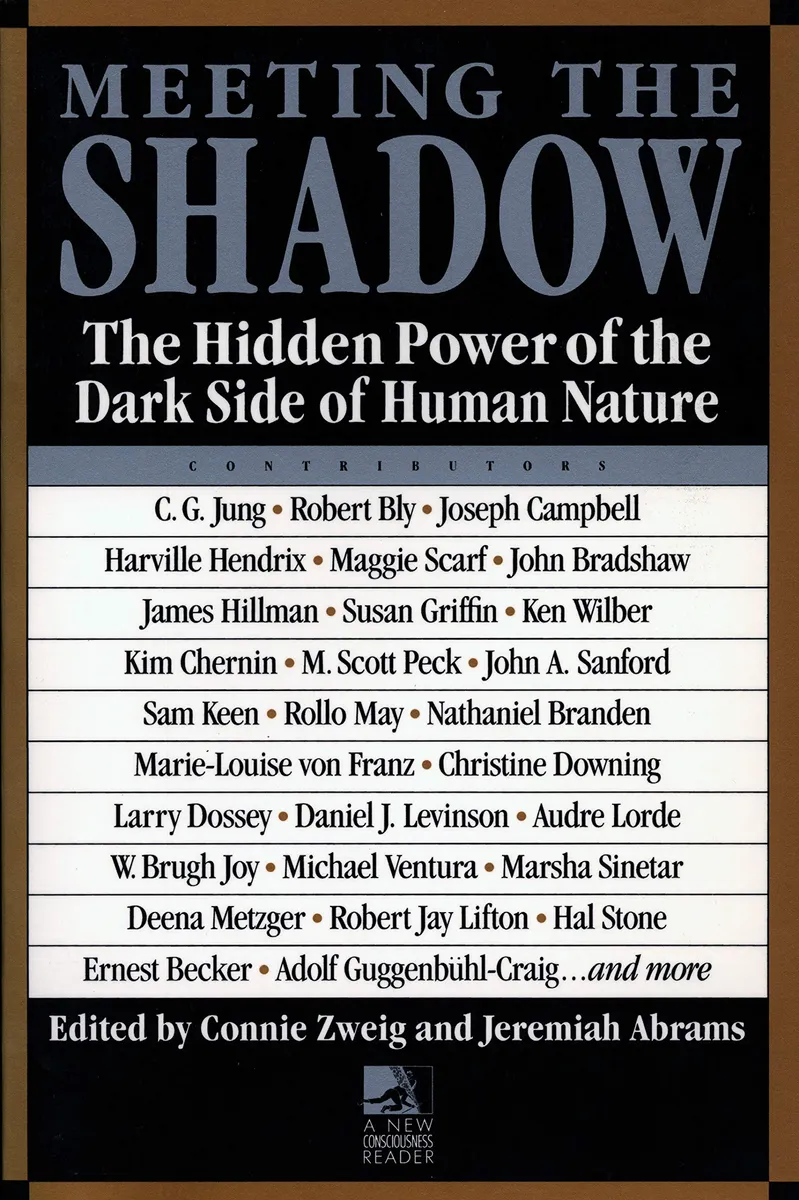
In opening this section, poet Robert Bly uses a personal voice to narrate the story of the shadow in an excerpt from A Little Book on the Human Shadow. The disowned self, says Bly, becomes a holding buffer as we grow up—a “long bag we drag behind us”—that contains our unacceptable parts. Bly also links our personal bags to other kinds—our collective shadows.
We end this section on a constructive note with therapist William A. Miller’s piece, “Finding the Shadow in Daily Life,” from his book Your Golden Shadow. Miller guides us into shadow phenomena by examining projections, slips of the tongue, and humor, and by showing how to discover the shadow in the ordinary events of life.
According to analyst Erich Neumann: “The self lies hidden in the shadow; he is the keeper of the gate, the guardian of the threshold. The way to the self lies through him; behind the dark aspect that he represents there stands the aspect of wholeness, and only by making friends with the shadow do we gain the friendship of the self.”
Every part of our personality that we do not love will become hostile to us. We could add that it may move to a distant place and begin a revolt against us as well.