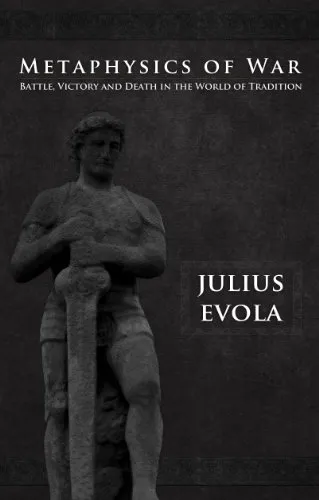
The definitions of heroism and the qualities of the warrior that Evola describes herein are surely timeless and universal.
(The kshatriya ideal: warrior as dharma, not desire)
Evola’s ideal was that of the kshatriya described by Lord Krishna in the Bhagavad-Gita, which has been explained by A. C. Bhaktivedanta Swami Prabhupada as follows: One who gives protection from harm is called kshatriya… The kshatriyas are specially trained for challenging and killing because religious violence is sometimes a necessary factor…
A kshatriya, therefore, is not an ordinary man, but rather a man of the highest aristocratic attitude and behavior. He does not kill out of a desire to fulfil some selfish desire or to bring about some temporary political gain. Rather, a kshatriya fights because he knows that it is the reason for his existence, his dharma.
Men Among the Ruins, in which he outlines his understanding of the concept of apoliteia, or the ‘apolitical stance’ which he felt was a necessary condition for those of a traditional inclination to adopt in the age of Kali-Yuga – the last, and most degenerate age within the cycle of ages as understood by in the Vedic tradition, and in which we are currently living.
(Heroic death, Valhalla, and the metaphysics of immortality in battle)
The moment the individual succeeds in living as a hero, even if it is the final moment of his earthly life, weighs infinitely more on the scale of values than a protracted existence spent consuming monotonously among the trivialities of cities.
The expression mors triumphalis in our own Classical tradition corresponds to this concept. As for the properly Nordic tradition, well-known to all is the part which concerns Valhalla, the seat of celestial immortality, reserved for the ‘free’ divine stock and the heroes fallen on the battlefield (‘Valhalla’ means literally ‘from the palace of the chosen’). The Lord of this symbolic seat, Odin or Wotan,
appears in the Ynglingasaga as the one who, by his symbolic self-sacrifice on the ‘world tree’, showed the heroes how to reach the divine sojourn, where they live eternally as on a bright peak, which remains in perpetual sunlight, above every cloud.
The spirits of the fallen heroes would add their forces to the phalanx of those who assist the ‘celestial heroes’ in fighting in the ragnarökk, that is to say, the fate of the ‘darkening of the divine’, which, according to these teachings, and also according to the Hellenes (Hesiod), has threatened the world since time immemorial.
Many may be astonished to hear that the well-known Valkyries, which choose the souls of the warriors destined for Valhalla, are only the transcendental personification of parts of the warriors themselves, parts which find their exact equivalent in the Fravashi, of which the Iranian-Persian traditions speak – the Fravashi, also represented as women of light and stormy virgins of battle, which personify more or less the supernatural forces by means of which the human natures of the warriors ‘faithful to the God of Light’ can transfigure themselves and bring about terrible, overwhelming and bloody victories.
(The inner enemy: subduing the natural man to reach the spiritual man)
Appearing in the forms of craving, partiality, passion, instinctuality, weakness and inward cowardice, the enemy within the natural man must be vanquished, its resistance broken, chained and subjected to the spiritual man, this being the condition of reaching inner liberation, the ‘triumphant peace’ which allows one to participate in what is beyond both life and death.
Thus, in Islam, ‘holy war’ – jihad – and ‘the path of God’ are interchangeable terms. The one who fights is on the ‘path of God’. A well-known and quite characteristic saying of this tradition is, ‘The blood of heroes is closer to the Lord than the ink of scholars and the prayers of the pious.’
They are pleased to be with those who stay behind. Their hearts have been stamped so they do not understand. But the Messenger and those who have iman along with him have done jihad with their wealth and with themselves. They are the people who will have the good things. They are the ones who are successful’ (9:86-89). Therefore we have here a sort of amor fati, a mysterious way of intuiting, evoking and heroically resolving one’s own destiny in the intimate certainty that, when the ‘right intention’ is present, when all indolence and cowardice are vanquished, and the leap beyond the lives of oneself and others, beyond happiness and misfortune, is driven by a sense of spiritual destiny and a thirst for the absolute existence, then one has given birth to a force which will not be able to miss the supreme goal.
Here is a very evocative image belonging to the same tradition: ‘Life – like a bow; the mind – like the arrow; the target to pierce – the supreme spirit; to join mind to spirit as the shot arrow hits its target.’
(Holy war, jihad, and the arrow of mind aimed at the supreme spirit)
According to ancient Indo-Germanic legislation, killing did not appear to be as serious a fault as betrayal, or even mere lying. A warlike ethics would also lead to more or less this attitude and it would be inclined to limit the principle of solidarity by means of those of dignity and affinity.
(War as cosmic image: the Olympian principle against titanic chaos)
Broadly speaking, we find that, especially among ancient Aryan humanity, wars were thought of as images of a perennial fight between metaphysical forces: on one hand there was the Olympian and luminous principle, uranic and solar truth; on the other hand there was raw force, the ‘titanic’, telluric element, ‘barbaric’ in the classical sense, the demonic-feminine principle of chaos.
In the Edda, in fact, it is said that ‘no matter how great the number of the heroes gathered in Valhalla, they will never be too many for when the Wolf comes’.The ‘Wolf’ here is the symbol of a dark and wild power which, previously, had managed to chain and subdue the stock of the ‘divine heroes’, or Aesir; the ‘age of the Wolf’ is more or less the counterpart of the ‘Age of Iron’ in the Classical tradition, and of the ‘dark age’ – Kali-Yuga – in the Indo-Aryan one: it alludes symbolically to an age of the unleashing of purely terrestrial and desecrated forces.
The judgement of the God is categorical: it defines the mercy which had withheld Arjuna from fighting as ‘degrading impotence’ (2:4) and ‘impurities…not at all befitting a man who knows the value of life. They lead not to higher planets but to infamy’ (2:2). Therefore, it is not on the basis of earthly and contingent necessities but of a divine judgement that the duty of combat is confirmed here. The promise is: ‘[E]ither you will be killed on the battlefield and attain the heavenly planets, or you will conquer and enjoy the earthly kingdom. Therefore, get up with determination and fight’ (2:37).
And as kynfylgja the Valkyrie is – like the lares of ancient Rome – the mystical power of the blood. The same thing applies to the Fravashi of the Aryo-Iranian tradition. The Fravashi, a famous Orientalist explains, ‘is the intimate power of any human being, it is what keeps him alive and sees to it that he is born and exists’.
Not all escape the dissolution of the ‘I’ into that lemuric residuum of which Hades and Niflheim were ancient symbolic representations.
In the Nordic tradition the warrior sees his Valkyrie as he dies or he experiences a mortal danger.
such as the Dorian Hercules, who obtains the crown which makes him share in Olympian immortality from Nike, the ‘goddess of victory’.
And, in classical Antiquity, the radiating royal crown symbolised glory precisely as solar and celestial fire.
Today this tradition
According to the ancient Roman ritual of devotio, as we understand it, a warrior, and above all a chieftain, can facilitate victory by means of a mysterious unleashing of forces determined by the deliberate sacrifice of his own person, combined with the will not to come out of the fray alive.