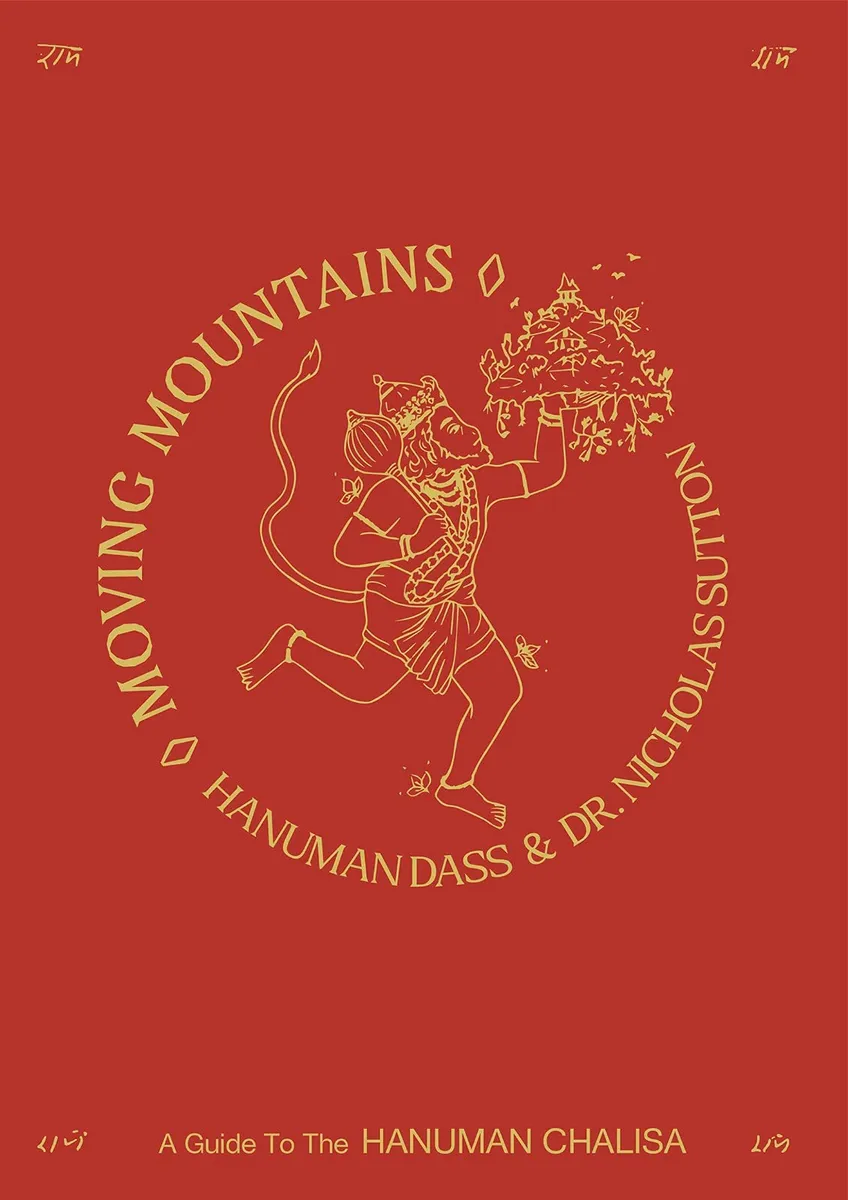
(Neem Karoli Baba on Hanuman as the breath of Ram and the sky of the heart)
He built Hanuman temples everywhere but he would also say, “these people think Hanuman is a monkey” and then would laugh. He would ask us, “Who is Hanuman?” We would give all the usual answers…he is a devotee of Ram… The greatest servant of God, etc etc… Then he would say, “Ram ke Swaas” The breath of Ram (God).” For Maharajji, Hanuman is everywhere: the vast presence, the sky of the heart, the space of the heart. And just as the sky surrounds and embraces everything, Hanuman holds the whole universe in his wide heart.
Maharajji gave us the Hanuman Chalisa to provide access for us into the deeper regions of connection with Ram/God. He said “Every line of the Hanuman Chalisa is Mahamantra” and “Reciting the Hanuman Chalisa can change fate.”
The Hanuman Chalisa is a deep lake of spirituality. If we step into its sparkling waters we can find complete happiness and great sustenance.
‘Rama, your form is beyond all speech and conception, unknowable, unspeakable and infinite. The Upanishads describe it as ‘Neti, Neti’ Not that, Not that’.’ Rama is beyond what our minds can conceive, he is God beyond God, the spirit of the heart underpinning all things. He is the supreme Brahman. Tulsidas then describes Valmiki worshiping Rama, ‘your body is all consciousness, bliss and truth, and you have assumed human form for the benefit of the saintly and divine’.
The poet saint Kabir said: If God be within the mosque, then to who does this world belong to? If Rama be within the image, which you find upon your pilgrimage, then who is aware what occurs outside of it? Hari is in the East, Allah is in the West. Look within your heart, for there you will find both Karim and Ram; All the men and women of the world are His living forms. Kabir is the child of Allah and of Ram: He is my Guru, He is my Pir. — Kabir,
(Dharma as universal compassion and Hanuman as its living embodiment)
‘There is no dharma greater than compassion for all, and no adharma greater than oppressing others. I declare this to be the verdict of all Vedas, Puranas, and the conclusion of all who are wise.’
Dharma is love for all beings and Hanuman is the most beloved of Ram because he lives this. He is the friend of the friendless, serving God in all with the great force of compassion.
I gleaned from them this practice of chanting the Hanuman Chalisa as a way to become aware of the divine love that lives within our hearts and which removes all separateness.
I listened to it non-stop and memorised the entire chant within three days. I have been in love with chanting it everyday since. It is my hope that just a little bit of the rasa (spiritual essence or taste) that I experienced comes through in this work.
The Hanuman Chalisa clears the fog from around us, helping us to realise that what we are seeking is right here and that we have a divine strength and capacity for goodness which is beyond our wildest imagination.
Touch the feet of the Guru within your heart and with all humility allow your ego to gently calm down. Through humility we provide our hearts with an opportunity to shine beyond our clouded minds and our lives become a vehicle for the spirit.
Tulsidas explains that the recitation of the Chalisa gives sustenance to the four goals of life, namely, dharma (virtue), artha (wealth), kama (enjoyment) and moksha (liberation). When you go to the gym to exercise, not only is it good for the body, but it is also beneficial for your overall well-being.
Gandhi described him as follows: “He is one of the few pearls in the Ashram. They do not come, like others, to be blessed by the Ashram but to bless it, not to receive, but to give.”
(Tulsidas’s radical humility: being a flute for God’s music)
Despite this however, when you read the Ramcharitmanas, and the true spirit of the verse above, you will find Tulsidas constantly saying that he is incompetent, useless, ignorant, and foolish. Tulsidas says that he is incapable of singing Shri Rama’s glories. He says, what chance does a small piece of cotton have in a wind storm which can blow away mountains? You may ask, how can beings like Tulsidas, and Vinoba Bhave remain so meek and humble whilst producing such magnificent results in the world? The answer is simple. They are flute for God’s music and nothing more.
Although Tulsidas produced literature which has profoundly impacted millions of people, he shows us nothing but humility, a crucial characteristic required for real spiritual growth.
The verse also provides us with an opportunity to pray for bala, spiritual and physical strength. For the strength of body, mind, and spirit ris equired for all of our service.
When Maharajji was approached by householders he would take a deep interest in their personal life’s circumstances, he would be intimately concerned with their well-being, he would ask about people’s parents, and whether their children were doing well; he would help people seeking employment or alleviate their worries with his blessings.
Being in the company of Saints and Siddhas will open our hearts faster than anything else. They live what we read about and express it through their actions.
‘Dharma is that which is best for all living beings’ (8.49.50).
Hanuman stands for what is possible through love of God. As a monkey, he has animalistic instincts but what his example teaches us is that he transcends them, he utilises every bone in his body for God’s work and so often achieves impossible feats. Although working diligently in the world, Hanuman is at the same time a great ascetic in full control of his mind and senses. He has supreme strength, but he is also supremely meek and humble.
We worship Hanuman not because of his simian form, but despite his simian form he gives us so much inspiration.
(The oneness underlying all forms and the sky of the heart)
For Tulsidas, the unseen infinite, supreme reality, and Rama, the personified divinity are one and the same. Sita and Rama are one. Hanuman and Shiva are one. This is why Hindu’s are so comfortable appreciating and recognising divinity in other religions and cultures, celebrating Christmas, Eid, or other festivals of other traditions. Hindu civilization has always placed value upon seeing the divine in all directions.
The Jiva (individual soul) is covered by your maya (illusory force) which is only removed by your grace. I do not know anyway of pleasing you my lord. As a servant requires a master’s instruction and a child his mothers direction, a master must take care of his servant.” Clinging to Rama’s feet, Hanuman was overwhelmed with love.
sincerity.’ He then later goes on to say, ‘Rama’s deeds erase all impurity in the age of Kali, they are a spell against the serpent of suffering and kindle true spiritual awakening.’ They are streams of spiritual nectar which removes all fear and error.’
You know Rama and Rama knows you. How could one know the limits to your glory?’ Hanuman replied, ‘I am a mere forest monkey and slave to you and Shri Rama’.
Hanuman is the breath of Rama, the divine spirit personified as a servant of God, but when we look through the spiritual lens of the Upanishads we realise there is more to Hanuman than a mere literal reading of the text would have us believe.
God, or Brahman, is enormous but also very small in size, Brahman is unmoving but at the same time swifter than the mind. Brahman can be known, but at the same time is completely unknowable.
He is as Krishna Das describes, ‘the sky of the heart’ and when you associate with the sky of the heart nothing can affect you and you are capable of achieving the impossible. The city of Lanka, which Hanuman burns to ashes, represents the baser qualities of our nature.