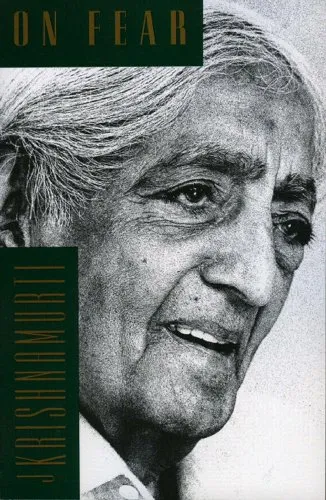
(Fear as a product of time and inattention)
There is fear. Fear is never an actuality; it is either before or after the active present. When there is fear in the active present, is it fear? It is there and there is no escape from it, no evasion possible. There, at that actual moment, there is total attention at the moment of danger, physical or psychological. When there is complete attention there is no fear. But the actual fact of inattention breeds fear; fear arises when there is an avoidance of the fact, a flight; then the very escape itself is fear. Krishnamurti’s Notebook
declared truth to be ‘a pathless land,’ which could not be approached by any formalized religion, philosophy, or sect.
When you compare yourself with another, ideologically, psychologically, or even physically, there is the striving to become that; and there is the fear that you may not. It is the desire to fulfil and you may not be able to fulfil. Where there is comparison there must be fear.
When you are confronted with something immediately there is no fear. It is only when thought comes in that there is fear. Therefore, our question now is, is it possible for the mind to live completely, totally, in the present? It is only such a mind that has no fear.
(Comparison and the desire to become breed fear)
One of the functions of thought is to be occupied all the time with something. Most of us want to have our minds continually occupied so that we are prevented from seeing ourselves as we actually are. We are afraid to be empty. We are afraid to look at our fears.
Can you watch fear without any conclusion, without any interference of the knowledge you have accumulated about it? If you cannot, then what you are watching is the past, not fear; if you can, then you are watching fear for the first time without the interference of the past.
When you see that you are a part of fear, not separate from it—that you are fear—then you cannot do anything about it; then fear comes totally to an end.
If one looks at what is, at the fact, and not at the idea, one will see that it is only the idea, the concept of the future, of tomorrow, that is creating fear. It is not the fact that creates fear.
So there is in our life this constant state of comparison, competition, and the everlasting struggle to be somebody—or to be nobody, which is the same thing. This, I feel, is the root of all fear, because it breeds envy, jealousy, hatred. Where there is hatred there is obviously no love, and fear is generated more and more.
The effects of fear and its actions based on past memories are destructive, contradictory, and paralysing. Do we see that? Not verbally but actually; that when you are afraid you are completely isolated and any action that takes place from that isolation must be fragmentary and therefore contradictory; therefore, there is struggle, pain, and all the rest of it.
So to learn about fear I mustn’t be distracted by running away from it; there mustn’t be a movement of repression, which again means a distraction from fear. There mustn’t be the feeling ‘I must get rid of it’. If I have these feelings I cannot learn. Now, have I these feelings when I see there is fear? I am not saying you shouldn’t have these feelings—they are there. If I am aware of them what shall I do? My fears are so strong that I want to run away from them. And the very movement away from them breeds more fear—are you following all this? Do I see the truth and the fact that moving away from fear increases fear? Therefore, there is no movement away from it, right?
(Watching fear without the watcher who wants to end it)
K: The same thing, only you push it further back. Now, please listen: this is the most practical way of going about it. You will see if you follow this very carefully that the mind will be free of fear, but you are not doing it. I am frightened of losing money and therefore what do I do? I escape by avoiding thinking about it. So I realize how silly it is to avoid it, because the more I resist it the more I am afraid. I am watching it and the question arises: Who is watching it? Is it the desire that wants to get rid of it, go beyond it, be free of it, that is watching? It is. And I know that watching it that way only divides and therefore strengthens fear. So I see the truth of that; therefore, desire to get rid of it has gone—you follow me? It’s like seeing a poisonous snake: the desire to touch it is finished with. The desire to take drugs is finished when I see the real danger of them; I won’t touch them. As long as I don’t see the danger of it, I’ll go on. In the same way, as long as I don’t see that running away from fear strengthens fear, I’ll go on running away. The moment I see it I won’t run. Then what happens?
K: Do I accept it? On the contrary, I forget that I am brown. I want to learn about myself. I must know myself completely, passionately, because that is the foundation of all action; without that I’ll lead a life of utter confusion. To learn about myself I cannot follow anybody. If I follow anybody I am not learning. Learning implies that the past does not interfere, because myself is something extraordinary, vital, moving, dynamic; so I must look at it afresh with a new mind. There is no new mind if the past is always operating. That is a fact, I see that. Then in seeing that I realize I am frightened. I don’t know what will happen. So I want to learn about fear—you follow? I am moving all the time in the movement of learning. I want to know about myself and I realize something—a profound truth. I am going to learn about fear, which means I mustn’t run away from it at any price. I mustn’t have a subtle form of desire to run away from it. So what happens to a mind that is capable of looking at fear without division? The division being trying to get rid of it, subtle forms of escape, suppression, and so on. What happens to the mind when it is confronted with fear and there is no question of running away from it? Please, find out, give your mind to it.
We can see what fear does to each one of us. It makes one tell lies, it corrupts one in various ways, it makes the mind empty, shallow. There are dark corners in the mind that can never be investigated and exposed as long as one is afraid. Physical self-protection, the instinctive urge to keep away from the venomous snake, to draw back from the precipice, to avoid falling under the tramcar, and so on, is sane, normal, healthy.
(Fear’s corruption of mind, education, and ambition)
Words like God, communism, hell, heaven, loneliness, wife, family—what an astonishing influence they have on us. We are slaves to such words, and the mind that is a slave to words is never free of fear.
This means that one has to go very deeply into oneself, putting aside all words; and when the mind understands the whole content of fear and is therefore empty of fear, both conscious and unconscious, then there comes a state of innocency. For most Christians, that word innocency is merely a symbol; but I am talking of actually being in a state of innocency, which means having no fear, and therefore the mind is completely mature, instantly, without going through the passage of time. And that is possible only when there is total attention, an awareness of every thought, of every word, of every gesture. The mind is attentive without the barrier of words, without interpretation, justification, or condemnation. Such a mind is a light unto itself; and a mind that is a light unto itself has no fear.
This requires tremendous observation, going into, working. To die means that you have to die every day, not just twenty years from now. You die every day to everything that you know, except technologically. You die to the image of your wife; you die every day to the pleasures you have, to the pains, the memories, the experiences. Otherwise you can’t come into contact with them. If you do die to them all, fear comes to an end and there is a renewal.
So you struggle, you are afraid. Your fear is generally used as a means of controlling you. Do you understand? Is it not very important that education should eradicate fear, should help the students to get rid of fear, because fear corrupts the mind? I think it is very important in a school of this kind that every form of fear should be understood and dispelled, got rid of. Otherwise, if you have any kind of fear, it twists your mind, and you can never be intelligent. Fear is like a dark cloud and, when you have fear, it is like walking in sunshine with a dark cloud in your mind, always frightened.
Otherwise, if you have any kind of fear, it twists your mind, and you can never be intelligent. Fear is like a dark cloud and, when you have fear, it is like walking in sunshine with a dark cloud in your mind, always frightened.
Most of us are very conservative. You know what that word means, you know what it is to conserve? To hold, to guard. Most of us want to remain respectable and so we want to do the right thing, we want to follow the right conduct, which, if you go into it very deeply, you will see is an indication of fear. Why not make a mistake, why not find out? But the man who is afraid is always thinking ‘I must do the right thing, I must look respectable, I must not let the public think what I am or not’. Such a man is really, fundamentally, basically, afraid. A man who is ambitious is really a frightened person, and a man who is frightened has no love, has no sympathy. It is like a person enclosed behind a wall, in a house. It is very important—while we are young—to understand this thing, to understand fear. It is fear that makes us obey, but if we can talk it over, reason together, discuss and think together, then I may understand it and do it; but to compel me, to force me, to do a thing that I do not understand because I am frightened of you, is wrong education. Is it not?
A man who is ambitious is really a frightened person, and a man who is frightened has no love, has no sympathy. It is like a person enclosed behind a wall, in a house. It is very important—while we are young—to understand this thing, to understand fear. It is fear that makes us obey, but if we can talk it over, reason together, discuss and think together, then I may understand it and do it; but to compel me, to force me, to do a thing that I do not understand because I am frightened of you, is wrong education. Is it not?
Fear corrupts, and to be free from fear one has to understand how the mind creates fear. There is no such thing as fear but what the mind creates. The mind wants shelter, the mind wants security, the mind has various forms of self-protective ambition; and as long as all that exists, you will have fear.
(The mind that is free must begin free, not end free)
The greater the fear, the greater the tension, the greater the neuroticism, the greater is the urge to escape. If we do not escape, then we ask ourselves, ‘How are we to solve it?’ We seek ways and means of solving it, but always within the field of the known. We do something about it, and this action bred by thought is action within the field of experience, knowledge, the known, and therefore, there is no answer. That’s what we do, and we die with fear. We live throughout our lives with fear and die with fear. Now can a human being totally eradicate fear? Can we do anything, or nothing? The nothing does not mean that we accept fear, rationalize it, and live with it; that’s not the inaction of which we are talking.
From Beyond Violence San Diego State College, 6 April 1970 WE SHOULD GO into the question of fear completely, understand it fully, so that we shall be rid of it. It can be done; it is not just a theory, or a hope. If one gives complete attention to this question of fear, to how one approaches it, looks at it, then one will find that the mind—the mind that has suffered so much, that has endured so much pain, that has lived with great sorrow and fear—will be completely free of it. To go into this it is absolutely essential that one has no prejudice that will prevent one from understanding the truth of ‘what is’. To take this journey together implies neither acceptance nor denial; neither saying to oneself that it is absolutely impossible to be rid of fear, nor that it is possible. One needs a free mind to inquire into this question; a mind that, having reached no conclusion, is free to observe, to inquire.
Surely fear is in the movement away from ‘what is’; it is the flight, the escape, the avoidance of, actually, that brings about fear. Also, when there is comparison, of any kind, there is the breeding of fear—
None of these problems of fear can be resolved through will—saying to oneself, ‘I will not be afraid’. Such acts of will have no meaning. We are considering a very serious problem to which one has to give one’s complete attention. One cannot give attention if one is interpreting or translating or comparing what is being said with what one already knows. One has to listen—an art one has to learn, for normally one is always comparing, evaluating, judging, agreeing, denying, and one does not listen at all; actually one prevents oneself from listening.
Will analysis free the mind from fear, not a particular neurotic fear, but the whole structure of fear? In analysis is implied not only time but the analyser—taking many, many days, years, even the whole of one’s life, at the end of which perhaps you have understood a little, but you are ready for the grave. Who is the analyser? If he is the professional, the expert who has a degree, he will also take time; he also is the result of many forms of conditioning. If one analyses oneself there is implied the analyser, who is the censor, and he is going to analyse the fear that he himself has created.
The more the mind is inquiring, penetrating, asking, the greater the sense of guilt, anxiety. And if this whole process is not understood, if this whole totality of fear is not understood, it does lead to peculiar activities, the activities of the saints, the activities of politicians—activities that are all explainable, if you watch, if you are aware of this contradictory nature in fear, both the conscious and the unconscious. You know fear—fear of death, fear of not being loved or fear of loving, fear of losing, fear of gain. How do you tackle this?
The moment there is no fear, there is no ambition, but there is an action, which is for the love of the thing but not for recognition of the thing that you are doing. So, how do you deal with it? What is your response?
A mind that has any form of fear cannot, obviously, have the quality of love, sympathy, tenderness. Fear is the destructive energy in man. It withers the mind, it distorts thought, it leads to all kinds of extraordinarily clever and subtle theories, absurd superstitions, dogmas, and beliefs. If you see that fear is destructive, then how do you proceed to wipe the mind clean?
you don’t create pictures and images, is there fear? We must first go into the question of why thought breeds these complicated pictures, images, in which we live. We must ask what thought is. We are investigating into fear and to go into that very deeply you must inquire into why thought creates the picture of the future or of the past, which breeds fear, and into what thought is.
So please, if you have not understood this now, spend an hour with yourself, quietly, to find out. You may cry, you may sigh, you may shed tears, but find out how to live without a shadow of fear. Then you will know what love is.
Please, I am not a professor, a scholar delivering a sermon and then going back to his rotten life. This is something that is very, very serious, which affects all our lives, so please give it your attention and care.
We are going to find out if it is possible to be totally, completely, free of fear in all its depth.
(Total freedom from fear as immediate perception, not future attainment)
FOR MOST OF us, freedom is an idea and not an actuality. When we talk about freedom, we want to be free outwardly, to do what we like, to travel, to be free to express ourselves in different ways, free to think what we like. The outward expression of freedom seems to be extraordinarily important, especially in countries where there is tyranny, dictatorship; and in those countries where outward freedom is possible one seeks more and more pleasure, more and more possessions. If we are to inquire deeply into what freedom implies, to be inwardly, completely, and totally free—which then expresses itself outwardly in society, in relationship—then we must ask, it seems to me, whether the human mind, heavily conditioned as it is, can ever be free at all. Must it always live and function within the frontiers of its own conditioning, so that there is no possibility of freedom at all? One sees that the mind, verbally understanding that there is no freedom here on this earth, inwardly or outwardly, then begins to invent freedom in another world, a future liberation, heaven, and so on.
To explore, as we are going to do, there must be freedom, not at the end, but right at the beginning. Unless one is free one cannot explore, investigate, or examine. To look deeply there needs to be not only freedom, but the discipline that is necessary to observe; freedom and discipline go together—not that one must be disciplined in order to be free.
We are trying to find out the truth of this question of fear so completely that the mind is never afraid, and therefore free of all dependence on another, inwardly, psychologically. The beauty of freedom is that you do not leave a mark. The eagle in its flight does not leave a mark; the scientist does.
question of fear, and when you leave the hall there must be complete freedom from it. That means you are a free human being, a different human being, totally transformed—not tomorrow, but now; you see very clearly that thought breeds fear and pleasure; you see that all our values are based on fear and pleasure—moral, ethical, social, religious, spiritual. If you perceive the truth of it—and to see the truth of it you have to be extraordinarily aware, logically, healthily, sanely observing every movement of thought—then that very perception is total action and therefore you are completely out of it; otherwise you will say, ‘How am I to be free of fear tomorrow?’