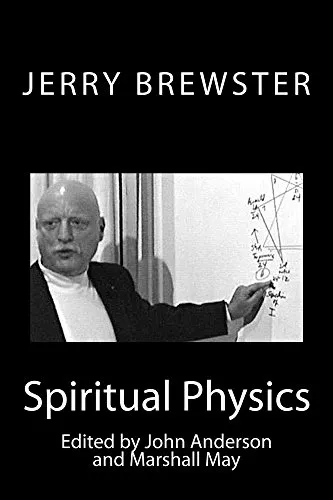
JERRY BREWSTER SPIRITUAL PHYSICS Another Generations’ View of the Work of G. I. Gurdjieff
WARNING All men are dead, except those who know. All those who know are dead, except those who practice. All those who practice are dead, except those who act. All those who act are dead, except those who act with righteous intent. All those who act with righteous intent are in grave danger! Twelfth-century Egyptian Sufi
It was Jerry’s stated intention to publish this material to help future group leaders and other seekers and their successors and to aid in their movement to the next rung.
When P. D. Ouspensky was asked if he intended to publish his lectures, he answered: “What is the use? The most important is not the lectures, but the questions and answers.”
Someone once asked Gurdjieff, “From what does the Way start?”
He also said: “The moment when the man who is looking for the way meets a man who knows the way is called the first threshold or the first step. From this first threshold the stairway begins. Between ‘life’ and the ‘Way’ lies the ‘stairway.’”
In the second triad it would be true self-remembering, the sensation of I to the feeling of I; this is quiet mind receiving impressions for the sake of [i]unity. Everything comes down to the unification of the centers, what Gurdjieff called a permanent I, which comes out of the unification of centers.
There is a phrase I came across recently that I think explains this: “Detachment, separation, unification, the three stages of attention.” First to detach oneself, to be unidentified; second, separation, to actually sense part of one’s body while in action. As I
said earlier, in order for there to be unification, two centers are brought together at first, but eventually I must inhabit all three centers simultaneously. This can facilitate a separation from your personality. It’s not personality seeing itself, it is now an objective part observing.
“One center: hallucination; two centers: half hallucination; three centers: awake.” In a way you are trying to cure an addiction to one-centeredness. It’s one thing to be in a coma and another to be awake with your eyes open lying in bed. It is something else to be awake, totally in action.
With false personality and essence, you are white-washing a burning house. If you reach the level of consciousness of Man No. 4, at that level of being you could understand that unless you achieve a crystallization of your finer vibrations, everything will be dissipated. When the house is burned down, what do you have? It went somewhere! Remember, in the universe nothing is destroyed, it just changes form. What happens to me when I die? My form changes just like the burning house.
In the food diagram, we see that there are three foods: physical food, air, and impressions.
Every frequency of vibration has its own value system, its own tempo, its own consciousness, and even its own body and circulation.
We have the higher vibrations within us but we can’t connect with them because we live through our personality, which is at such a low vibration.
“There is a magnetism that pulls us back to our thoughts, which are usually just associations relating to the past or future. Our ‘muscle of attention’ has never been exercised and is very weak. In the freeing of our attention from this magnetism it’s possible to ‘travel’ inwards… opening a door to new places in us that heretofore were invisible.”
1 Attention
1.01 Q: What is attention? How can we see and know our attention? What do we mean when we speak about the division or the expansion of attention?
What is a nonactive attention? What I realized is that for everybody in the world, and for me until I met the Work, our attention follows the path of least resistance. Whatever calls it, it follows. I don’t have an authority in me that acts for the whole of me, no permanent I, an authority that the attention will obey. We often use the same word—attention—for lack of attention, captive attention, directed attention, divided attention, or what I call “expanded attention,” which includes more than one center.
We become whatever the attention is called to, which Gurdjieff calls “identification,” actually becoming it, not just thinking it. When we first come to the Work, everyone is given tasks which demand taking the attention out of the path of least resistance.
We can’t trust the mind in our present state. Just as I dream at night and I believe the dream, when I wake up in the morning I believe I’m awake: the same delusion. Eventually, we will be able to trust the mind, if and when we learn the real energy of the mind. Same thing with the emotions. They’re too powerful for me; again, I’m too identified. We usually begin with the moving center because it’s the most available.
The sensations are always there; our body is filled with sensations, but I’m not aware of them because they’re usually blocked by tensions.
There has to be an expansion of the attention to include two forces; the sensation of my leg is the active force,
it’s really the attention. The passive force is my mechanicality, the path of least resistance. Also, there is a division of the attention: one part of the attention is mechanical and the other part is conscious. Now I’m centered in the body, and I sense without that pull of my mechanicality. I connect with the sensation and then I try to open to the energy of my mind.
Gurdjieff said, “The higher blends with the lower in order together to actualize the middle and thus to become either higher for the preceding lower or lower for the succeeding higher.”
Q: Can you talk about the relationship between attention and sensation, and what is the relationship between sensation and tension?
The Buddha gave a sutra on the setting up of mindfulness. He didn’t mean mental mind. He meant being present. To paraphrase, he said, “I take in a short breath, and I’m aware of letting out a short breath. I take in a long breath, and I am aware I’m letting out a long breath.” He is saying, don’t manipulate the breath; don’t change it; be aware of it in the body.
Look inside yourself and ask, “What is my attention? Where is my attention?”
First, I direct the attention, and by directing it, there is an opposing mechanical force that pulls attention away. The only way I’m going to be able to climb the ladder of consciousness is through the division of attention to include two forces. As we are, in sleep, we are under the law of one, not under the law of three. That’s identification.
It’s possible to experience a struggle with the attention by the friction between these two opposing forces until there’s reconciliation. Gurdjieff called these the Holy Affirming, the Holy Denying, and the Holy Reconciling. Our problem is that in our sleep in life we have an “unholy denying.” What should be our passive force, our personality, is under the illusion that it’s active.
The effort to sense brings me much further, brings a relaxation much deeper than if I just try to relax. The reason for this is I don’t create sensation. Sensation is part of my essence. I was born with it. It exists as long as I am alive. Tensions and postures block out sensation. My experience is that relaxation is an important part of the way.
Gurdjieff tells us that nature supplies us with enough energy to work on ourselves and remember ourselves, at least for a period of time, but we often spend it all in negativity and dreams. Even our associations take a lot of energy. If I sit in a chair all day and just associate, I’m exhausted, more so than if I chopped down trees all day. If I’m aware of the energy of the mind, not the content, almost no energy is used! It even brings energy, because it can receive impressions. The same is true with feeling. If I am really feeling, I am enlivened, there is a joy of life. When I am in the body, even if I am exhausted, I could be filled with energy!
There is a center of gravity to everything, and being that we’re not connected even to the center in ourselves, we’re not connected to the center of the Earth, which could bring us to an organic alignment. This is why we see the horrors people cause on this Earth. It is due to this lack of alignment! We are not children of Earth any more. We are children of the moon. We’re not just under twenty-four or forty-eight laws. We’re under many more unnecessary laws.
With sensation you can go very far; you can even go past sensation of the flesh into a sensation of a new vibration. This may be what is called the Holy Ghost, or the chi energy. Throughout history it has been given many names.
You have to expand your attention, start to open to the whole body; find hollowness where there are no obstacles to the movement of energy and attention. In this way one can sense the chi energy, or what I call in the Enneagram the “succeeding higher”; the vibration of the energy of hydrogen 24. One must experience and be acquainted with this subtle resonance, a circulation in every cell of the body.
This is like working on the structure of the vessel, like laminating the vessel with the energy of the mind, a coating with the texture of the emotions. Unless one has this basic vessel to hold these finer substances, one cannot accumulate anything.
We’re learning how to use the law of Triamazikamno, the law of three. If we knew how to live under that law, we would be conscious very quickly. But we live under the law of one, maybe sometimes two.
“As I start to receive impressions, I start to see the unbecomingness of my life. Something awakens in me that I need very much. These moments are very important—in the reaction after that moment in which the space is filled anew I try to beautify the picture or change it, but not taking a new photograph. I must learn, again and again, to take another photograph..
2 Group Work
Nobody realizes the tremendous forces we are up against. We think that we are free. We don’t realize we are in very strong currents. One has the responsibility to understand the principles of the Work. You must make an effort to externally consider other group members.
Then there is a point where you need to go further than that, to bring external considering; in another way you work to help each other’s consciousness. You become conscious friends, seekers of truth.
You may believe we’re asleep, but that’s not good enough; you must experience it. Very different, knowing we’re asleep and experiencing the state of sleep. Usually, you experience it by waking up for a moment and realizing how deeply asleep you’ve been.
These two active forces, active personality and the task, which also represents an active force, is the struggle I bring. I often get the opposite result for everything I want because personality is in total control and thinks that it’s the center of the universe.
They may want to but they can’t. Another factor about a group is that it’s a group of people that in general have little or nothing in common. They’re not there for business or interested in money. They’re not there for personality or because they like each other; they’re not there for family, it’s not blood. They are there for consciousness. That’s the vibration that is like the string in a string of pearls, invisible.
They commit to the Work, and they serve it not for personality or essence profit but because they’re giving back what they received. They know it’s for consciousness, real seekers of truth. Years ago I remember hearing that a group is like a stew. There are times some people bring the meat, some bring the carrots, some bring the peas, and some bring just a little broth because that’s all they can bring. But a year later, the one who brought the broth now brings the meat; the one who brought the meat now brings the broth.
2.02 Q: Can you explain the inner work with interference, participation, and experimentation?
We know what interference is. What is participation? We need to develop a new center of gravity; for participation, you need a place to be that’s free of the centers. You need to participate with, and it can’t be one I participating with another I. Sensation does not participate with, sensation separates you, the separation of I from it. Participation uses a new center of gravity. It’s a place that’s not from my ordinary centers. We find our work on interference is hard to give up. It takes a long time to shift the emphasis from interference towards participation.
Gurdjieff said, “No man friend—no man enemy, all are teachers.” All are impressions. Experimentation comes in more at that level.
2.03 Q: What is the purpose of the sitting in our Work? Can you expand on the history of the sitting? Can you explain different kinds of sittings done in private, quietly in a group, and guided sittings? At times you instruct us to follow the breath in a guided sitting. Can you explain the use of the breath in light of Gurdjieff’s opinion against manipulating breathing?
To be quiet and still is a very active movement. If you’re in the middle of a stream with a strong current, to be still will take a lot of effort.
The transformation of the energies we receive from following the breath comes from what Gurdjieff calls the “first conscious shock,” remembering ourselves in front of an impression. It will cause the breath to go further in its transformation and transmutation of energies and bring me these higher energies and the coating for what he calls a “higher being body,” or astral body. In this Work we don’t interfere with the breath. Somebody told me they were doing some exercise, in which they breathe in one nostril and breathe out the other or take short, quick breaths; all these are manipulations of the breathing. Right now the breath is basically controlled by the instinctive center. The last thing we want is the breath to be controlled by the wrong center;
Mme. de Salzmann once described it “as if we’re afraid to breathe out.” If I’m in my emotions, I find my breathing is a short and rapid, and it’s only when I’m present in my…
I bring my attention to the breath, I let the breath guide my attention, and…
In my own personal experience, I found blockages in my diaphragm, tensions that felt like steel. It took a long time to erode the tensions, but even when I did the diaphragm would vibrate violently. When I finally got rid of the tensions, it was such a blessing for me, and I hadn’t even realized I had them until I started to lose them. Mme. de Salzmann told us there are three kinds of breath; the ordinary breath, which comes from whichever center is dominating; a breath that comes from the abdomen; and a third breath that comes from the initiating energy of life, which I consider the vibration of hydrogen 24,…
but because we have a little clump of them in our solar plexus, that’s where we usually experience emotions. These are doorways into the centers. The circulations have to expand throughout the whole of each center and the whole body. The…
breathed out; but if one is conscious, or aware of oneself, remembering oneself, there’s something extra from the breath that stays or settles in the body. It’s not…
You’re not creating it; you’re opening to it. The breath is very useful…
In the Work there are times when you do sittings at night as well as in the morning. At night you can go much deeper because you’re out of the current of life. There is no opposition: the body is already a little tired; you’re ready to go to bed; and you don’t struggle as hard against this force that sweeps us through our lives. The sitting in the morning is an active force; the sitting at night is a passive/receptive force. The minute you wake up, you’re in the current of life.…
The first part is interference, the collecting against the pulls of each center, of life: you’re collecting your attention; you’re collecting your centers; you’re collecting everything. Once you’ve opened to a finer energy, it brings you to the second triad, participation. When you have this resonance, you can then open to the question, “How can I receive an impression?” I have to be aware and be present.
JB: I know certain older people who only bring silent sittings. There’s a danger in the Work, which is that you can become too humble! And, you know, there are two sides to that stick: one is total arrogance and power possessing, and the other side of it is this humility of, “Oh, we really can’t know anything.”
2.05 Q: From the perspective of the Work, what could be meant by prayer? What is the difference between prayer and meditation?
The preposterous ego or ignorance involved in thinking that you could reach God directly is extraordinary.
She said, “Yes, I asked Mr. Gurdjieff the same question and his answer was, ‘Thank you, Lord, for giving me one more day to work on myself.’”
When one thinks of what’s at stake, the reality of accumulating astral matter, finer vibrations, and learning to know myself through self-observation, every day is valuable. What I see is that I waste every day. I do a certain amount of work, but I don’t really feel the extraordinariness of having one more day. The idea of thanking the Lord is different from asking for something. You are not petitioning to be given something; this is a different kind of prayer; it’s recognition of what’s at stake.
Many times what people call meditation peace is often actually an attracted attention. I am pulled into another part of the body or my feelings. The struggle is to collect the attention or the energy of each center. Regardless of your state when you struggle with your morning collecting exercise you are bringing order, which means the attention can’t go wherever it wishes; this is the struggle. In meditation we are trying to work with the energies of all the centers; it’s possible to be open to all the centers at once. The centers are alien to each other. They don’t even speak the same language. They are not at the same tempo. They don’t have the same associations or the same I’s. But they need to know each other.
This is a great demand because it means the attention has to open and be divided to include two forces. The attention has to be divided as equally as possible, 50/50. In the beginning it’s usually more like 90/10. This is a work for a lifetime. We’re after something more valuable than diamonds. We are asking for and trying to buy what is perhaps the most expensive material in the world. We think we can buy it with our counterfeit or Monopoly money. One can’t expect consciousness or an astral body in a week or a month.
It’s here that one begins a new level of work, where the centers are no longer alien to each other. In this new center of gravity there’s a new vibration, the source of a circulation that exists in every cell of the body.
The law of three does not consist of three isolated forces; there is an attraction between the forces, like gravity. If I can maintain this equal attention simultaneously on the energy and the resonance of the mind and body, then the law of triadic attraction, which I believe is what Mme. de Salzmann calls “self-tuning,” comes into play, and these two energies which normally repel each other will start to be drawn towards each other. We need to allow the emotions to become the third force. It has a different “color” than the energies of the mind and body.
The canon which supports this prayer I Wish to Be Myself brings the attention to I in the head; “wish” in the solar plexus; “to be” in the spine; and “myself” in the whole lower part, including the abdomen, sexual area, and legs, what the Taoists call the “sea of elixir.” So, when you say “I” you sense the energy of the mind; when you say “wish” you sense the energy of the emotions; when you say “to be” you sense your spine; when you say “myself” you sense the whole lower part. This is more a practice than a prayer.
There is a spot between the eyes where Indians from India put a red mark, the bindhi;
found that spot to be like a doorway into the mind that can be used to quiet the associative mind. It’s not a doorway into the energy of the higher mental center, but into the energy of the head itself.
With “wish” you have a doorway to the feelings behind the breastbone. Usually I block what is behind the breastbone from my awareness. I don’t want to experience the chaos that is behind the breastbone. For “to be” we have the spine, the doorway into the whole body.
For instance, now you have the energy of the head, but what is I? I don’t sense I, I sense a lower energy that has stolen the sense of I. Similarly, what is “wish”? The energy of “wish” that I have now is not very high. “To be”: How much being do I really have? “Myself”: Who am I? How can I bring this ultimate question to work in life?
One could use a question as a way to interfere with ordinary personality. I ask, “Who am I?” and I search, and it’s like demanding a more conscious attention, a presence, sensation, to maintain the question for at least a short while, and one may see one’s personality. It could be used in that way. When you’re trying to remember yourself in front of an impression, asking “Who am I?” becomes very important. If one could have this sense of I am-ness for a moment, this impression of that moment, a much finer energy is generated by the transformation of substances from air, physical food, and impressions.
“Who am I?” I remember vividly one sitting, where I saw a whole sheaf of tensions and a picture of myself tied to an emotional state. I saw that as being the lie of I, and I suddenly relaxed, going much deeper in myself. I saw everything that said I in me was a lie. In fact, I felt as though I was walking through the Land of Not I, that was my formulation; but there were certain moments where I felt there was an opening to feeling, something of what life could be, and that what Gurdjieff calls “permanent I” was not a big or small I but it was something very different, unique! I started to have a much deeper feeling and a new kind of sincerity.
I have found that the question “What am I?” can evoke the sensation of I more easily, and the question “Who am I?” evokes the feeling of I more directly. We worked for a long time with Mme. de Salzmann on the sensation of I, not I have a sensation, but the sensation of I-am-ness, and some time later we worked on the feeling of I-am-ness. Then there are the questions “Where is the center of myself? Where is my source?”
You must get a sense of different centers, the mind, the body, and the feelings; so these kinds of exercises—“I wish,” “I can,” “I am”—vivify the centers and invigorate the search for I. We can’t search for it in our fantasies. We have to bring this search for I with a higher presence. It seemed to me that I could open to this search from any cell in the body. I couldn’t allow any cell in the body to go unobserved. I had to be totally connected with everything; such vigilance brought these kinds of experiences. I had seen this in my search for “Who am I?” I remember feeling, “I cannot get disconnected from any part.”
There are many spiritual ways that are better than the Work for a change of state. Visit a holy guru and sit by his side, get the benefits of his presence and feel a very high energy. But the minute you walk out the door you put back on your postures, your tensions, your anxieties, your values; you go back to the center of gravity of your level of being.
It actually works very well, you get your Work injection, but there is one big problem: personality can hide in that glow of vibration; your features can hide; your buffers can hide. It isn’t that you get to certain energy and hope that your personality will appear; you have to bring that struggle with this energy into the moment to see your personality.
You need to develop a vessel that can hold this holy water of vibrations. Everything in life causes you to spill it.
2.09 Q: What is the meaning of the designations first, second, and third lines of Work? What is the importance of each of these lines, and how are they related to each other? JB: Even the Work itself must follow the law of Heptaparaparshinokh, the law of seven; and Triamazikamno, the law of three.
One principle was that you were expected to take on the job as given. Some people, including me, just couldn’t and had to argue, and one would see and suffer one’s personality. Even though I remembered this principle of the Work, I always tried my own version and it was obvious to the group leaders, who would say, “Mr. Brewster, just do your job as given.” Another principle was that if you were blamed for something, you would accept the blame, even if you weren’t at fault! One had to understand that even if you didn’t do it this time, you probably did the same thing a thousand times before and didn’t get caught. I struggled to keep from saying, “Wait a minute, I didn’t do that.” Years later, when I found myself being unfairly blamed in life,
I found it almost impossible not to accept blame. It was always a struggle, but I remembered the principle, and it woke me up. Second line of Work is filled with principles like that. This is a practice of going against self-will.
One of the methods is working in life with a task, with support of others in the group who are trying the same task at the same time.
Work periods can be used as a shock bridge to see oneself. The work periods made visible the things about ourselves that are invisible in life. This is due to the interaction with people. Working with others helps you maintain a work with the support and energy of others while in action. There is a point when one reaches a certain level or an interval where third line of Work is required, the principle being work for the Work. The third line of Work is a way which serves the needs and aims of the Work itself on a large scale, not just for my own benefit or the benefit of a small group, but for the benefit of furthering the aims of the Work. You have to sacrifice your own requirements and needs to serve the Work in a larger sense. There are many ways to serve the Work and what the Work needs. Third line of Work is for people able to do third line of Work.
It’s not the development of the center. The number one thing is where you make your decisions from: With which centers are you most identified? Which center does your I-in-quotation-marks come from?
When you get past that, when you get to the energy of H24 it’s free of gender, no more male or female. When there is a vibration of H24 in a room, and there are men and women there, it’s all the same. In the Gnostic Gospel according to St. Thomas, it seemed that Mary Magdalene was sitting with Jesus and his disciples, and they said, “Why do you allow Mary to be with us? She’s a woman.” And Jesus responded, “Let us say I will make her male.” And I feel that he was speaking about this energy that exists and is beyond gender.
The Work is never convenient to life; life is never convenient to the Work. Otherwise, maybe life forces will win or overcome the Work forces. But there are angels working for the Work, not just devils working against it. There are also conscious forces working against the Work. The ray of creation is an involutionary octave. The idea that Satan
was part of God, this is the idea of the Hasnamuss; as is the destructions of the holy labors of Ashiata Shiemash from within by power-possessing beings.
The biggest obstacle to unity is chief feature. Chief feature is the foundation of the entire mechanical structure of personality; it is what stands in the way of having a center of gravity
within oneself, unification, and yet it’s invisible. It’s the last thing we would even admit to having.
Man No. 4, or higher, whose lives are devoted to the Work and vibrate at a certain vibration could be receptive to H12 or higher, representing a real teacher.
“Personality has a way of turning you from work, making you feel uncomfortable, without a role. It’s personality’s way of trying to divert you from a much larger Work. Suffer the discomfort, stay with it; wait; the discomfort will soon be gone, comfortable in the emptiness, not having a role to play.”
3 Personality
3.01 Q: If there is a difference between ego and personality, what is it? JB: Most of the time ego is invisible. I don’t see it; in fact, I am the ego. I define that as active personality. Ego runs the world. People die unnecessarily because of it. Everything’s a triad, so there’s always a part that’s lower. There’s ego on every level; every frequency of vibration has its own relationship to ego. The aim of that ego is to satisfy an illusion or the lie about myself: that’s active personality, everything is about me, me, me; I want, my requirements, and it’s all for personality’s profit.
Then there’s the ego of the essence, an I-am-ness. It does have an ego, but it’s a much better, healthier ego than personality’s.
And then there’s the ego of Man No. 4, which is the ego of consciousness. I need this ego to evolve. There’s ego, but I act from a truth about myself, not the usual lie of personality. The ego of Man No. 4 is really what Gurdjieff means when he speaks about a more conscious egoist.
3.02 Q: What is the effect of ego on our centers? JB: We need to consider that our centers are contaminated and ego is one of the forces behind a lot of the contamination. There is a something put into all sentient beings that comes from a very high place, the real need to be.
“What are you doing? I told you that God put out this edict ‘to be.’”
He said, “I know, but I added something to it. I added to be good, to be famous, and to be rich. See, I put a little tagline on it; now we’ll get them all.” “To be” is what we need, but a tagline has been included. It’s the equivalent of Kundabuffer. It becomes active.
We’re educated to create this illusion of being something, and that’s the contents of the centers. Certainly, not all; some contents are different and each center has its own content, and its own illusion of being; even our postures act as an “I am.”
JB: One of the machine’s main fuels is ego; probably 85 percent of what drives me is ego. With a little less ego, maybe our whole life would be different.
Can you explain the idea that the result comes from the sincerity of the effort, not from the magnitude of the effort?
JB: According to the Enneagram, you could say that personality is based on the frequency of vibration of H192. You can say that man is a triad which includes false personality, which is H384, total illusion and personality; H192 which is education and formatory apparatus to a degree, what we’ve learned; but the third part of the triad of ordinary man is essence, H96.
There’s nothing in life that needs consciousness. Consciousness will help you in life, but there’s no need for it. If you’re in a state of identification, the last thing that the I’s that are identified want is consciousness. They don’t want the light of consciousness. We need passive personality to evolve in the evolving triad. Active personality is the descending triad. You have to see and know the difference. You need to maintain the effort of consciousness along with the idea of active personality and passive personality. If you maintain the effort for a certain period of time, you may see the posture you’re in: your shoulders are up, you have this expression on your face, all artificial; you’re leaning over and you can’t get your head back, and you’re nodding, even though you think they’re full of shit or you don’t agree with anything, you’re still nodding, like one of these bobblehead dolls on a car dashboard. And you see in the emotions you’re just trying to impress this person. You feel at that moment and you see how mechanical it is but the personality can’t take the light, and suddenly it’s gone; it hides.
This kind of seeing enables me to get to passive Do, which is receptive personality, and the I’s that wish to evolve that wish to help.
that claw is active Do, active personality. It’s dragged you down the path of least resistance all your life. Suddenly, at the moment you see that, you realize that. It’s still not essence, but a freedom appears. But in the next moment, active Do imitates passive Do. You have the self-remembering look. You’re still really close to that state of relaxation, but you’re not sensing yourself anymore; you’ve now got active Do imitating passive Do. It’s a situation that one has to see and recognize over and over again.
3.05 Q: What is sincerity? JB: Conscience is what we must aspire to. It begins with real remorse. I was told time and again I was practicing cheap remorse. I’d bring in my sob story and would be told this is cheap remorse. I was given special exercises by Mme. de Hartmann to be able to open to real remorse, but at that time I wasn’t ready for it, and I couldn’t understand why she gave me these exercises. I didn’t have the right feeling. Later, I understood the exercises she gave me and was able to use them to acquire the right vibration of feeling. What we usually call “sincerity” is usually cheap sincerity or cheap remorse. Gurdjieff refers to this as a very big weakness. So, one must ask, what does it really mean to value consciousness?
Gurdjieff says, “Conscience is to the emotions what consciousness is to the mind.” When he says conscience, he means objective conscience, that
everyone in the world will feel…
It can’t conceive of death. That’s why when one sees deeply enough one sees that everything underneath is fear. Personality knows it is a lie and that it will die. So it bends…
If you are able to consider externally, then if you need to lie, you lie, if it is all for the good of the person and yourself. Gurdjieff spoke about clever sincerity and stupid sincerity. When you are stupidly sincere, people will walk all over you. There are predators in life that are looking for this…
I found I was able to have friends with whom I didn’t have to be sincere. I knew they would use me if I showed weakness, so I was strong with them. There were other people whom I call triers. I was able to open my heart…
3.06 Q: What is active personality as opposed to…
“We have been taught that the evolutionary octave starts with a passive Do.” I was stunned, because you would think it starts with an active Do. But I realized, of course, the ray of creation is a descending octave which begins with an active Do: the higher meeting the lower and becoming the middle, an involutionary octave. A force can be either passive or active in the moment. If you are in the descending, involutionary octave, it could be a passive or active force which is descending. The evolutionary octave is…
Descending becomes more and more mechanical. Returning against that descent is very different. In an evolutionary movement it has to become more and more conscious. The energy becomes more and more refined. To me, the Enneagram reflected the…
It is easy to think that passive is bad. The idea of being passive as a start to the evolutionary movement was a revelation. I started to see that my…
How do I maintain an attention long enough to see my personality and how it works? In Beelzebub, Gurdjieff says, “Holy Affirming, Holy Denying, Holy…
Struggling against personality is like looking into the distorting mirrors at a Coney Island funhouse. Our…
need to turn active Do H192 passive. Then the struggle is to bring the active force of the Work, H48, to passive H192, and through the law of triadic attraction, or self-tuning, to be reconciled at Mi H96; essence and can become receptive to a succeeding higher. In my view of the Enneagram, active Re H48 represents tasks or methods of a real teaching. In the beginning, this struggle is brought into my life by the meeting of two active forces repelling each other, active Re H48 and active Do 192. Only sustained effort to maintain the struggle between these two active forces will result in Do H192 becoming passive/receptive and thus becoming open to a succeeding higher, active force! When you reconcile at essence, Mi H96, the triad is completed, you then feel the joy of life, you love people who Work. It doesn’t matter what you think of their personalities because you get by that immediately and you love them as brothers in the Work. We need more of this. Essence is a state of love, where all three centers exist simultaneously—maybe not unified, but simultaneous.
can maintain this struggle at passive Do like a preemptive strike, to prevent active personality from automatically imitating passive/receptive personality. I immediately need to find exact methods before active personality returns. I need to find a new active force! One example would be to like what it does not like. When we say “like what it does not like,” what is “it”? It is active personality, my habitual strong likes and dislikes. I go against what active personality is attracted to at that moment. I use this to awaken; this struggle can bring me to a state of passive Do. If I’m asked to do something in work conditions, I do it to go against active personality, like work in a dirty basement, volunteer for the manure team, to like what it doesn’t like.
Every moment there is an automatic inclination to do something in a way to protect oneself. We are never out of opportunities to go against personality. Gurdjieff’s aphorisms are all remarkable. Another one is “Remember yourself, always and everywhere.” We know about “always,” but what about “everywhere”? Are we willing and able to bring these efforts into the dark and hidden parts of our life?
Associations are one of the greatest gifts that God has given man; however, when they’re the active force they’re horrible, but they can be incredible servants. In real thought, you have to be in quiet mind for long periods of time. It’s very rough terrain to get to quiet mind, because the conceptual I is in the way of it. The most difficult thing is to sacrifice conceptual I, to die to that. That brings fear like you can’t imagine since you are the conceptual I. Fortunately, if you’re on the right track, it’s not a long chasm; it’s deep, but it’s bridgeable. You get by it quickly if you maintain the right Work.
4 CONSIDERING 4.01 Q: What is considering? What is the difference between internal considering and external considering? And what is the work of freeing one from considering? JB: Gurdjieff said identification with people “needs its own designation because it’s so big,” and he called it internal considering. In my own Work, I discovered that there are three basic kinds of internal considering. The first type is to think, what an idiot I made of myself yesterday; it’s the past.
“I don’t want to make a fool of myself in front of this person; I must act like I’m their boss.” You’re considering all the time. So there’s that kind of considering in the moment. Basically, there are three kinds of considering: the past, the future, and the present. And there are three different kinds of Work involved in that. One of the things I found out is that the experience of struggle against and becoming free of considering brings an extraordinary sense of well-being, a very high state. How do we work on considering?
First, one must struggle against considering, not to succeed, but to see its power, that it has an enormous energy supporting it.
There was a Buddhist in one of my groups who said, “This doesn’t apply to me because I don’t consider. Maybe because I’m Buddhist, I couldn’t see one example. I don’t consider at all.” I said, “That’s really very nice.” I said, “Since you don’t consider, you can get up and dance for us!
She asked, “What are you talking about?” I said, “Well, you don’t consider, you’re free! So dance!” “I couldn’t do that!” she said “Sure you could. You’re not considering, so why not get up and dance?” “No, no, I couldn’t.” She turned pale. And suddenly her eyes opened wide and she said, “So that’s what you mean by considering. I have that all the time!” And it’s true; she always had to act “properly.” People don’t even know considering exists; they say things like, “I’m really being sincere.” They’re floating on that very strong current and they’re giving it all kinds of other names, even saying how wonderful considering is.
It’s a very strange movement; you don’t go against the energy, you suddenly slide around it, but you see this movement and struggle against considering, and suddenly you find you can go against it. A half-hour of struggling to go against a big identification brought me one of the high states of my life.
all to cover up the sound. But I said to myself, “Everybody knows I’m in here peeing. I mean, what’s wrong with peeing in the toilet?” I said, “I’m going to do it.” Now, that’s considering.
But I walked out in total command, and I became the center of attraction there because I went into such a high state. Think of it, from overcoming considering about peeing I went into a high state! That showed me the power of going against considering, that was a struggle against it. Usually we slide, finding a way to move around it, but sometimes through our struggle something in us is freed, and we go right past it.
The next stage is to do something in front of people. You’re nervous as hell, inside you’re trembling, but outwardly, you could succeed and you could look calm. I once gave a talk at the Morikami Museum in Florida. The week before was a whole week of worrying, of anticipating with dread that I was going to be in front of this group and make a fool of myself. Not only was it in front of 120 people who were mostly retirees who weren’t going to understand anything I said, but also the whole Boca Gurdjieff group was there and that worried me more. What if I give a bad talk? And that was the first breakthrough, where I had no fear, no anxiety, and was able to hold an entire audience in the palm of my hand, for an hour and twenty minutes. I found an energy that was so powerful because I was free of considering; a wonderful thing to be able to speak without those weights, that anxiety and nervousness.
You don’t know. You never know when you’ll have a result; you just need to struggle. You just concentrate on making that movement, make a commitment. In order to go against considering, you have to remember yourself a lot.
Gurdjieff always brought, “What’s the next step?”
With external considering, you try to see what people need. And if you see what they need, you’re at the service of that. Somebody’s very unhappy and you know that they’re lonely, so you make yourself available more than you usually would; it’s not that you’re doing it because of inner considering or to get rewards, because sometimes you make an effort and they turn on you. Don’t expect gratitude because your heart will be broken. You have to do it for consciousness.
When you’re in a lower state you can’t bear the people in the Work because of personalities. When you’re in a better state, you love everyone in the Work.
When you try to do something as if you were conscious, you get such an impression of sleep, you start to see that you’re considering internally, that you’re expecting others to meet your requirements. This is why second line of Work is very important because one of the principles of second line of Work is that I don’t come with requirements and I do what’s asked of me. I come to receive a higher: whatever it is that takes that place, even if I’m cleaning a bathroom, that’s the higher; I serve that; it’s the equivalent. How can I serve God if I can’t even serve a urinal?
It’s often hard for me to tell whether I’m internally or externally considering when I help someone. For instance, it might seem like a sacrifice or effort to really help someone, but maybe I am just afraid to say no.
JB: How do you know you’re considering? It’s usually an emotional attachment which could be a weakness in the emotions; my reaction is to justify it. This is why you’re working on presence. It’s only you being there to see both sides.
And presence is like a third force. It’s the reconciled result of a triad of struggling to be awake. It’s like the middle, and then, if you can see what is true, maybe you can work against considering at that moment.
But considering is only concerned with people, except you can even consider a dog, you know; you slip in front of a dog, you try to make it look intentional. You even consider people that aren’t there.
5 UNITY 5.01 Q: Can you talk about the Work which relates to how the energies unify the centers?
We have to quicken our lower centers; it’s only that quickening which will allow us to relate to finer energies from the higher centers.
The memory of those higher states may be enough to give some people the illusion that they’re still connected or that they are enlightened. But these states never stay, and I’m back to the center of gravity of my level of being.
If I don’t have a vessel for higher energies, then, like a lightning bolt, they will go through me and into the Earth. I’m a conductor for something very high, but nothing remains. We need a vessel for these high energies. In the Work, the idea is not just change of state, but change of being. My work is the struggle that will allow this accumulation of astral matter that could bring me a higher body.
Right now, we look inside ourselves, and there’s no being, there’s no vibration of life. What would it mean to have a vibration of life that circulates and stands in front of anything? I don’t lose myself. The vessel eventually becomes a Kesdjan body or an astral body. It’s through the daily grind, the daily Work, that I start drop by drop to deposit this very fine vibration in my vessel, and it may be only be a drop, but they add up. There starts to be a receptive quality to these energies.
Even if I can become receptive, what do I hear? The equivalent of a rap station; the associative process is just turning because that’s all I’m receptive to. We need to start to enhance and vivify the vibration of our lives, the vibration of the way I live, because the food of impressions is what allows the air octave to create this higher inner body. Through this approach to have a body that’s receptive to my ordinary states, and to start to see myself, I see what’s in the way of this vivification. I start to see all of the leaks that take my force. This struggle is what produces a vessel, drop by drop and day by day.
I’m normally carrying so much baggage that I can’t even see the openings; and even if I do see an opening at that moment, when I’m sitting, there’s no way for me to get through because I won’t let go of these structures of personality. If I work on myself during the day, observe myself, the baggage starts to erode; through the observation of bringing a light into my life and finding that I can suddenly enter new, sacred places in myself, it’s like a new world.
The mind is noisy; it’s turning; it’s thinking; it’s associating. My feelings; usually I’m feeling nothing, or I’m irritated. I start to investigate this. I look in my body and I don’t find a real vibration of life; my mind, my emotions, my body are all noisy. But if I can go further there is a void, a place of complete silence, nothingness.
And yet that nothingness is more intelligent and filled with a much finer energy. It’s just that I can’t perceive that energy now; it has a flow, a circulation, a resonance in the whole body, but I can’t yet be aware of it. The first note of the octave of that resonance is silence, complete stillness.
I discovered that certain tensions in my breathing stopped me from intentionally going deeper into myself.
JB: The elimination of associations and formatory thoughts and vivifying the energy of the mind—I found out how to come to the state called in Zen no-mind.
When you work this way you are actually eliminating conceptual I, you actually feel the terror of dying to it. It’s frightening at that moment when you’re losing your associations and conceptual thoughts. Then, I found it isn’t a big gap; it’s like a deep chasm, the great darkness of fear, but it’s not wide. I found that this energy will carry you right past this interval. I used to have minutes of no-associations, then hours of no-associations; later, days and weeks. It was in this state of no-mind that the development of my new interpretation of the Enneagram came, and I think I even became receptive to the higher intellectual center at times. With this new relationship with my mind, I was able to understand in a new way.
This is why I feel that what Gurdjieff said about seeing chief feature for oneself is very different than the dangerous practice of telling people what their chief feature is. Because people can hear what it is, know it, but never get rid of it. It’s more important for a person to get rid of chief feature than to know about it. Having someone else tell you about your chief feature can even stand in the way of getting rid of it, because it’s the wrong part that knows of its existence.
JB: In the food diagram, Gurdjieff describes how the transformation of energies takes place up to a certain point with mechanical shocks, and then everything stops. To keep the transformation going, the first conscious shock is needed, and the order is very important. He describes this as bringing self-remembering to receiving impressions.
and then came a moment with a sensation of I-am-ness, which coexisted with the real vibration of the body. You work, maybe a year, on the sensation and evolution of I-am-ness, and then you start bringing work on the feeling of I through the struggle with reminding factors.
Mme. de Salzmann once brought a task to remember yourself and have the sensation of “I am” at 10:00 AM and 2:00 PM. I brought to the group that I tried every hour. Mme. de Salzmann seemed angry: “What do you mean you tried every hour? That was not the task. That could be harmful.”
I later understood that doing a particular task more frequently instead of at the designated times promotes the disease tomorrow because if I don’t do it this hour, I will do it the next. But if you only have one or two hours to do it in, you can’t escape it: I missed it; I was asleep; and the shock comes!
The use of reminding factors is a science. Just as a task is like a surgical instrument, each time you fail something is deposited. You learn something and understand at a certain moment what work you really need because you struggled and failed. The same thing with the feeling of I. We worked on that even longer; it’s very elusive.
We have to learn to separate consciousness from our functions, from thinking, feeling, and sensing; that is why we need this practice. I once thought that when we are born a light is given to us, and as we live we become identified with the shadows this light produces. And the question becomes: What happens to the shadows when the light moves on? That is a devastating question. This light could in reality be equated with real I; only real I can go into a place in me that is the Holy of Holies, where the center of gravity produces a materiality drop by drop. If our real I is to live on, consciousness has to be separated from the functions. In Solomon’s temple there was the Holiest of Holies. The high priest alone could enter the room. Doesn’t this represent something in us? A place where ordinary I’s cannot go, only I-am-ness?
The action of the attention is mysterious; there is a science to it, and the Enneagram explains it, that the simultaneity of the attention opening to the two forces brings
This could be what Mme. de Salzmann meant by “the look from above.” You don’t become the higher consciousness, but it coexists with the level you’re on, though it is only with the simultaneity of the attention that this happens. The problem is that our attention moves back and forth so fast from one center to another that it appears simultaneous—but it’s not. True simultaneity of attention is a very big thing. It demands an expansion that has been atrophied in us. If you are in the right order in yourself and are maintaining the lower and the higher, you will find that the impressions that vivify this resonance will come in because only the resonance is able to receive the impression that is sensitive enough; it is a very fine energy that’s living in the whole body. This is why Gurdjieff said, “Bring self-remembering to an impression.”
It’s one thing, early on, to see and feel a tension based on a habit and struggle against it. These tensions only exist in the dark; brought to light, they’re seen.
A very long work is the illumination of chief feature, the seeing of it, knowing it, and its elimination, which will enable me to go further. If you start to understand how to deal with intervals, it’s possible to save a lot of time. We need to recognize the taste of an interval. I’m at an interval and I don’t know it; the symptoms are that the energy is gone, the impulse and interest in work is gone. I feel guilty. I feel self-pity. I make all kinds of plans: Tomorrow I’m going to really work twice as much. All this weighs me down, and I fall away from the interval. We know there’s a pendulumatic movement to our struggle in the work. When I struggle and make efforts, I start to move towards a better state and to receive richer impressions. I start to live more vividly. But at a certain point it gets a little too rich and something in me starts to pull in the other direction. I don’t yet have a vessel to support the intensity of this kind of energy. I can’t take any more impressions; the energy is too strong, and so it starts to pour out through structures like negative imagination, negative emotions, and dreams.
With each movement of the pendulum, I need to keep the higher state a little bit longer, and if I can maintain the level long enough, my being will change: it will rise. Inhibiting the downward movement by a little extra struggle at that moment is a very big thing.
All of these activities can supply shocks to get me past intervals. The problem is that when I come to an interval where one of these forms would bring the shock, instead of staying at the interval, I’m taken away.
I discovered later, with the Enneagram, that active Do, passive Do, and reconciled Do each have different tastes, three absolutely different impressions. Active Do and passive Do, a world of difference; active Do is a descent, the Ray of Creation; passive Do is the evolutionary movement, the difference between heaven and hell, between dying like a dog and trying to die like a man. Every vibration has a level of consciousness, of intelligence, and of time. We have to understand the vibration of Do, the vibration of Re, Mi, Fa, Sol, La, and Si.
In the Enneagram every note has several characteristics. It has the note of the octave it is in, which determines where it is in the Enneagram and where it is in relation to what we’re trying. It represents an active, passive, or reconciling force, which means the direction it’s going in. If it’s active, it will be descending; if it’s passive/receptive, it has the possibility of opening to a higher force and ascending; if it’s reconciled, it will bring a sense of wholeness
and then turn either active or passive depending on the influences. In other words, the vibrational rate, or the hydrogen involved, determines the level of consciousness and especially the value system. Without understanding this, one will never understand intervals or be able to get past them intentionally.
Personality has a very different vibration than essence, a different value system than essence, a different tempo. It even has a different body. Everyone must learn this taste for themselves. By knowing the taste of intervals, we can accelerate our Work, accelerate our change of state, and keep the pendulum higher for a longer time. This work will change our level of being.
5.06 Q: How can unification of the centers be achieved? JB: I need the sensation of the different energies in the body.
But there is an energy of the mind and it’s very important to eventually separate the contents of the mind from that energy. As we are, our centers don’t usually work with the right energies. The contents of centers can never be brought together because they are too coarse and they are magnetized. Our attention is very susceptible to this magnetism, so when we’re trying to work we see what pulls the mind.
The real aim of this work on participation is to bring you to another place in yourself that’s not of the centers; an objective place in us that can be an active force in relation to all the three centers, like a refuge.
Mme. de Salzmann, quoting Gurdjieff, said that unless we develop this new center of gravity in a certain place in us that the centers can’t go to, no further Work is really possible. Then she went on to describe how, if that center of gravity is developed, the energies of the centers can become unified. We have the Devil working against us with the help of the centers. Contents are parasites; they eat up the energy of the centers. They have no energy of their own. The more content I have, the less energy I
have. I talked about the force of triadic attraction, how the descent of the ray of creation materializes the universe. It works against consciousness, keeps us asleep so that we serve it. Without our being awake, nature takes everything. Contents pull us away from our aim, our path; yet at the same time, they may be our salvation. If you wake up, you can start to give the ray of creation only what it needs. You don’t have to give it everything.
If I can start to learn how to discover and occupy this new center of gravity, and at the same time separate the contents from the energy, the energies of the centers can come together because these energies naturally are attracted to each other.
The attention has to open to two forces; part of my attention has to be on the materiality of this new center of gravity and on the three centers unified. Unity means the unification of the center of gravity where a real I can exist with the centers.
The reason it’s so important to be in a group is because if you’re left on your own, you’ll go down the path that you have an affinity for. That’s also why I don’t trust groups without a group leader because each person will only go down the path that they have an affinity for.
With observation of centers, you start to see the wrong work of centers. You can’t avoid working on all the centers if you’re working on a right path, second line of Work, the Work ideas in action with the right people.
“Start to understand by taste the laws that apply to vibrations and a relationship between frequencies.”
Vi Sacred Laws
6.01 Q: Can you talk about your understanding of the law of three and how one can make that law practical? Also, regarding your law of triadic attraction: What do you mean by that? JB: What is called empty space in our universe is filled with vibrations. And everything in the universe relates triadically. I believe that the law of three forces, the law of Triamazikamno, is the basic law of the universe: “the higher blends with the lower in order together to actualize the middle, and,
thus, to become either higher for the preceding lower or lower for the succeeding higher.” It is the motor that causes movement. Then the law of seven, the law of Heptaparaparshinokh, describes how it moves. One movement is the descending, involutionary movement, which Gurdjieff calls the “Ray of Creation,” the creation of the material universe. Everything becomes more and more dense, more and more mechanical, and comes under more laws. The other movement is the evolutionary movement, which I believe is the movement shown by the Enneagram. All frequencies of energies relate to each other triadically, whether they move up or down. In In Search of the Miraculous, the forces are called active, passive, and reconciling (or…
How then do we ascend in a world of mechanicality and with an attention that only follows the…
I believe it is a consciousness that one could access, or it could appear as a result of effort, an “I-ness” that could turn the reconciled force to passive/receptive. You must be able to wait and resist the preceding lower, thereby becoming receptive to the succeeding higher, which will appear if the right effort is made. This process is what one must trust. The middle has only one influence on it which is the preceding lower. The succeeding higher is not yet there to influence you. If at that moment you bring a succeeding higher, you move to a very high energy. That is a universal I not an I that is attached to dreams, thoughts, or personality, or an I attaching to essence…
is more universal, galactic. I have to open to this in order to resist the preceding lower. That means I have to allow that force to exist in me or have…
Try to divide your attention; no matter what the higher or lower is, you have to include both equally. Mme. de Salzmann’s words were “50/50, that is your aim.” It may start as 90/10 or 99/1, out of balance, but you struggle. I started to see that what I thought was simultaneity of attention to two forces was really jumping back and forth very quickly between one force and the other; but as you fail you start to observe more; you keep struggling and struggling, and then you succeed for longer periods of time, and suddenly for a moment it is simultaneous. You must be present; struggle demands vigilance so a…
To make it practical I have to accept what I am at this moment, to bring a higher force to what I am now. There is no such thing as a generic Do; there is passive Do, active Do, and reconciling Do. You have to come to the proper Do. If reconciling Do becomes active, it is going to descend; if it turns passive, it has the chance to move into an evolving octave. Understanding the law of Triamazikamno will make our work practical. Too much of our work is vague; we don’t understand the role of tasks, that at any moment it is possible to evoke an ascending, evolving triad if I understand this law. What is the higher for me now? It is different for…
the higher for a saint might be to give up sainthood itself and open to God in a new way where the ego must be sacrificed. I have to take an impression of myself, be present to myself right now to be aware of the sensation of my whole body, rather than just a part. Maybe my spine is not quite straight; I may have a mindset and mental picture of it being straight but maybe it’s not really balanced. I have to straighten it, find a balance, and open the doorway to the sensation of the whole body. I can do that at any moment. The higher means to bring…
But a moment later I see my personality imitating my wish to work: I am not straight, I have lost the balance; a struggle is being done now by active personality imitating what would be passive personality, which could be receptive to a higher force, whereas active personality is…
Then I am not thinking in an ordinary way, my mind is totally quiet. I’m a vessel for something that I trust. I bring this to the awareness of my body and I see that my attention is not simultaneous but is…
it; I am struggling to be aware of the life of the body and the life of the mind that’s keeping the evolving triad going. I don’t know what the result will be. If I go for a specific result such as speaking better or to feel love, it won’t take place. I don’t know what will take place.
Maybe the entry, instead of being from the spot between the eyebrows, now has to come from the top back of the head, which is a way to open to the higher energies, just like the spot between the eyebrows is a way of opening to the associative mind and quiet it.
We need to use all of that to awaken to an I-am-ness, which is really at the heart of everything: the higher.
The law of triadic attraction is going to answer many questions in physics which are now a mystery. Scientists don’t understand this movement within.
“One of the very useful aspects of self-observation is that we start to see a creature filled with habits. As you go against them, you’re challenging physical, emotional, and mental states connected to it.”
7 Work Ideas
7.01 Q: How do self-observation and self-remembering relate to being-partkdolg-duty?
If you do it for awakening, there’s no personality profit or essence profit. The result would be evolutionary, more towards consciousness.
Active personality can’t evolve. It relates to the lower by momentum. The ray of creation is a descending octave.
When I bring an active force from a struggle, such as a task, two active forces exist at the same time—active Do (my personality) and active Re (my struggle, the representative of self-remembering). Now two active forces exist, and what happens? I can’t help but observe it. Active Do stands out; if I can maintain my struggle I cannot not see this artificial, ridiculous slave that’s made up or invented. If you maintain your attention long enough while these two active forces are in opposition, you will see whatever is at that moment.
One of the results is the creation of a very bright white light. Isn’t that what I’ve been talking about? The two forces are two active forces that produce this seeing. White light is the equivalent of seeing from another center.
Active personality is still there, it has the attention. Some people will just try to do the effort, but they won’t see because they are just one force, active personality. I want to sense my leg, but when I see my postures I don’t want to see them. It’s like closing your eyes to the bright light. Passive Do, passive personality is much more subtle, and it is through maintaining this division of the attention, with personality being passive, that you move to reconciled Mi, which is essence.
“Cut your hand, and suffer if you wish. But that’s mechanical suffering. I know that’s not what you’re interested in.” Our ego suffers for a long time when we begin struggling with self-remembering. There’s a separation, I and it. And what happens the next moment? One I is looking at a photograph of it, and
that I suffers. The ego then comes in: “Oh God, how could it be this way? This is not the picture I have of myself.” The emotions take my sense of I and go into reaction. But maybe I can see that what I call suffering is content, the suffering of the machine, the ego. Even the first moment of this kind of separation is very valuable because that will stay with you the rest of your life. That moment is real. Even if it was stolen very quickly by that little reactive I, that could be one’s entire experience with intentional suffering. But if you can get past that point to a more objective level, you see it, and at that moment there’s no reaction: you’re not suffering; something is there that’s absolutely objective. This is why I say when there’s real seeing there’s no suffering in that reactive way. We need to practice intentional suffering. If you’re in a higher state, or what Mme. de Salzmann called the look from above, and see objectively that this mechanical machine can’t be different from its environment of accidental factors and is going through life the only way it can, that would not be suffering. Intentional suffering is not that. It’s not reaction.
7.02 Q: What are buffers? JB: In observing oneself, one has to first acknowledge that buffers exist. What’s extraordinary about what Gurdjieff brought is that he delineated the characteristics that keep us asleep.
For us, he said, buffers stop us from knowing our contradictions and feeling our contradictions. Buffers cut us off as we begin to feel a contradiction so we have a sense that everything is okay: we don’t have to think about that. They interfere with the rising of conscience. They justify my behavior and the behavior of others. All centers have buffers and they are very simple. A buffer could manifest as the raising of an eyebrow. It could be the phrase “So that’s life.” It could be a shrug of the shoulders or a mental phrase.
In feeling the contradictions, Gurdjieff says, “it will in you the rising of conscience.”
If I can bear the suffering of the contradictions, something will change.
Buffers are very subtle, and one sees them by the struggle of sensing and maintaining a divided attention. You’ll never see a buffer just by taking an inner snapshot, which is the beginning of observation. When you receive the shock of seeing yourself; you have to be present long enough to see how you digest that shock. If I sense my foot right now, there is a point where I see I have a certain amount of sensation. If I can keep my attention on my foot, the sensation becomes deeper, stronger. But I see I need to move my foot a little bit because it’s not aligned: I move it, and my sensation is gone, and now I’m gone. The moment that you receive the shock of observing yourself, the buffer steps in. But by that time we’re already reacting to the shock: we’re analyzing the shock; or we’re gone; or we’re thinking, “How will I bring this to the group?” We move to another center in that moment and we lose our attention. We don’t maintain separation or division of attention long enough, strongly enough, or consistently enough. But even if I lose my attention, the sensation can remain, like a fan when you pull the plug but the blades keep turning for a period of time. I lose my attention but then I come back; there is a rhythm to that. Sensation can keep me grounded. This is why we begin with the sensation of the body. Sensation alone, however, has its limits. What we call sensations of the flesh is the life of the body. There is another vibration, which I call succeeding higher H24.
separation or division of attention long enough, strongly enough, or consistently enough.
JB: Chief feature causes my personality to be perceived completely the opposite of the way I see myself. I bend over backwards not to be it. It’s the main ingredient of the structure of my personality. Chief feature cannot work in the light. This is why it’s so hidden in us; it will only work in the dark. Mr. Gurdjieff described work on the chief feature by saying “the struggle against the ‘false I,’ against one’s chief feature or chief fault, is the most important part of the work, and it must proceed in deeds, not in words. For this purpose the teacher gives each man definite tasks which require, in order to carry them out, the conquest of his chief feature.
There is a difference between knowing your chief feature and getting rid of it. Seeing it is only part of the process of eliminating it.
know if I’m negative and I really bring sensation to my leg, that sensation couldn’t care less about what my emotions are involved in; all the moving center wants to do is vibrate and expand. That’s all it knows. It doesn’t have “I hate this, but I like that.” It’s involved with pleasant/unpleasant! It may be neutral but it wants to expand, it wants to vibrate. At any moment, the associative mind will be at the service of whichever center is serving the body or the emotions. This is the separation I was speaking about between these two energies, an active force and a passive force. One must be able to maintain this relationship of the centers through what I call the “law of triadic attraction” until they start to harmonize and eventually unify.
As you strive to bring an attention to this work there is a point where you are aimed at that new center of gravity, but you can’t get there. So what happens? You start to see everything interferes with that movement: postures, tensions, the way we breathe. You have to separate consciousness from associative thought. If you work on yourself, there are times when you are free of chief feature, but in general, you always return to your level of being.
All the centers are magnetized by content, like you magnetize a nail. This new center of gravity does not have magnetism; it needs gravity. In space, anything that’s material has gravity: it attracts.
This is when you are not trying to have a representative of self-remembering but to have true self-remembering.
7.04 Q: How does one recognize being in front of an interval?
Do has a certain taste and characteristic ring in us. Re has its characteristics and taste, etc. The same thing with intervals: they have a certain taste.
The real knowledge of intervals, not intellectual knowledge but the taste of intervals, is very important.
Once, when I was with Mme. de Hartmann, I saw something very clearly in myself. For the next six months, whenever my associations brought me back to that impression, I felt organic shame. Instead of reacting, I was able to accept the impression of this organic shame rather than buffer up, or justify it. I had to suffer the interval. Seeing this and knowing what it was, it lost all of its force and action upon me. What I had seen was so clear that it brought me past the point I was at, and I changed! It was like a Si-Do shock. I went past the interval to a new octave. The next time I saw her, I found I was past the interval and I was able to have a different relationship with her.
The trouble is we don’t stay at the interval, taste the interval, or even see it as an interval. We see it as a personal failure.
Intervals have a very unique taste and give very unique impressions. The acceptance of this idea is not easy for us. One reason for this is that we live in a dream. We repeat and repeat many times unnecessarily, but if we just keep repeating mechanically, we’ll need a thousand years to evolve. We don’t have that kind of time. We need shortcuts and the knowledge we get by struggling to develop understanding and being. It takes intentional suffering. You need to learn the taste of Do. In the Enneagram, Do is either active personality or passive personality. Re is the methods of the work. Mi is the…
JB: I developed two primary Enneagrams. The first is the Enneagram of the Change of State and the second is the Enneagram of the Level of Being. The Enneagram of Change of State deals with short-term changes, something that could take place in a moment, in an hour, or in a day. One will then go back to what could be called the center of gravity of one’s normal state. Everybody has a certain level of being, or central hydrogen. Your level of being is determined by your central hydrogen. Let’s say my level of being is H192, but to evolve to H96 it moves through 191, 190, 189,…
You can move through this Enneagram quickly, but you will always come back to your basic central hydrogen, your level of being. To change your level of state is possible with struggle, with effort, with the methods that Gurdjieff brought us. To change…
In Buddhism I think instant enlightenment is change of state and gradual enlightenment is change of being. In intensive work periods, a much finer energy can be…
Under new values of this finer vibration, money, ego, power, sex mean nothing! All one wants to do is be in the presence of that finer vibration, but the moment you move away from that influence, you put back on your postures, your tensions, your anxieties, your worries, your future, your past, and your dreams!…
In their confusion, some people aspire to change of state. People come to live for that! It feels good. Some people come to their group meeting for their weekly energy injection, so their state changes and they are calmed. Gurdjieff says at one point that “self-calming is man’s greatest sin; self-calming is the Devil.” Certainly, change of state…
Self-observation brings a light to see that all of these things we are carrying are unnecessary, and as you let them go, your level of being rises. At least, that’s part of it. If over a period of time, through change of state, you get more of the higher hydrogens than lower hydrogens,…
The Kingdom of Heaven is within you and without you, and unless you know yourself, you are in poverty. The key there is “unless you know yourself.” “Know thyself” has come down through the ages. It’s through self-knowledge and self-remembering that we start to achieve change of being.
But if you become identified with change of state, your level of being won’t change. This is a trap for many people, even people in the Work. 7.06 Q: What is a super-effort? JB: A super-effort is not necessarily a bigger effort but what Gurdjieff describes as an unnecessary effort. He said, “Only super-efforts count.”
In the first triad the effort is interference with the mechanicality of personality; the effort is very much like putting a stick into the spokes of a spinning wheel. Your struggle is to interfere again and again. The first triad is a bridge to the second triad. The second triad is participation. You have to develop a place in yourself that can participate with the impressions you receive from the roots of your personality. Participation is what people sometimes call the “effortless effort,” meaning to remember yourself in front of an impression. The effort is centering: it is not doing; it is opening, which is a different movement. That movement could bring you to the third triad where a super-effort could be made.
One of the characteristics of the third triad is that one has to become receptive to the values of the next higher octave or Enneagram by making a commitment to those values. In the first triad there is no super-effort, there is only the effort of interference with personality. What happens when you say, “I am going to walk an unnecessary mile with no personality profit or even essence profit?” Everything in personality screams, “No, I’ll get the paper while I am there,” or “I’ll do it later.” In experimentation, you ask yourself, “What would serve the values of the next octave?” Think about this!
My personal experience with the third triad and a super-effort came when I first moved to Miami. Remember, I was diagnosed with MDS and very weak from it, and I was seventy-two years old. I would fly down to Miami, then drive three hours to the west coast of Florida, have dinner and meetings for two or three hours, then drive three hours back to Miami; that for me, at that time, was unnecessary!
If you can start to vibrate at a higher frequency, it causes the negative forces to be stronger, but you also awaken the angels, the forces that are for evolution! There is always a struggle between those two worlds. But when you are mechanical you are not participating in that struggle: you are under the law of accident.
JB: Self-remembering is the separation of the sense of I from the mind, body, and emotions to a place that the centers can’t go. That separation is what can open to an impression so the impression doesn’t fall directly on the centers
It’s possible for an impression to come through and give you a little bit of energy, but personality takes that energy and makes you a little more emotional. In a restaurant where the taste of the food forces itself upon you, everybody is talking.
As I begin this struggle, I see my personality and I can make an effort to open to both sensation and personality simultaneously. This is a big struggle and it takes a long time because my attention jumps back and forth. I am so addicted to and satisfied with being in one energy instead of a triad of energies.
Christopher Fremantle once said, “The great knowledge is in knowing how one moves between states.”
Each energy has its own circulation: H192, personality, is circulating in the social environment of your life; impressions related to H96, essence, are associated with the level of Earth; for Man No. 4, impressions may be on the level of the sun or the solar system, or they could be galactic. Energies that are more universal vibrate with an energy that has a larger circulation. All these energies have their own circulation; as you climb the rungs of the ladder of consciousness you deal with different energies.
I believe commitment to higher values is the second conscious shock.
Since they don’t remember themselves as a practice, what appears as commitment is often for personality profit or essence profit. They may be called to a higher set of values but they don’t know it’s coming from their personality, not from a real wish for consciousness. They’re thinking: “I love God. I am going to heaven because I am a good person.” What a wonderful idea, but it’s a fantasy It could be a commitment to the energy of H384 or H192, the illusion of security. Even if someone commits for the right reason, is it for the crystallization into a higher body? It could be they commit, but maybe they do it to interfere with personality and are not at the right rate of vibration for energies that could be transformed or crystallized into a higher body.
Right development on the Fourth Way must begin with the first conscious shock and then pass on to the second shock.
Through experiences in the Work, one becomes aware of the value of impressions, that they are food and bring energy. You take in something and excrete something after you take the nutrition out. Gurdjieff says, “We take in impressions and we excrete behavior,” and we don’t think about the gap in between.
First conscious shock is self-remembering in front of an impression. What makes it the first conscious shock is the division of the attention to include both active and passive forces in front of an impression. When you live a more essential life, like a native in the jungle, it demands a more harmonious relationship between all three centers. When you are young you have moments, not many, but some, when you see and feel one with God or at one with the universe. Self-remembering is a very high, galactic energy like the real energy of the mind.
One of its characteristics is that it demands being directed and divided. This struggle for consciousness, this work, is going against the ray of creation. Habitually, we live in one center at a time, as if under one force. The process begins by the effort to open to two forces simultaneously where I am two-centered for a moment.
Like considering, the disease tomorrow is not an action; it’s more like a very deep state of identification.
It is important not to allow active personality to imitate this new awakening; instead, you try to maintain the state until you reach the next station, which is essence. The ideas of identification—lying, stupid sincerity, and clever sincerity—all demand a work that cannot be done by active personality, or in sleep.
To climb the mountain is difficult: there may be traps; you may have to fall down many times. Or you could say that, according to Gurdjieff, in the involutionary octave, sleeping man is necessary because he is serving a function in feeding the moon. One stool serves the involutionary octave, while the other stool serves the evolutionary octave, consciousness. Both are blessed in that way. They serve a function. In between the stools is the tricky part. There is pain in birth. If you realize that we’re not born with a soul, as Gurdjieff says, but have a possibility of developing a soul, you move into a different arena than people who believe in heaven and hell. They may be asleep, but for them there isn’t this underlying trepidation about where I am or what’s at stake. If I believe I have a soul and will go to heaven automatically, I won’t understand that what’s at stake is a very, very big thing. If you believe in an automatic heaven and hell, there is nothing I can teach you. There is a magnetic center that seems to be implanted in very few people in the world. What is a magnetic center? It is something in us that’s not easily satisfied, impelled to find a way to objective consciousness. If one’s magnetic center is weak, it could be satisfied with false ways and false gurus. But if it is very strong, those people will go past all the false ways and false gurus. Out of millions of people, only a few feel the need for objective spiritual growth. Some echo of it must be present in almost everybody, because religion is based on it. People are called to what Christ calls “awakening and being reborn.” People are touched deeply, so there must be something.
When you begin your struggle for consciousness you have to get off the first stool and step into your helplessness; if you work, you see you are asleep all the time, but you are no longer comfortable with sleep. You start to receive impressions of yourself. When you open to certain features they fight back and intervals come. It’s a struggle.
People reach an interval and then they lose it. It is not permanent yet. There are joys, heartbreaks, and torments on every level. Mechanical suffering is the pouring out of the vibrations you’re in; you’re losing the stuff of your life. Then there is a different kind of suffering, what Gurdjieff calls “intentional suffering.” The bringing in of a higher vibration and that also comes with joy and a materiality. With intentional suffering you are potentially gaining change of being, not just change of state. When you are more unified you are at an intermediate stool, but then you have to sacrifice what you’ve achieved if you…
7.12 Q: What does it mean that we don’t have a soul but only a possibility? JB: The higher centers are brains in us which are able to receive vibrations that come from the galaxies. These vibrations are everywhere at once. The problem is that we are not receptive to them. These higher energies start to support the evolutionary path; they can start to coat in us a body that can be receptive to these higher vibrations. The intelligence of the higher centers knows…
but that you can’t have objective consciousness in a consistent manner without achieving self-consciousness. And the reason we don’t know about self-consciousness is because we think we already have it. I believe the first octave in this band of waking sleep is the octave from H384 (false personality) to H192 (personality). Essence H96 is part of the higher octave of waking sleep. It’s closer to self-consciousness, but you can be in essence and still be asleep. We need to experience states of essence and self-consciousness; as you receive more higher vibrations, you start to move upwards in this band.
would really taste the depth of my identification, and it was unbearable.
There are two octaves in the band of self-consciousness. The lower octave is Man No. 4: You have some unity of the centers; you have astral matter in you, but you don’t have an astral body yet; and your aim, as Gurdjieff describes it, your life, is for consciousness; everything serves consciousness. You must have already eliminated all the deeply identified sleeping I’s and the remaining I’s now have to serve the real Steward. Then there is Man No. 5, who has unity and permanent I, but is still in the second octave of self-consciousness.
There is a work in which you see what you are serving. Before you can serve something higher, you must work to see that you’re serving something lower. In reality, it is a very big thing to see yourself serving something lower because we don’t know that we are serving anything. We think we have will at our level: I do this, I do that. We think we are doing, which is will, but we’re not. One can’t do! Once a woman in my group said, “I can’t believe we never do, because I ‘do’ all the time.” I didn’t argue with her. I said, “You have the right to your opinions.” Six months later at a meeting she said, “You won’t believe what happened. I had the task to be present at ten, eleven, and twelve. I was present at ten, and then suddenly at six in the evening I woke up and looked back and realized I didn’t exist for the last eight hours. It wasn’t that I was asleep, as we normally say; I was nothing.”
It’s truly a shocking experience—not just that I was asleep, but I was gone! What’s even more painful is when you start to see you don’t know what you were serving for the last twenty days or the past ten years. That is a shock, that’s suffering, to realize you don’t know. I believe Gurdjieff was very kind when he said we are asleep. We are actually in such a deep coma there is no existence. How could one do in nonexistence?
Will is something that is of the universe, of God. God is very remote, way above the ladder, but He has representatives on every rung.
When that inhabits your body, you cannot help but serve. I sit here now and I wish to serve something higher! What does that mean? I have to be aware of an energy in me. I don’t have to think about what to say, how to formulate it, to make it sound good. All I have to do is have this energy in me that knows what to say and my mind will serve it. There is no momentum for consciousness. Each vibration has its own level of consciousness, its will or the representative of will, its tempo, its circulation, its location whether it’s up in my head, in my feelings, or in the solar system, or the galaxy.
Let’s say I’m in a state where I feel bliss and ecstasy. Bliss is the energy going through the emotional center, a way of releasing it. A characteristic of these higher energies is the feeling of joy and bliss. The vibration itself doesn’t have bliss. Experiencing bliss is the beginning of a descending octave or triad. If I understand that, if I go with the middle, the bliss, it will be higher for a preceding lower; then I can even search for the finer energy again, and maybe in a new triad the succeeding higher could come. I need to search to maintain the inner vibration which is cooler, not necessarily emotional.
I struggle, I’m depositing something, but failure or success is not part of the equation. At first it is a struggle of putting a stick between the spokes of a spinning wheel, and later it’s a struggle of letting go.
One starts to trust these higher vibrations that are not conforming to outer influences of life; when I have the life in me that is not conforming to the outside influences and I trust it, my outer life conforms to it. All
If I understand centering, it makes it easier because the centering is connected with the whole in a special way. Usually, a part immediately opens to the whole like a doorway.
I’ve had a few moments in which I touched something like that, but it was always taken over by the emotions or the mind or body and put into content. The experience has to be guarded as precious.
Once you have had that experience, you can then know when it’s not there. This is where the exercises of prayer that we talked about come in. You have to live with this and see. When you work no one can say what you will reach in that moment. The Enneagram shows it: in the Enneagram of Change of State you can reach the highest level at any moment; you can “become God” for a moment, but you always come back to the center of gravity of your level of being. We can never know what energies have been deposited already: like salt in water dissolves until it reaches the saturation point, and you never know when you’ll reach the saturation point and crystallize the finer energies that would change your level of being forever. That’s why we can’t work for results; if we think “result,” we’ll never get it.
Personality is active in us: it’s not passive/receptive; it twists the will of God for its own benefit, the reflection of what Gurdjieff called the organ Kundabuffer. It was put in us to keep mankind asleep, but even after it was removed from humanity, its effects and personality being active has remained. I believe I’m awake; I believe I’m doing. This is active personality, and because it’s in the dark, it’s sometimes very bizarre. And it’s all under the law of accident.
What is the resistance? Personality is active and it doesn’t want to let go. There’s a natural lawfulness in this tension, this repelling force between the two. I have to maintain the attention open to two forces which create the triad; this friction brings a “light” and results in seeing. Now I see this active Do for what it is: a bizarre trap. Active Do can’t operate in the light; if it is seen for what it is, it dissolves, and passive Do is there instead.
In this new triad, by maintaining these two forces with an active attention, passive Do and active Re can be reconciled at Mi, in essence, where the energies of three centers are moving by themselves. They’re not unified, but they all exist: I’m three-centered. We’re now talking about the first triad in the Enneagram. Working this way, over a period of time you start to eliminate a lot of the active I’s of personality, and you start to have I’s that can relate to what Gurdjieff calls “deputy steward.” If I struggle consistently, my personality is more friend than enemy. The evolving triad can be actualized so much more quickly. It’s not so necessary to have this long struggle, in which you bring the active force to another active force; that’s eliminated. When you begin with the passive force, you can then open to the direct energy of the active force. Now I do the task not to wake up, but to not fall back asleep. Beginning with passive/receptive force, when you’re bringing in active Re, you’re bringing a representative of self-remembering, such as a task, and that representative can have an action which can go on for a very long time, maybe years.
We can also start from the third force, the reconciled force; this is very advanced. In this particular triad I have to know my aim and keep my aim every moment so that no matter what I do it’s in the direction of that aim. In life, I have a wish to do something, to be present, or to achieve something. Every moment I’m aware of that wish means I can’t be identified with my turning thoughts. I still have turning thoughts, but I have to be at a level where I’m not a victim of associations, of my negative imagination or emotions or of postures and tensions. My aim has to be in all three centers. Something in me knows that’s my aim no matter what I do. Gurdjieff asked someone after returning from being asked to do something, “How did you do it?” He said, “Very good.” And Gurdjieff’s answer was, “Very good is not good enough.”
The exact method, the precision of the Work, is being lost by the way the Work is being brought in America. Subtle differences in how tasks are brought, when and under what conditions, turns them from being an active force to being worse than useless, even dangerous. They are nothing if they don’t wake you up. Tasks have to be brought by a group leader who is a vessel for active Re 48 and should be in the octave of Man No. 4. If someone bringing a task is in the octave of Man No. 1, 2, or 3, they can only bring self-betterment, the idea of the Work, self-improvement, personality, a better life, which are side results of consciousness. If you are conscious, you will think better; but thinking better doesn’t mean you’re more conscious.
JB: Today’s my birthday. I sat down when I was fourteen to think about what I wanted to be when I grew up, and when I got up, I was seventy-eight. We don’t know time in reality. Time flows, and we’re taken. We don’t use time. According to the Enneagram, there’s a series of hydrogens that connect with the ray of creation, or what’s called the involutionary movement.
According to how I see this Enneagram, hydrogen 6 is an energy that has a circulation through the entire universe, unlike H384 which has a circulation of just one little I in my head.
The smallest inner octave has the same series of inner vibrations as the larger octaves. As above, so below, and every degree in between. What is in the cosmos is in me. This may explain a very mysterious statement in the Bible that we are made in the image of God. The note itself determines where I am; the hydrogen determines the value system and the force acting through it; and whether it’s active, passive, or reconciling determines the direction you’re going, whether you’re ascending or descending.
I see the change in my tempo, to make it a tempo that is for consciousness, not for personality profit or even essence profit, not in order to enjoy the day, but for consciousness. This produces results way out of proportion to the struggle I made. I’m now participating in my life rather than taken by it.
What happens when I’m awake, when I’m present? Time expands.
And I saw that my fate is determined according to the state that I’m in, according to what vibrations are in me; these will determine the movement through time.
I had moments where everything mechanical is sacrificed, and I could become one with the universe. It sounds like a trite phrase. I remember having it so deeply where I wasn’t only one with the universe, I was also one with every person who worked on themselves, with every teacher throughout time. And this is what I felt: like time didn’t exist at that moment; at that vibration we were above time.
7.21 Q: In our inner work are we trying to free ourselves from the ray of creation? JB: What I see in my life is that I have the ray of creation in me, in miniature. I believe that if there’s a descent, the energies becoming coarser, there must be an ascent of the energies becoming finer, which is the evolutionary movement. That is what I call the harmonious circle. I know consciousness is needed. Mankind may have been brought here for a reason. We’re not very old as a species, and we’re very new to the Earth. Consciousness is a force in the universe, and we’re probably not the only ones involved in the return of the energy. I think the Earth, the sun, the solar system, even the galaxies are sharing this struggle to bring the energy back to the Absolute.
The idea is to be a receptor to the right triadic frequency. I believe our universe is self-contained, and no substance is lost; everything just changes form.
What makes that so important here is that there’s only one influence on the middle, which is the preceding lower; the succeeding higher is not yet there.
If, however, I come into the meeting and my H24 is not so strong, and your personality is very strong, I’m suddenly struggling to sense my right arm. I’m not in H24. I’m now in what I would call active Re H48. I’m sensing my right leg, my feet; it’s now directed attention, not a divided attention. I’m reacting to the personalities of the group.
Take a protein: if you “fold” it one way, it will have a certain action; “fold” it another way and it will have a different action. Nature is like that.
J.B.: There are two accumulators in each center, and when you start to work with a center, you start to use up the energy in the first accumulator of that center. Then, let’s say you have a cup of coffee or take a walk: a shock; and if it’s the correct shock and the right intensity, you jump to the second accumulator, which is described in life as second wind. Usually what happens is that the second accumulator runs out of energy before the first accumulator has totally refilled, and if the attention jumps back and forth, the accumulators finally end up with almost no energy. It is then that you could connect to the larger, main accumulator, which can connect you with the highest energies. I would say that would be very dangerous to do unless you’re ready for it, unless you know what you’re doing. There are people who Work themselves to death, but that’s not going to be our worry. It’s not working hard or long enough.
There’s a certain point where accumulators reach a little blip, a jump, like when a record or a DVD skips. If it jumps to another center, you can find yourself tense and emotional, and you can’t continue. A close friend of mine, an intelligent guy, could never learn to drive because every time he decided to learn, he’d become impatient, negative, and it affected his whole life.
From then on, I had the possibility of doing things very well. My attention no longer jumped from center to center. I was able to stay; and then, when it went into the second accumulator, the energy would get finer and finer. I saw it was possible to become a master craftsman; from someone who wasn’t even good with his hands, I became the one who had to do great gilded portraits frames that would now cost up to $50,000. If you go into the Metropolitan Museum, you can see those huge frames with carvings; I did those kinds of frames.
One has these habitual three-centered connections. We can start to see that even though all three are operating at once, there is one which is often dominant at the moment.
The mind is usually in the future or the past, identified with associations and formatory thinking; we don’t know the mind through its real energy. Why do we believe what we dream at night? All the scenarios in my dreams steal my sense of I-am-ness. I believe I’m awake and conscious. The same mind that believed I was an elephant tiptoeing through the forest now believes it’s awake, aware! I can’t trust that. It’s the same with feeling. The emotions are usually in a state of reaction from thoughts about the past or the future. I certainly wouldn’t trust my emotions as a sleeping being. The real energy of the mind is foreign to us, and the real energy of the emotional center, faith, love, and hope, is not possible for us now.
If self-remembering, which is an I-am-ness, is there, there’s a life in it—a force, a higher energy, a vibration. Usually, we can recognize when that sensation has become mechanical because the “light” goes out of it, but one can work for years with a low energy of vibration and with a vague sensation of the flesh, with the result that your work becomes mental.
For instance, we see the turning thoughts, postures, and tensions most clearly when trying to sense the lower part of the body.
“The sexual energy is very fine energy. It has its own circulation.”
8 Sexual Energy
Gurdjieff says, “One must first eradicate the ‘dogs’ in the village of the sexual center.”
One has to be careful of how one understands some of the things that Gurdjieff says about sexual energy. It’s a dangerous subject to talk about unless you have real knowledge of it. Current work groups must acknowledge this. The sexual center, like the other centers, has its own coloration, and a very fine and volatile energy. When it’s strong, the mind, the body, and the emotions are at the service of it. In the groups we’re trying to find a finer vibration that isn’t a coloration of any center.
The problem is people have sex with the contents of the sexual center, dreaming they are conscious. It becomes great fantasy and hysteria. I believe it can create great damage to the centers, maybe even damaging them irreparably. The contents are using the energy for their own purposes under the illusion of consciousness.
To illustrate, I want to share a story. When I was a young blade, I met this girl; we had a few drinks and went back to her apartment. When she turned on the light, the floor was full of cockroaches! But the instant the light went on the cockroaches disappeared! The reason cockroaches have been able to survive so well is that most are allergic to light. Cockroaches not allergic to light have been stepped on and squashed, but the German cockroach gets along very well with man because it is allergic to light. All those active ‘I’s’ in my personality are like those cockroaches: they are allergic to light; they flee in the presence of this new resonance which took years to connect with, and I spent an equal amount of
time developing a stronger attention before it started to assist in my life. The chief difficulty is bringing centering into life! If you really take a part of your body, intensify the sensation, and stay with it, it will relax that part and the sensation will get stronger and stronger. If it gets strong enough, you’ll see that when you lose your attention, the sensation will bring it back. You’re able to maintain consciousness and a presence longer. At times somebody would do something to bring out a feature of mine, and there would be an I without its protective mindset, without its protective postures and tensions. I not only saw it, I also saw where it had begun in me, and now its dominance was gone forever! I started to understand this nontriadic relationship of energy was like a disintegrating ray, and I realized this was an accelerated way not only of observation but of change.
I discovered that I had a stronger sexual circulation. Identification limits the circulation of sexual energy. Sexual energy doesn’t go through your whole body; it has its erogenous zones.
“Yes, you have a problem. The energy is not vivified enough.” Gurdjieff speaks often in Beelzebub about vivifying the energies. To move to the next stage this energy needed to be more vivified. What I needed to see was more subtle and at a deeper level
How can one be totally receptive, to allow a wave of energy to cleanse the body? What we speak of now is how sexual energy can vivify the energy that is needed to cleanse the centers, to get rid of the contents, and allow the centers to work with their vibration of the rightful energy. Many people tense when experiencing orgasm rather than surrendering to the experience. This can cause harm. I believe the way men have their orgasms affects the prostate.
9 FAMILY AND INNNER WORK 9.01 Q: How can I work with my family—particularly, with my parents?
“When you’re with your mother, really see her face, see her body; see her, take her in, not just through the mind.”
But one day I really saw her. And the first impression I had was that she was a victim. How could I react? She had no choice, a victim of a life, of hereditary factors. At that moment I felt such love for her. The effect of that experience lasted for weeks.
When I’m closer to essence I see personality is such a lie. Essence could exist at the moment of receiving impressions, could grow with it; and this is what personality is afraid of and does everything to make sure doesn’t happen.
When you are more connected, you can take in the impression of family members.
We’re given a certain amount of experiences like that. Gurdjieff says, “It’s like fishing in a river, and at the end of your life you have what you caught, and you will not have more than what you caught; you will have some big ones, small ones, medium-sized ones, and that’s your currency.”
JB: Mme. de Hartmann had me sit every day for a period of time and try to remember the bad things I did to people, especially my family, and especially my mother. She said, “Try to remember a time when you made your mother cry.” That went right to my heart. The minute I tried that, I felt remorse like you couldn’t believe because I did make my mother cry, and I remember those moments vividly; I might have been six or eight or twelve or twenty. And that went deep into my heart, and so to sit and try to bring that back starts to vivify remorse of conscience, not cheap remorse and not guilt. It is a practice to start to vivify the emotional center.
Think of things you did to people, and you start to see something that has an effect of a positive energy in you because real remorse is very uplifting. It gives you a finer vibration. It has energy, a life; your emotional center vibrates. The danger there is feeling guilty, or cheap remorse, but with struggle you start to separate the two.
Our habitual nature is not guided by light and by intelligence. So, what is habit? It’s repetition. You might be like your father, and you might be like your mother, and you might be like your brother, all according to the law of accident. It’s material for you now. Where it came from is not important.
The circle was real to the Yezidi. It was a psychological wall. We are all Yezidis, Devil worshippers. What do we worship? Money, power, sex, the illusion of life security? We’re trapped in it. It’s much bigger than just your family. Only something like the Work helps people who want to be free of these attachments. Gurdjieff says, “People are in prison, and they need the help of other people who have been in prison and escaped, in order to get out.”
A master walked out of his meditation room and noticed that all of his main disciples were sitting around a table having a very animated discussion. Later, he called one of them over and asked, “What were all of you discussing so passionately a short while ago?” The disciple answered, “We were trying
to decide if we had finally reached a level where the Devil had stopped chasing us.” “No, no,” said the master, “you are not that advanced yet. You are still chasing him.”
10 Centers
As we are now, one of the problems we face is that we don’t live in all three centers at
once. We live in one center at a time. The mind, body, and emotions are tied together accidently, but these configurations are based on chance, like the pull of the lever of a slot machine.
Whichever I supports the magnetism draws the attention. We now only know our centers through their pouring out of energy. The attention can drive a wedge between the contents of a center, which are magnetized, and the real energy of that particular center. One center starts to become free, and in that struggle we start to find this new attention, find the energy of the mind, and bring that to the postures and tensions of the body. It’s this attention that actually frees me from the magnetism. I start to learn that there is an energy that circulates and vibrates in my essence.
What Gurdjieff calls “chief feature” is not going to be seen by one center seeing another because it’s in all centers. However, the heart of it may be in the center I’m most identified with while its roots are in all centers.
True observation is not one I seeing another I within the same center; it is one center seeing another center. First we have to demagnetize the centers, separating the contents from the energy and bringing them into balance. The work called participation is possible after proper preparation.
10.02 Q: How can one reach and use the real energy of the centers? JB: We live like we are going into a dark basement with a flashlight, and we shine the light and see a chair, a sink, an old carriage. We came down looking for something, but we become identified with each thing we shine the light on. We become the carriage for a moment. We become the sink. We don’t see the light; instead, we become the objects and their shadows. These are the contents of the centers, and they’re meaningless and transitory. What happens to the shadows when the light moves on? It’s the same with the postures and tensions of the body. What we’ve lost is the light. The light is energy, and apart from the contents, each of our centers has a light of its own and a frequency of vibration. It’s the contents of the centers that have the illusion; that’s what personality really is, the contents believing they are the energy, the light. But personality reflects the energy of the centers like the moon reflects the sun.
There are many cases of people getting something that they didn’t have to work for. In the spiritual world, however, nothing is received unless it is paid for. You must pay for everything! Sometimes you pay in advance, sometimes you pay during, and sometimes you pay later, but you must always be ready to pay. You must have the attitude of wishing to pay in advance. In the spiritual world everything is lawful. In the spiritual world there is no such thing as injustice. People say, “That’s unjust. I want justice.”
There could be a light in us that one day will be permanent, that will never go out. This is what is at stake in this kind of Work.
have many little I’s like that, with their postures, voices, ways of formatory thinking. How can we appreciate the light of the body? The light is also material of a certain vibration.
If the mind is quiet enough and the energy is receptive enough, there are moments when one is more unified and can touch energies of the mind that are extraordinary, that may even come from the higher intellectual center, H6.
All of this comes into my inner vision, and instead of identifying and becoming the contents of the centers, I now can sense them both. This begins a very difficult work because the vibration of the body and mind repel each other and to go further requires a very developed attention.
I don’t realize that this state of not knowing is an intelligent state because it is in the present.
These ruling I’s that we have in us are so strong because we’re one-centered most of the time, but they’re three-centered. They’re three-centered little gremlins! And they rule us! We don’t realize that. One of the main reasons I can’t change is that I want to change one center only; however, I’ve got two other centers pulling me back to imbalance. I’m a slave to the magnetism of that movement. This is why we’re told “Don’t try to change,” but this doesn’t mean we don’t interfere in order to observe.
and then I say certain things that get me the opposite of what I want. I have a certain reaction; then I need to know that reaction’s posture and its mindset. Or if I see the mindset, I have to see the emotional reaction and the body. Otherwise, I’ll never have a chance. If I interfere with one center, I can start to see the other two centers, and it’s very important when I observe a certain state. One I seeing another I is not self-observation.
Let’s say somebody steps on my pet corn and I get enraged. I have no choice about this. It’s amazing how enraged we can get, even with people we love—whatever the situation, whatever injustice! We are helpless slaves to our mechanicality. Now if I say, “I don’t want to be negative,” I’m Bambi, right? And that negative emotion is really Godzilla. I usually have very little chance, especially if justice is on my side, or if I think I’m right. With my reactions, out pours all the finest energy and poisons are created in me. The mechanical union of the centers is glued together by the law of accident; I realize that I’m Bambi, helpless, but I can change the arena away from the emotions with the help of the Work.
JB: Let’s begin by identifying the difference between the centers’ contents and the energies. The contents of the centers are acquired in life and glued together by the law of accident. At this moment, the energy is invisible in our state of sleep. We see the contents and we think the contents are what is alive, but they’re not.
our postures and tensions and contents of the centers are coarse vibrations, mechanical in a mechanical world. They feed off the real energy of the centers to exist. One can never come to real unity of the centers through the contents. I once told a story to one of my students. We are created as if we were a computer on an assembly line that falls on the floor. A person picks it up and accidently pushes all the wrong keys, and that’s the program of my life.
There’s a series of tasks that deals with how to see and observe the contents of the centers; this is what…
When we start to bring in another center in this way, we get an evolving triad; then we start to see and identify the content: it stands out as being artificial; it stands out as being…
real energy of the center which circulates and doesn’t pour out unnecessarily. It is this separation which…
You have to learn to come to the Work with the real energy of the centers first, bringing them into recognition of each other so that the real energies…
That’s all “I” want to be. “I” want to be identified with the mechanical part of one center and go along the path of least resistance. The gravity of the involutionary…
The contents have stolen my sense of I. This is why, if I die when I’m just the content of the centers, it’s the equivalent of having been given a light when I was born but becoming only the shadows. What happens to the shadows when the light moves on? If there is to be a continuation, it’s going to be a continuation of the light. 10.05 Q: What is the role of higher experiences in the Work? JB: Gurdjieff tells us that the higher centers are already developed. It’s the lower centers that are out of relationship. I had some very high experiences, even when I was young in the Work. But I’ve come to realize that one could have these experiences, and the rule of the law that I’ve come to is that no matter how high an experience you have, you always come back to the center of gravity of your level of being. I know people who have…
I realized at one point that people can experience high energies by visiting a place that has a sacred vibration; one could be open to that. Especially in religion where people might see the Virgin Mary, I don’t think they really see a woman who gave birth to Christ; rather, they feel an energy which brings them into the higher centers, but their ordinary mind can’t understand that or accept it, so the ordinary mind creates an image it can deal with. Edgar Cayce used to say about his trance state that he would go into a white hall and see a man with a long grey beard who would hand him a stack of tablets to read. I don’t really believe that a little old man was hanging out in a white hallway somewhere. I believe that’s how Cayce’s mind saw the vibration that came from the higher intellectual center, which I believe Cayce connected with, judging from the transcripts of what he said in these states. People have these experiences from higher levels; the problem is they don’t have a vessel that could hold them, so they come back to the center of gravity of their level of being, which is a…
Our work is more the daily grind, the drop-by-drop depositing of astral matter. We need to make efforts and not work for results. You could say it’s for the unity of the centers, what Gurdjieff calls the “Kesdjan body,” the astral body. It’s the first higher body.…
10.07 Q: In the first triad, do we always create interference in order to bring another center?
JB: Well, it’s not quite bringing another center. It’s using a different center. You’ll still be one-centered, but you’re using a center you’re not used to using in that situation. You are starting to exercise that center. Now we’re talking about developing the sides of ourselves that we haven’t developed, and that our tendency is not to develop and to follow the path of least resistance. This is a rut and I don’t open and use parts of me which eventually may get rusted. Or as Gurdjieff said, “Like a coach that was built to go over rough roads, and the greasing system was based on the shocks from these rough roads that would force the grease into all the parts of the coach.”
The idea of the Fourth Way itself is a revelation. It’s a truth that somehow you knew had to exist but was never formulated, and then suddenly there it was, formulated and coming from a high place, a high consciousness.
There are certain people who love the Work with all their heart but they often don’t know anything about the Work. They don’t know the ideas, and many times they don’t even make physical efforts. They even cry at times when they speak, very emotional. They’re the monks; they believe in the Work, and yet they don’t know it. And then there are the people who count the number of angels on the head of a pin, where the whole Work is conceptual, ideas, and in a sense you can equate them with the yogis. There are also some people who are really only interested in the Movements; to them, the Movements are the Work.
“We don’t stay present long enough to have a deep impression of ourselves, and it’s lawful. When you practice centering you need to practice it, not for a moment, but for an hour or more —an effort of being with yourself, of participating for longer periods of time.”
11 Centering
JB: We do know the associative part of the centers; the moving part. Gurdjieff does say that “self-remembering is being in the intellectual part of all three centers simultaneously.” How can you know that? We were taught that you can know each part of the center by the way the attention works there.
For example, I like detective stories. I’m reading a very good mystery, I feel a feeling, but it’s not from the emotional center; something in me is dying to know what happens next, and I can’t stop turning the pages. That is the emotional part of the intellectual center. For the intellectual part of the center, read Beelzebub. Gurdjieff wrote a book…
I have had that experience and have used the reading of Beelzebub to get out of bad emotional states. Using the intellectual part of each center demands an…
You allow the body to find a real momentum. We don’t walk from momentum; we are so tense and out of balance with gravity, it takes energy and effort to walk. One could walk from an inner place where you can produce energy rather than pour it out or waste it. Gurdjieff describes it as “walking with the right kind of momentum.” When one is in the state where the moving part is used in a right way - that is coming from the intellectual part of the moving center - which is the brilliance of work in Movements, and why people get so much from it. You can only do Movements from that place, the…
Emotionally, finding the intellectual part is where you have to struggle to have real remorse or develop conscience, where you bring a certain effort to get past your mechanical emotions, even past real feelings for some, or past falling in love or being infatuated or other things that touch you emotionally. The intellectual part of the center is another level, a feeling, not an emotion; it’s the energy of the emotional center that is very…
The moving part of this center is all content. It is filled with it. We have the moving part in each center but they are motivated and moving, not because they want to, but because the weight and…
The intellectual part of the intellectual center is the pure energy of the center and a different attention. Your associations don’t move, but they can bring you anything you want to know. They are there, but they don’t spin or turn. In this state I felt that the real associations, which we often despise and…
When you’re present in your body you don’t need to move from the moving part that has acquired postures, tensions, wrong alignment, or as Gurdjieff called it, lopsidedness; and then the intellectual part is something very different. Operating certain machines or doing very fine crafts…
11.02 Q: You mentioned something about the energy of the mind and associations. How does one connect to that? JB: At one point, I discovered that associations may be one of the greatest gifts that we were given. But that’s if they are the servant. When they’re the master they take…
The Enneagram came that way. I used to be in a state like that for hours, without any associations turning; and it was in that state that I wondered, “Why am I wasting it just like this? It’s nice, I’m in a good state, but why don’t I look at an idea of Gurdjieff’s that I never understood, and try to understand it while I’m in this state of no-mind?” I realized I knew nothing about the Enneagram, not a clue. I never really understood it because the way I viewed it, it didn’t work. And in that state, it took me only a few hours to work out the beginnings of a new understanding of the Enneagram that now has become so helpful to me. And over time, other extraordinary ideas and visions came to me which showed new aspects. It showed how the triangle worked, in a way that nobody had ever explained before. I got a flash of something. I saw something like how the…
There’s this idea that there’s something so subtle that we don’t see it. There’s a story where Mullah Nasr Eddin comes upon a…
The mullah said, “Okay, stand over there,” and he counts them, “1, 2, 3, 4, 5, 6, 7, 8, 9, 10.” And they kissed his feet and they thanked him; he had returned their lost friend.
bags – I couldn’t find it. It’s driving me crazy! Where could you possibly have hidden it?” He said, “If you tell me where you hid it, I swear I’ll go straight, I’ll never steal again.” The merchant said, “That’s simple. I hid it under your pillow.” There’s story after story like that and I believe they’re talking about the energy of H24. It’s there, but nobody sees it. Maybe it is that personality cannot see it because, as I said, personality is not triadically related to H24. I believe this has been referred to in esoteric language. Nobody’s ever explained the Holy Ghost. According to my Enneagram, H24 is not self-remembering; it’s what brings you to self-remembering.
When Mme. de Salzmann brought centering, people like Mrs. Sutta, at that time, didn’t accept it as a Work of Gurdjieff’s; she thought it was Mme. de Salzmann’s own version. A few did accept it. Bill Segal did, I know, and other people. First, in the sittings themselves; these were forty-five-minute guided sittings. She would bring us to this place, this void, that didn’t have any personality content, didn’t exist with a materiality available to our senses.
Mme. de Salzmann gave us all kinds of work and ways to try to help us with this work on centering. I remember once having something I couldn’t get past in my emotions, and I remember telling her, “I find a barrier in my emotions.” And she said, very simply, “Sense your feet and come to the center from below.” And, you know, it worked for a period of time. Mme. sometimes said, “Come from the top,” or “Be there quicker than the mind.” I asked, “What
do you mean, be there quicker?” She said, “Beat it, be there before the mind.” She brought that for a period of time, and it also worked. Using various techniques, openings appeared and also the features in us. All features are barriers to centering, including chief feature. This was during the sittings. Through struggle these features slowly eroded and started to weaken or fall away for a period of time.
It wasn’t just ice cream; you’re not going to eat ice cream all the time. I passed a beggar asking for money, so I reached in my pocket and I took out a quarter, dropped the quarter in his cup, and turned away. I was centered, and I started to see an onslaught of “Did people notice me? I gave a guy a quarter! You know, I’m a good guy after all. Who saw me?” All these things started to fill me, and I participated with them; I wasn’t taken. Normally I would be those thoughts, but I was smiling, laughing, “What a joke! Here I am, trying to have a moment of pure giving. I couldn’t even have a minute of pure giving without all of this inner considering suddenly taking over and corrupting it.” That’s one way we were trying.
He told us not to speak about it because at that time we would be the only ones doing it. And the work was to try to be centered; you
struggle, and then, at a certain moment when you feel prepared, you begin to risk speaking about it, not from your mind, not from a second before, not from a second after, only in the moment. You can describe what’s happening, but as you speak, your attention will jump; it will shift; it will move. Don’t try to change it. Keep struggling to be centered. Describe exactly what’s taking place. So we would try that with Christopher, and the moment we spoke about even a second before he would stop us: “No, that’s the past.” The moment we’d talk about the future, he’d say, “No, that’s the future. Now!” This became what we now call Work in the moment. I felt it was a great help in bringing the Work into life because it was teaching me how to follow being centered, watching how my attention was taken and speaking about it, sensing my voice, and speaking about what’s taking place only in the moment. This produces a very strong energy even if you’re not centered, the demand to be in the moment that way.
That’s enough to get a glimpse. But as we get older in the Work, it’s not enough. We have to maintain struggle; you must be able to maintain it long enough so that struggle in life can do its work.
It’s very easy to be a group leader and say “Work in the moment.” And in most of the groups I’ve visited, people wouldn’t even be speaking from the moment. There wasn’t a Fremantle saying, “Wait, you’re in the past,” or “You’re in the future.” Some groups are more disciplined, but even then, many don’t know anything about centering, much less about hydrogen 24. So at best, it turns into, “I feel the air on my skin, it’s nice, I feel the sensation, I feel it, and I feel the energy in the room” and if you’re honest and you’re really connected with watching in that way, there’s a demand to be present that does bring in energy. But as I said, from what I understood, “It’s not about the energy; it’s about the maintenance of effort.”
Free attention has a different sense of I; it allows me to touch the void.
I remember reading from ninth-century Chinese Buddhist Master Huang Po saying: “Mind is like the void in which there is no confusion or evil, as when the sun wheels through its shining upon the four corners of the world. For, when the sun rises and illuminates the whole earth, the void gains not in brilliance; and when the sun sets the void does not darken. The phenomena of light and dark alternate with each other, but the nature of the void remains unchanged.”
I say all this with a warning: You don’t want the mind to take this work. It can never enter this place, and you don’t want to give the search to the mind. Even though I’m speaking about this, it can be dangerous. We don’t usually speak about it until you’re ready for it. It’s not going to come accidentally. Many exercises can help lead you there. The work on centering is a long practice. It takes a long time to even know it exists, even though you keep trying. The materiality of the new center of gravity is so fine that I can’t perceive it as I am. The finer the vibration, the less perceptible it is, especially with my other centers manifesting individually, un-unified.
I need to be willing to die to the formations of my habitual structures, feelings, and postures in order to shift my attention to this nothingness, or void. This struggle deposits a finer demagnetized energy of the centers, which can flow through the whole body. In the Enneagram it would be the energy of hydrogen 24. In the first triad, it is succeeding higher H24. H24 is invisible to personality because it’s not triadically related to H192. But if you struggle in the right way, drop by drop, you start to accumulate these finer vibrations, this finer materiality, and at a certain point there is a shift and this new center of gravity can exist.
The new unity of the lower centers needs to blend with this new center of gravity so that together they reconcile at the higher emotional center. Then, that higher emotional center, which will reconcile at La H24, can receive the higher intellectual center which is at H6. That is why consciousness is higher than essence, which is H96. This work on centering made an extraordinary impression on me! Not right away, but after struggling for a few years, there was a shift. I remember vividly when I had that real shift for the first time. It was the first moment in my life that I was without fear. I saw that my whole life had been based on fear without me knowing it. I’d heard Mme. de Salzmann say “Underneath everything was fear,” and I didn’t quite believe it until that moment when my attention shifted to a place I never knew before. It was like coming home, so I can’t say I never knew it. But it was the first time that I knew I could face anything, even death, from this place without fear! At that moment, I knew this was a very special work. I believe this is the real meaning of the Garden of Eden. As I struggled, slowly tensions started to leave, sometimes violently. As the tensions holding the breath let go, I was actually frightened. My chest and stomach were bouncing in and out involuntarily, a very scary experience. I thought I would have to go to a hospital. Then I realized these were tensions letting go, tensions I may have had for my whole life. As I was opening up to this new passageway I came to this place where my pelvic muscles would relax and just walking became extraordinary. It allowed, not only observations, but I also started to see the obstacles to getting there. It may be that the soul is born in this place. The location of this place of rest or this new center of gravity is different for different people. For some, this place was above the navel and for others it was lower. It was easier in Mme. de Salzmann’s presence because of the special energy available when you were with her.
12 Autobiographical material JERRY’S WORK EXPERIENCES
12.01 Q: Please explain how you understand the ways that the teachings should be exposed to people outside the Work.
I saw that the role of the group leader—and came to understand this later, when I became a group leader—was to take each person’s experience and connect it with the proper ideas. Gurdjieff is quoted in In Search of the Miraculous as saying, “Unless you connect your experience with the exact right ideas, it invariably will be lost.” It’s very important to file these experiences in the right place, because it’s not just one experience. They need to accumulate like a jigsaw puzzle: piece after piece comes together until they form a picture. The emphasis, instead of being on the ideas, needs to be on having experiences. When I struggle with the task of being present at 10:00, 12:00, and 2:00, I start to see immediately that not only am I asleep but when I wake up at 6:00 that night and realize that I didn’t exist all day, it’s shocking.
And maybe one of them will be the next patriarch or matriarch of the Work, or will change the Work in a way that makes it actualize its aims. Our role has to be to serve that and not be satisfied with what has become comfortable.
I realized they’re hearing these ideas in the context of what they already know, and they’re not hearing the extraordinary miraculousness of Gurdjieff’s ideas, which are really very different.
Instead it’s being heard in the way of New Age ideas and ideas of self-improvement, etc. Now it’s even more difficult to shock people. Trungpa Rinpoche called America “the supermarket of spiritual ways.” With the ideas being everywhere in a trivialized form, the shock is lost.
There are a certain number of people with a magnetic center, and our question is: How do we reach these people? There are more than enough; more than that are not needed. We don’t need to take people without a magnetic center or to try and develop a magnetic center in people. That might destroy the Work; their values may be of too low a vibration. The current approach isn’t attracting enough of the right people.
they could plan for who was coming, and I saw my body get up, walk over to the board, and write my name in while an inner dialogue went on saying, “Are you out of your mind? What are you doing?” As I saw myself writing my name down on this board I realized something in me had been fed that had been starving; and it had nothing to do with this personality that hated it or the discomfort or the blisters on my hands. In these conditions something else was being fed; and that part was also being fed by the group and by Movements (in which I was struggling also).
After I was in the Work about a year, something took place that had an enormous action on me. In a way it was the worst thing that could ever happen to me, and at the same time it was the best thing that could have happened to me. I had been smoking pot, marijuana, long before I came to the
Work. I was brought up in that culture, so to me there was nothing wrong with it. Some people drank. I smoked pot. I’d never smoke before Movements, but occasionally, if I did a little bit earlier, I could see the effect it had on my attention. I never used any heavier drugs, but it was a time when a number of people in the Work were using pot. After a year I went to Mrs. Sutta and said, “Look, very truthfully, I smoke pot, and I just want you to know it. Now, if it’s bad for the Work, I’ll stop.” She said, “Well, I don’t know, personally. Let me check and find out.” Well, it turned out there were a number of other people who were caught smoking pot, or they told on each other. I got a call to see Lord Pentland, president of the Gurdjieff Foundation, and he said that they’d decided to put me out of the Work for up to seven years, and after, if my life was solid, I could possibly come back. I remember the room actually spinning, and I left. I didn’t know what to do. A couple of days later I got a call from Mrs. Sutta. She said, “Mme. de Hartmann would like to see you.”
She said, “I’ll tell you what I’ll do; if you follow a number of suggestions that I give you, I will see you on a weekly basis.” I said, “What are the suggestions?” She said, “You have to give up cigarettes, and in addition you have to give up all your friends who are not in the Work.” At the time I was hanging out with a number of musicians whom I loved and had close emotional ties with. I said, “Well, I’ll say goodbye to them.” She said, “No, not even goodbye. Also, you have to move from where you are so they can’t find you and you have to get a job and give up music.” Again the room spun when I heard “give up music.” All I could say was, “I’ll do whatever you wish.” I walked out, took the pack of cigarettes which I’d never been able to stop for more than two hours and threw it away. I was living in an apartment with my friend Alan…
horn, my saxophone, didn’t say goodbye to my closest friends, disappeared. I did it. Later, somebody once said, “You know, it’s like you were asked to die to your life.” I didn’t think of it that way then. I had no alternative. Whatever was asked of me, I said yes. Mme. de Hartmann was an extraordinary being, maybe not appreciated in general by people around her in the Foundation. To the group leaders, she was more often an annoyance factor because she brought them to task; she kept them in line, in a…
He was also a very interesting man, but Mme. de Hartmann was the one who actually met with me weekly. I met with her every week, and she gave me tasks. I kept a notebook, and I would go home after each meeting and write down everything that I could…
How extraordinary is that? She left that party that she and her husband were hosting because that was the time for my work. I would
have come back anytime, but this was how seriously she took these things. She gave of herself. There were many, many instances like this. At the end of a year, she said, “It’s time.” She went to the Foundation, what they called Group One, and said, “It’s time Jerry came back.” I guess it’s my karma that the only rule I established was that if you were put out of the Work, it was for a year.
When people visited I’d be washing dishes behind the doors. I’d wait on a stool until the conversation was over before I came out. It could last up to an hour or two, but I could hear everything that was said. Even when Mme. de Salzmann was there, sometimes she’d let me stay. We became very close. I felt I was her spiritual son. She hurt her back once, and she had to lie down for a couple of months and couldn’t get out of bed. The novel Doctor Zhivago had just come out. I bought it and I read her the entire book over the period of time that she was ill. For me, it was wonderful just to be with her.
And suddenly I thought, “Everything I’m feeling now is ego. She’s not trying to insult me. She’s showing me my ego.” And I started to take in impressions of myself, saw the look on my face, saw the way I was holding myself: all ego! I realized I had been arrogant in my group, very arrogant, because I knew Mme. de Hartmann—right after I had come back to the groups, over the next year. She kept going on the entire evening like this. Later, I had to drive her back home, and there was silence in the car for a while. And then she said, “Do you know what I tried to do?” And I said, “I just want you to know, Madame, that not only do I not hold it against you, I thank you very much.” And we both laughed, and she saw I could take it. I’m sure she was interested to see if I could take that kind of thing. Being around Mme. de Hartmann was no picnic because the moment you fell asleep, you paid the price.
One day she said, “Oh, Jerry, get my glasses.” I looked around at this huge room thinking, “Where are her glasses?” I looked here, there, everywhere. She said, “You idiot, where are my glasses? Why can’t you find such a simple thing?” And on and on, just screaming at me. As time went on I got to a state where she’d say, “Where are my glasses?” I didn’t even have to think, or look, I just reached out and my hand knew where they were. I developed the ability to take a photographic impression of everything in the room the minute I walked in! And then she would smile. If you could find them, she’d give me a big, loving smile and warmth. The minute she saw you understood something, she gave you that look.
12.03 Q: How did tasks and the principles of the Work come into play with your relationship with Mme. de Hartmann? JB: I’ll give you another Mme. de Hartmann story about how sometimes miracles take place if you have the right vibration.
We don’t realize that Gurdjieff could have withheld a lot of this knowledge and given just a little drop here, a little drop there. But he supported people who loved the Work. This is another kind of mentality and is why it hurts me when
I see people who can’t give like that or don’t give like that, and yet they gain power. They gain places in the Work and control many things.
We’re not people who are awake trying not to go to sleep; we’re people who are asleep, trying to wake up!
My personal relationship with Mme. de Salzmann began during the stage when I started buying art. I was going to Europe at least eight or nine times a year. I established connections, met people, other dealers and the publishers of Chagall and Miro. That’s what grew me from a frame shop in the West Village into a Madison Avenue gallery. I bought art in Europe and sold it here. I saw that I had a real feeling for it. I had learned from Mme. de Hartmann to take stock of one’s life. Maybe every couple of years, I think, “What is my life? What are my aims now?”
Christopher Fremantle and Bill Segal were painters. One day, after Ouspensky had died, they were talking to Mme. de Hartmann, and she said, “You know, you’re both artists. Why aren’t you painting?” And they mentioned that Ouspensky had asked them to give up their art as a task to go against their mechanical nature. She responded, “That’s nonsense! Gurdjieff would never ask someone to do that. Temporarily, yes, I could understand giving it up for a certain period of time. But you’re artists, so go back to painting. I give you a special task: every Friday morning I want you to leave a painting outside my door.”
With me, it was a different story. After eight years, one day I was with Mme. de Hartmann, having coffee, helping her some way, and she looked at me with a quizzical look, saying, “Jerry, why aren’t you playing music?” I said, “Madame, don’t you remember? You asked me to give up music.” She said, “That’s the past, I wanted to make sure you didn’t have a road back to drugs. But it’s been eight years. Play!” I went back to music, got back some of my ability, and actually, occasionally, played professionally again for a few years until I felt it was not a right work for me.
Nobody then had a hint that he would become the Michel that we knew later, another man who gave everything! I believe that my meetings with Michel over the next eight years positively affected his feelings towards America.
The influence of Mme. de Salzmann is so great because she brought lines of Work over long periods of time, and later we realized it all made sense—it’s all like a scientific spirituality, a spiritual physics. It was all based on objective science, the laws and the forms which I’m sure she got from Gurdjieff. I’m sure she tried to pass on as purely as possible what she got from Gurdjieff, just as I try to pass on as purely as possible what I got from her. People who knew Gurdjieff say that you could not even conceive what he was like. But if he was anything like Mme. de Salzmann, he was quite extraordinary. She was amazing. When you were with her she was never without a certain presence, an inner stability, and a center. You felt that every minute. You never saw her without it, no matter what. You laughed a lot; there was a sense of joy being with her.
At that time I would work downstairs in the basement all day, learning the craft, and then I would go up to Movements or to a meeting; I’d make sure that the Movements and readings were early enough, then take a train down to Bleecker Street, play the first set, at which time I would be starving, and I would then go around the corner to a place called the Hip Bagel, the in spot at that time. Then the second year we started to make a little money and I was able to leave working at the club, but not the Hip Bagel because I met this waitress who I fell in love with, Joan, a young actress from California, and we got married. However, after three years of marriage even though we loved each other, we decided to break up, as friends, still loving each other.
was torn by yes and no: “Mme. de Hartmann, to whom I owe so much, may need me now,” but “even she didn’t want me to come over,”
And I looked into his face and said, “George?” We looked at each other, and at that moment, I thought, “This could have been me if I didn’t meet the Work.”
There are a couple more stories I could relate that involve Mme. de Salzmann and Trungpa Rinpoche, the Tibetan lama who brought Tibetan Buddhism to America. Trungpa Rinpoche was quite an extraordinary man. Mme. de Hartmann liked him very much, and I used to take her to his talks. A close friend of mine, Michael Cohen, was involved in his teachings and became very close to Trungpa, and was in charge of his work in Europe at one time.
Trungpa had an extraordinary attention, but one of his problems was that he was an alcoholic who drank very heavily, drank himself into oblivion, and he did eventually die from it. I remember once he was to speak at a Unitarian church, and he was already about an hour late; he was so drunk his disciples had to pick him up and walk him to the car. I remember thinking, “How is he going to talk now?” When we arrived he started to walk, staggering a little bit. But as he walked he began to straighten up. Suddenly there was no staggering, and he got up on the podium, and for an hour and a half he spoke so brilliantly, it was unbelievable, generating an energy, speaking about the cutting edge of attention, the sword of attention! Then he walked off, and as he got closer to the car he started to stagger again, and as we got into the car, he was dead drunk.
The next evening I walked into the Foundation and Lord Pentland was in the foyer waiting for me. His first words for me were, “Brewster, are you a wolf in sheep’s clothing or a sheep in wolf’s clothing?” I said, “What are you talking about?” He said, “I saw you last night. Don’t think you’re going to get away with this. I saw you on Channel 13,”
Once, when Trungpa was in New York I went to see him and decided to tell him about my real inner work, about exactly what I was doing, centering, how this energy was vibrating in me at that moment. I was looking him in the eye and I could see he was vibrating too, and a tremendous atmosphere sprang up between us, a living vibration. I was in a state of grace, and I explained exactly the work I was doing, exactly the results, how these energies worked in me. And then my time was up and I left. When I left Trungpa, I was elated. I was in a state of, as I said, grace. And I remember thinking, “God—nothing could top this.” That night I had my group meeting with Mme. de Salzmann, and I went into the meeting room and sat down, and after a short while Mme. de Salzmann came in. I was just floating in this energy that remained after my meeting with Trungpa. Then somebody asked a question and Madame started to speak. Within five minutes, the thought in my mind was, “No contest!” Even though she was speaking to everyone, it was it as if she was speaking only to me, to the heart of my work. From what she was bringing at that moment, I started to feel an even higher energy penetrating me. At that moment I became totally convinced about who Mme. de Salzmann was.
On another trip to New Mexico, we were out drinking in a Mexican bar, downing tequilas and talking about the Work with Carl Robinson, a doctor into holistic medicine who had been living there. I think his family is in the Work. Then a middle-aged Indian came up to the doorway and said, “Would you mind if I join you?” And I said, “Why do you want to join us?”
Every subject that was brought out, like when she would bring up a subject about art, I would talk about my art and what I did.
Whatever the topic, I would bring it back to me; I became the center of the subject whenever I spoke. Mme. de Salzmann was seeing me, accepting me, “That’s part of Brewster.” She wasn’t judging; she was like a mirror. I saw that I turned towards me; I had to be the center of every subject.
I would see Mme. de Salzmann in my mind’s eye and I’d feel myself doing it, then organic shame.
We had a wonderful conversation, without it being just about me, and the conversations went further with a lot of laughter and joy. What a feature that was, invisible to me my whole life, and even when it became visible, unstoppable for so long. Once I was free of it, it enabled me to relate to her as a human being, to be present in front of her without that filter. My wish for you would be that you too experience this one day yourself.
13 MY NEW UNDERSTANDING OF THE ENNEAGRAM JB: For those of us who are in the Work, the purpose of the Enneagram is to show us where we are at all times in our inner search. It’s a map. It shows me where I am and where I need to go. The main difficulty is to maintain objectivity about where I really am.
Everything, everywhere, space, “emptiness” is filled with vibrations; we live in a sea of vibrations.
If you have the right receiver, you can get South Africa, China, or Norway right now, here. You are not calling the waves: they are already here; all we have to do is be receptive to the right frequency. All vibrations are under the law of octaves, and all vibrations react triadically. I believe that each center is part of a large octave and that each center also has inner octaves, like a piano, C to C, Do to Do. Depending on the scale, all Dos have the same characteristics, just like each octave’s Re, Mi, Fa, Sol, La, and Si will have the same characteristics. The hydrogens in the Enneagram are used simply to show scale. Mr. Gurdjieff used them in the Food Diagram and in the Ray of Creation. For example, in the Food Diagram he said that H96 represented rarified gases. In the Ray of Creation, H96 represented the number of laws under which one lives according to where they are in the universe. In my Enneagram of Change of State, H96 represents essence; and in my Enneagram of Level of Being, H96…