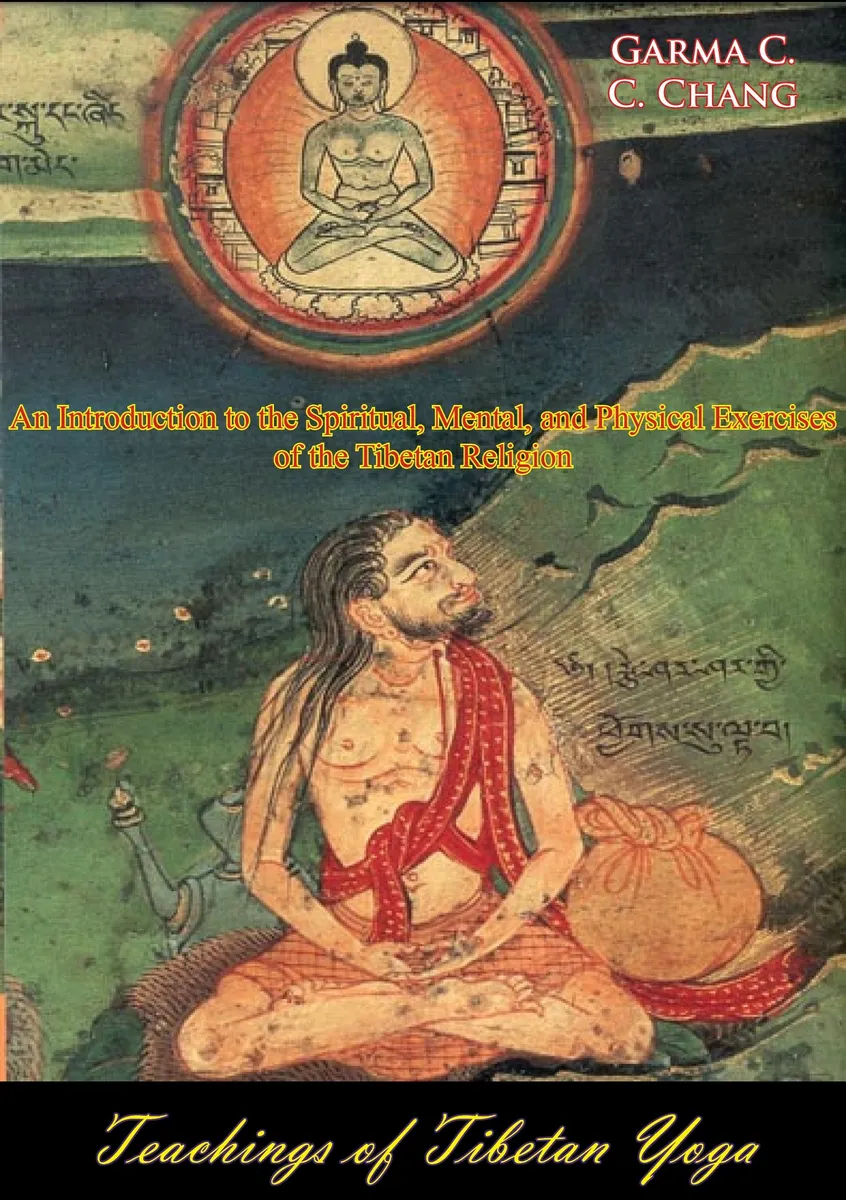
This book is most profitably read, then, not as a scholarly work but as an introduction to a religion by which its author-translator lives.
(Dumo heat yoga as the indispensable foundation of all Tibetan practice)
Most readers, even those who have read a good deal about Yoga, will find the practice of Dumo—the generating of internal heat in one’s body—strange and not at all easy to believe. I want to call to the reader’s attention the fact that this Dumo is the very foundation of the whole of Tibetan Yoga, without which no other part of it makes the slightest sense.
As in the case of Dumo, the retention in the body of male semen has a special meaning in Tantrism, although this idea (and practice) has an age-long history. In ancient Hindu and Chinese medicine, among other archaic medicines, it is believed that orgasm without ejaculation is not only healthful but preserves the semen and leads to long life.
The point is that the Tig Le retention continues to be crucial to Tibetan Tantrism because here the practice is based not on a mistaken physiology but on a mystical technique: in effect, all the life processes are reversed, turned topsy-turvy, taken out of the realm of nature: breathing is stopped as far as possible, thinking stopped, hearing stopped, seeing stopped, and so on—in a word, everything is transformed.
(Tantric reversal: passion-desires as expression of innate buddhas)
“The divinity of Buddhahood is omnipresent, but the quickest way to realize this truth is to discover it within one’s body-mind complex.” By spiritual exercises and the application of Tantric techniques—such as the Six Yogas—one can soon realize that his body, mind, and the “objective world” are all manifestations of the divine Buddha-hood. Samsara is Nirvana, men are “gods,” the “impure” passion-desires are themselves expressions of the Five Innate Buddhas,{1} Enlightenment or Liberation is not attained by eradicating man’s passion-desires but by identifying them with the transcendental Wisdom. The basic doctrine of Tibetan Tantrism can thus be called a doctrine of viewing man’s body-mind complex as corresponding to, if not identical with, that of Buddha. The spirit and practice of all Tantric Yogas are also directed toward the unfoldment of this basic principle.
his aspiration and energy as the Wisdom-Prāna and “Light”…In the Perfecting Yoga practice he is taught first to dissolve all his Energy-Thought{2} in the Innate Light—the Dharmakaya—hitherto concealed “in” the Center of the Heart Cakra, and from it again to project the Body-of-Form (Rupakaya), and thus to animate the infinite acts of Buddhahood.
Each of these dualities, though apparently antithetical, is, in reality, an inseparable unity. If one can understand completely and master one member of the duality, he automatically understands and masters the other. Thus, he who realizes the essence of mind as being Transcendental Wisdom will at the same time realize the essence of prāna as being inexhaustible vitality and the act of Buddhahood.
The translator declines all responsibility for readers who may rashly experiment with these Six Yogas. A mere reading of these texts can never replace a living Guru from whom a serious Bodhi-seeker should first receive initiation and guidance before he can start the actual practice. For serious students, this book can serve no more than as a source of reference, a pointer to the Way.
Ālaya Consciousness—the Store Consciousness which preserves the “seeds” of mental impressions and supports the formation of habit.
Buddhism as the “Primordial,” or “Universal” Consciousness.
2 Arising and Perfecting Yogas—the two main Yoga practices of Tibetan Tantrism. Arising Yoga is the “Yoga of Growth or Creation”; Perfecting Yoga is the “Yoga of Consummation.” See
5 Bindu (lit.: “drop” or “dot”; T.T.: Thig.Le.)—In Tibetan Tantrism, Bindu or Tig Le usually refers to the essence of the vital energy of the body, especially male semen. Tig Le in “Tantric physiology” seems to refer to the secretions of the endocrine system.
14 Dharmakāya—the “Body of Truth” or the “Real” Body of Buddha, which is formless, omnipresent, ultimate, void, and yet all-embracing.
15 Dhyāna—an equivalent of Samādhi which, according to the Buddhist doctrine, denotes a group of pure concentrative states.
16 Dumo (T.T.: gTum.Mo.)—the “mystic fire” produced in the Navel Center through the practice of Heat Yoga.
20 Māyā—the Doctrine that all phenomena and experiences in the manifested universe are illusions or magic plays; that all matter is devoid of self-entity.
21 Nāḍīs—the “psychic nerves” that transmit the vital energies; the mystical “channels” within the Yogic Body.
22 Nirmāṇakāya—the Transformation Body of Buddha, which incarnates in numerous forms in the various worlds.
23 Nirvāṇa—the state of ultimate Liberation.
27 Samādhi—literally meaning “putting together” or “combining with,” i.e., a pure or “transic” concentrative state wherein the mind and the observed object are merged into one.
28 Sambhogakāya—the glorious and divine body of Buddha, manifested in the Pure Land and visible only to enlightened Bodhisattvas.
Staying in the “Unborn” realm All appearance will dissolve Into the Dharmata,{8} all self-will And pride will vanish into nought. The supreme Understanding transcends All this and that. The supreme Action Embraces great resourcefulness Without attachment. The supreme Accomplishment is to realize Immanence without hope.
THE ESSENTIALS OF MAHAMUDRA PRACTICE AS GIVEN by the Venerable Lama Kong Ka
(Mahamudra: non-clinging, looseness, and direct self-awareness)
“He who can rest his mind in pure Self-awareness without distraction will be able to do anything. To practice Mahamudra he should stop discriminating, abandon habitual thoughts of ‘accept this’ and ‘reject that,’ and strive to reach a state where Samadhi and activities become one. Until he has done so, he should stress quiet meditation first, and then as a subsidiary exercise apply his Mahamudra-awareness to his daily activities.”
Equilibrium’ means to balance body, mouth, and mind. The Mahamudra way of balancing the body is to loosen it, of balancing the mouth is to slow down the breathing, and of balancing the mind is not to cling to and rely on anything.
The essence of equilibrium is not to cling. The essence of relaxation is not to hold. The essence of naturalness is to make no effort.”
“None of the above experiences should be treated as perfect and complete, and one should never cling to any of them. Among them, that of Non-distinction is most important and unerring. Some of the Illumination and Blissfulness experienced could be very misleading and even harmful.”
“Sometimes you should purposely stir up desire-passions such as lust, hatred, jealousy, etc.—and then observe them in depth. You should neither follow, relinquish, or correct them but clearly and ‘awaringly’ remain in a loose and natural state. When in deep sleep you should try to merge Awareness with the unconscious without strain. This is the best way to transform the unconscious into ‘light.’
“(3) To utilize apparitions and devils to further Realization: “Whenever any fearful apparition appears, you should employ the Mahamudra meditation on the fears. Do not try to dispel the fear but dwell on it clearly and loosely. In doing so, if the apparition vanishes, you should try once more to conjure up even more frightful apparitions and again apply Mahamudra to them.
“(5) If one only cultivates ‘Blissfulness,’ ‘Illumination,’ and ‘Non-distinction’ without practicing ‘penetrating-observation-into-the-mind,’ it still cannot be considered as the correct Mahamudra practice. “(6) He who develops a dislike to manifestations is most likely to have gone astray.
“(7) He who concentrates on his Awareness and cultivates the illuminating-void Self-mind is said to practice Mahamudra correctly. However, this ‘concentration-effort’ has a tendency to hinder that spontaneity and freedom of spirit, without which it is difficult to unfold the vast and liberating Mind. One should therefore never forget to practice the ‘looseness,’ ‘vastness,’ and ‘spontaneity.’”
Therefore, as long as you can keep your Self-awareness, no matter what you do, you are still practicing Mahamudra.”
(Prerequisites and breath mastery for the six yogas)
To purify worldly clingings and to lay a good foundation for the advanced practice of the Six Yogas, the disciple should first obtain the four complete Initiations of Demchog,{37} and practice the Arising Yoga{38} until he has reached a fairly stabilized stage. To conquer inertia and laziness, he should meditate more on death; to overcome his hindrances, he should pray to the Buddhas and arouse the Bodhi-Mind;
If one can hold the breath without strain for two minutes, he is considered to have fulfilled the minimum requirement for mastering the prānas; for four minutes is average; but if for six minutes or more, that is the highest requirement.