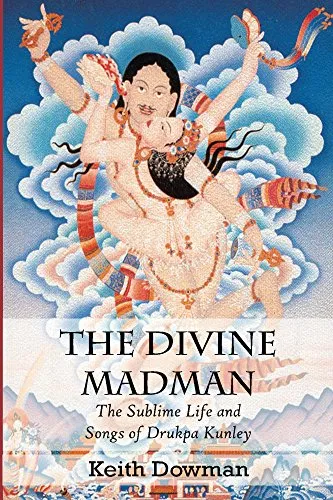
(Drukpa Kunley as awakened buddha and tantric exemplar)
Foreword by Dugu Chogyal Rimpoche The Naljorpa Drukpa Kunley was an awakened Buddha, a Master of Mahamudra and Dzokchen. I am very happy that English readers now have the opportunity to read this full account of a Tibetan mahasiddha’s life. The stories in this biography are not fiction or fable – the events described really happened.
how he renounced the eight worldly preoccupations (praise and blame, loss and gain, pleasure and pain and notoriety and fame); how he gained an understanding of karma; how he met his teacher and took refuge in the Lama; how he practiced his moral precepts, study, and meditation, to gain both relative and absolute compassion; how through the maintenance of his samaya vows and his accomplishment of the two stages of Tantric practice, he brought his body, speech, and mind to full enlightenment.
He works without any discrimination, inhibition or selfish motivation, to give meaning to other people’s lives.
An uncensored account of the Lama’s activity is likely to raise all sorts of doubts and fears in the minds of devotees. Also, it is secret, a mystery, because a Buddha’s existence resolves the paradoxes and dualities of being. The way Drukpa Kunley acts makes us understand how the Three Precepts of the Three Vehicles (Hinayana, Mahayana and Vajrayana) can be combined without any contradiction.
Saraha, after a long tenure at Nalanda University, took an arrow-smith’s daughter (a Dakini) as his consort, and said: Only now am I truly a pure Bhikshu. Drukpa Kunley’s life shows us a liberated mind that is free from the preconceptions, preferences, bias, and mental activity that binds us in tension and fear, and shows us a way of life that frees us from emotional attachments and family ties. He gives us a vision of mad indiscipline and free wandering, and having accomplished the goal of his Dharma in one lifetime, he demonstrates a deceptively simple example and inspiration. His behaviour shows us the result of the practice of Milarepa’s precept: Concerning the way to pursue your inner search, reject all that increases mind-poisons and clinging to self even though it appears good; and, on the contrary, practice all that counteracts the five mind-poisons, and helps other beings, even though it appears to he bad: this is essentially in accord with the Dharma.
Translator’s Introduction
Although we expect an adverse reaction from members of Buddhist schools adhering closely to the Buddha Sakyamuni’s teaching in the ‘First Turning of the Wheel’, we hope that the interest in the tantras this translation excites, the misconceptions that it removes, and the insight and inspiration that it infuses, will vindicate us.
(Renouncing institutions to free the spirit’s divinity)
This tradition produced the mystic poet Saraha (Drukpa Kunley was a reincarnation of Saraha), who sang his apocalyptic songs denigrating pious show, academic scholasticism, empty ritual, and self-righteous morality.
The aim of both Saraha and Drukpa Kunley was to free the human spirit’s divinity from slavery to religious institutions, and moral and ritual conventions, that had originally been designed to support spiritual endeavour. Both these yogins, as exemplars of the uncompromising, ascetic path, believed that total renunciation and detachment, including detachment from religion and its institutions, were necessary conditions for perfect happiness.
However, Drukpa Kunley’s attacks on the establishment are never vicious. He himself was a product of monastic training (though he grew out of the spiritual nursery at an early age), and he must have realized that the monastery provided a unique haven for those with inferior capabilities and those with different propensities in need of a social environment for their spiritual evolution.
(Purifying desire rather than suppressing it)
Emotion, particularly desire, is not to be suppressed; it is to be purified. And then free of selfish motivation, in fulfilment of the samaya (the pledge to sustain Ultimate Awareness), it is to be used to bring dis-illusionment, awareness, and delight, to all beings.
the blissful nature of all phenomena is realized in the union of duality (subject/object, consciousness/sensory stimulus, male/female).
the universal psychosis that occludes the Buddha-nature inherent in us all – and eradicating the fixed notions of who we are and what we should and should not do. The genius of his therapeutic craft lies in spontaneous speech and action that awakens awareness of an authentic existential reality. Outrage and laughter are the skilful means he employs to shock people out of their lethargic acceptance of the neurotic status quo of their minds, and out of their attachment to conventional forms.
Jealousy of one’s chosen method of spiritual evolution functions, initially, like a tin pipe placed over a seedling to protect it from the ravages of sheep or rabbits, but, finally, it becomes necessary for the neophyte to stand alone, free of all social supports and psychic crutches, as the Guru demonstrates. This glorious isolation, in the world but not of it, is one definition of the indefinable Great Perfection (Dzokchen) and the Magnificent Stance (Mahamudra, Chakchen) that outside the schoolroom are synonyms for Drukpa Kunley’s spiritual attainment (see chapeters six to eight).
These imperatives are found embedded in the legends of the Eighty Four Indian Mahasiddhas, in the stories of the plethora of divine crazies who appeared during the flowering of the Tibetan tradition (fourteenth to sixteenth centuries), and even today in Indian villagers’ highest expectations of their Pagala Babas (mad saints). Carefree renunciation, an excess of compassion, total lack of inhibition, skilful use of shock therapy, tears and laughter, are the specific characteristics of the divine madman.
(Demons transformed into guardians through empty awareness)
If insanity is defined as deviation from a psychological norm, the divine madman is truly crazy; but if a spiritual ideal is used as a yardstick, undoubtedly, it is the vast majority of us who are insane.
The different species of demon can best be explained as configurations of various natural, elemental forces affecting the minds of human beings, and inseparable from the fear and instinctual responses that they incite. The seat of these forces may be inside the body or without.
The internal demons that bothered Sakyamuni as he sat under the Bodhi Tree are ‘simple’ demons: the demon ‘fear of death’, for instance, can be located in states of enervation and depression, and recognized in both thought and emotion as well as in habitual reaction patterns.
Drukpa Kunley demonstrated not merely how to destroy demons, but how to transform them into guardians and protectors of the Buddhas’ Truth.
Drukpa Kunley’s stick with a penis head, or by his own penis (Vajra, Dorje), referred to as ‘The Flaming Thunderbolt of Wisdom’. The demon takes refuge in Buddha immediately the Dorje reveals its Empty nature, and, thereafter, so long as the Master occasionally reminds the demon of his continuous intuitive awareness of demonic apparitions’ essential Emptiness, it is tied to his will. What originally were hostile elemental forces, and atavistic fears, can now ferocious masks to frighten interlopers intruding upon the sanctuary of truth, and potent energies capable of performing mundane tasks for the adept – friendly helpers on the path.
The last of Drukpa Kunley’s epithets, Jadral (bya-bral), I have translated freely as ‘Duty-Free’, means that he abides in the free-space of Mahamudra, wherein action is called Non-action: his motion is in such harmony with the universe that it requires no effort or striving; spontaneous and uninhibited, it transcends our concepts of work or activity. Three other titles, often misunderstood, deserve definition.
Prologue
His essential nature was the all-embracing field of Ultimate Reality. Free of passionate impulses, his virtue fully matured, he was a manifest Buddha, constituting in himself an infinitude of perfected qualities. Through his pre-eminently skilful dance of life controlling every situation for the sake of all beings, he demonstrated his knowledge of the identity of samsara and nirvana. Without any equivocation he revealed the magical signs of his accomplishment to the public eye; and due to his unfailing intuition of delusory appearances as a lie, he was free of all hypocrisy and deceit. Through spontaneous execution and carefree enjoyment of whatever it befell him to perform, he created immense space and freedom in his mind; and since he had destroyed all partiality in himself and shared his love equally with all beings, he found himself a homeless renunciate.
Chapter One: How Drukpa Kunley became an Ascetic Wanderer and how he delivered the Lady Sumchokma from the Ocean of Suffering
(The key to all realization: guard the mind)
Through a synthesis of the meaning of all the oral instruction he had received, he discovered the key to all realization: Be aware! Guard the mind!
Unable to love all beings as your sons, What use is solemn prayer and ritual?
If an enlightened perspective is not intuitively grasped, What can be gained by a systematic search?
The sage who refuses to teach or write Is as useless as the jewel in the King Snake’s head; The fool who knows nothing but prattles constantly Merely proclaims his ignorance to all.
By the age of twenty-five, Kunga Legpa had gained mastery of both mundane and spiritual arts. He was accomplished in the arts of prescience, shape-shifting, and magical display. Returning home to visit his mother in Ralung, she failed to recognize his achievement and judged him merely by his outward behaviour.
That night Kunley went to his mother’s bed carrying his blanket. ‘What do you want?’ asked his mother. ‘This morning you said you’d perform a wife’s duties, didn’t you?’ he replied. ‘You shameless creature!’ responded his mother. ‘I said I’d do her housework. Now don’t be so stupid. Go back to your own bed.’
Early next morning he went down to the market place and shouted aloud, ‘Hey listen, you people! If you persist, you can seduce even your own mother!’ When the whole crowd was aghast, he left. But by exposing the hidden foibles of his mother, her faults were eradicated, her sins expiated and her troubles and afflictions removed. She went on to live to the ripe old age of one hundred and thirty-years.
(Drukpa Kunley’s wild compassion in the marketplace)
‘Listen to me, all you people!’ shouted the Lama. ‘I am Drukpa Kunley of Ralung, and I have come here today, without prejudice, to help you all. Where can I find the best chung and the most beautiful women? Tell me!’
‘This madman says he’s come here for the sake of all beings and then asks where he can find alcohol and women! What kind of piety is that? He should be asking who is the greatest Lama, what is the name of the most desirable monastery, and where is religion flourishing most strongly. But he has no such questions. Most likely he’s the type of religious freak who binds girls to the Wheel of Truth rather than demons!’
‘Oh, you mad dog! Sit down and keep quiet!’ Kunley shouted in reply. ‘You want to know my origin and birth? You want to know my spiritual lineage? Listen then, and I will tell you.’
In particular, the girl called Sumchok interests me. How old is she?’ ‘She’s fifteen,’ replied the Kongpo woman. ‘Then I must go there quickly before it’s too late’, said the Lama. ‘Stay well all of you! I must go and find Sumchok!’
‘I am looking for a fifteen year old girl,’ the Lama told them. ‘She has a fair complexion and soft, silky, warm flesh, a tight, foxy and comfortable pussy, and a round smiling face; she is beautiful to behold, sweet to smell, and she has a sharp intuition. In fact she has all the signs of a Dakini.’ ‘Are we not Dakinis?’ asked the girls. ‘I doubt it,’ replied the Lama. ‘You don’t appear to be. But there are many types of Dakini.’
‘You are a rather different kind,’ replied the Lama. ‘What type?’ they insisted. ‘You are greedy but poor, and sexually frustrated but friendless. Even if you do find some idiot to couple with you, no one will gain anything from it.’ The girls were deeply offended by the Lama’s words, and went on their way sulking.
Henceforth, the Lama carried a bow and arrow –representing Penetrating Insight and Skilful Means – to slay the Ten Enemies of the Ten Directions; and he led a hunting dog to hunt and kill the habit of dualistic thinking.
‘In the garden of heavenly delight, Thick with blooms of various hues, The flower that radiates bright scarlet light Harbours the honey sucked by the bee. Surely Drought and Hail are jealous! Say they are free from envy and jealousy And let me make an offering to the Three Jewels.
Full moon beggar, listen to me! Your ashen body hides a Buddha’s heart And your naked body radiates glorious effulgence; A small shield of patience is slung on your back And you carry bow and arrow as Insight and Means; You lead a dog to hunt confusing emotion And you control the Three Realms with your ascetic yoga. You are either a shape-shifting demon Or an adept with miraculous powers– You seem too good to be true!
Kunley and Sumchok, singing their songs back and forth to each other, were overheard by Ox-Head.
This was like refreshing rain in the desert to the ear of the chieftain. ‘If that is so, prepare provisions for a seven days for myself and thirty servants,’ he ordered. Sumchok obeyed him instantly. After he had departed, the girl invited the Lama into the parlour and began to prepare tea.
‘O Sumchok, now serve me your tea!’ said the Lama when he had done. She brought him tea, the first straining of chung, together with meat and tsampa, and everything that his heart desired. Finally, he got up to leave, ‘It is best if you stay here, Sumchok,’ he said. ‘I must go now.’ Sumchok, with undivided faith, prostrated before him. ‘Don’t leave this unfortunate girl in this mess. Take me with you,’ she begged. ‘I have no time to waste with you,’ he told her. ‘I will remember you and return to you again.’
‘If you’re afraid, go into the cavern, and I’ll seal up the entrance,’ he advised her. So leaving her inside, he built a wall across the cave mouth. At his departure Sumchok sang this song:
(Songs of teaching and the theatre of shock)
Chapter Two: How Drukpa Kunley visited Samye and Lhasa for the Sake of All Beings
Through his craziness taming the perverse and faithless, Guiding them to spiritual freedom through every sensation.
An unending string of dry words Satisfies the ambition of scholars; False meditation in a fool’s paradise Satisfies the minds of uninstructed Gomchens; Knocking on doors and the barking of dogs
The prattle of harmless drunkards Satisfies spineless young men;
Worldly attachment and ambition are the bane of every Lama Destroy them by meditating upon the purity of all phenomena. Disciples who keep several women Are a drain on the Lama’s wealth – Avoid it by placing their quarters apart.
Errantly failing asleep in assembly Augers rebirth as a beast – Avert it by sweeping out laziness.
Loaning money for profit Is a danger to monks following the Teaching – Avert it by tempering needs, content in simple experience. Preaching the Law with pride and vanity
‘but it is actually teaching upon non-attachment to whatever arises in the stream of consciousness.’ And they took refuge in him. Those who folded their hands in reverence were filled with faith.
‘Let’s see if your spear of ignorance is as powerful as my spear of Empty and Pure Awareness!’ said the Lama. And he grabbed the head of the spear that was thrust at him, pulling it like elastic and tying a knot in it. ‘You must be a ghost or a demon or a great adept,’ said the frightened leader. ‘Tell us who you are.’ ‘I’m whoever you think I am,’ replied Kunley. ‘It makes no difference to me.’
Many people gathered together in curiosity. ‘Rather than stand around in idle curiosity watching my magic tricks and listening to my insane raving, it would be better for you to recite the mani peme Mantra,’ he said, and began to perform the Mani Dance called Exhortation to Continuous Awareness of Impermanence, singing this song:
‘Ho! Listen to me you men and gods! All those who have achieved a human body And can say, ‘I always keep my next death in mind’, They will find the Sacred Path of Buddhas, And he who can say, ‘The Sacred Teaching has manifest’, He can turn and revere Samsara.
We should take refuge in the Great Compassionate One And recite his Six Syllable Mantra: Om mani peme hung!’
Then he took off his finery and returned it to the Chieftain, who, however, insisted that he should keep it. ‘You can’t take it with you!’ said the Lama. ‘A moment of enjoyment is sufficient. Listen to my song!’ ‘Bathe us in bliss-waves, Father Kahgyu Lama! Gold, silver and jewels are illusory happiness,
And seeing it snatched away by others is seemingly sad – Take refuge in the one who is infinitely generous! Attaining the goal of one’s life is illusory happiness
To give freely is generosity; To be free from avarice is wealth.
‘I will dance now,’ said the Lama, ‘and you must follow my movements!’ and he sang this: ‘In the cleansing, cleansing spring, Sword sways, sways to and fro, Rocks rub, rub together, Head rises, rises proudly, Now tightly grasp it, grasp it tightly!’ ‘We don’t mix with people like you!’ said the girls. ‘Yah! Yah!’ replied the Lama. ‘If we don’t get along there’s no point in my staying!’ And he continued on his way to Palzang Buti’s house.
‘Yes, I’m Palzang Buti. Come inside.’ She felt him to be an old friend from a previous life and accepted him without constraint. Before serving him tea they made love. Afterwards she begged him to stay with her for ever, but he promised her only a few months.
Drukpa Kunley told Palzang Buti. ‘I must see if his mind is free of lust and anger.’
‘Stay still! Don’t be afraid!’ the Lama commanded, and he asked Pebdak to bring a black lasso that he had seen hanging upon a pillar. He put the noose round the child’s neck as it lay in its mother’s lap and said, ‘If you don’t lick my cock today, my name isn’t Drukpa Kunley! Now down to the river!’ Dragging the child behind him with the lasso, followed by the parents wailing, swallowing dust, chewing stones, and tearing their hair, he reached the river bank. ‘If
you dare to return here again, you’ll get this same treatment,’ said the Lama holding the child at arm’s length by the neck and then hurling him into the centre of the swirling stream. Suddenly the child’s corpse was seen to change into a black dog with a gaping red mouth that snarled, ‘You’ve no compassion, Drukpa Kunley!’ as it swam to the opposite bank. ‘That was your son!’ he told the parents, and gaining complete faith in the Lama, they returned to their house blameless and free from fear.
Chapter Three: How Drukpa Kunley visited Taklung, Yalpachen, and Sakya, to give Meaning to the Lives to the People