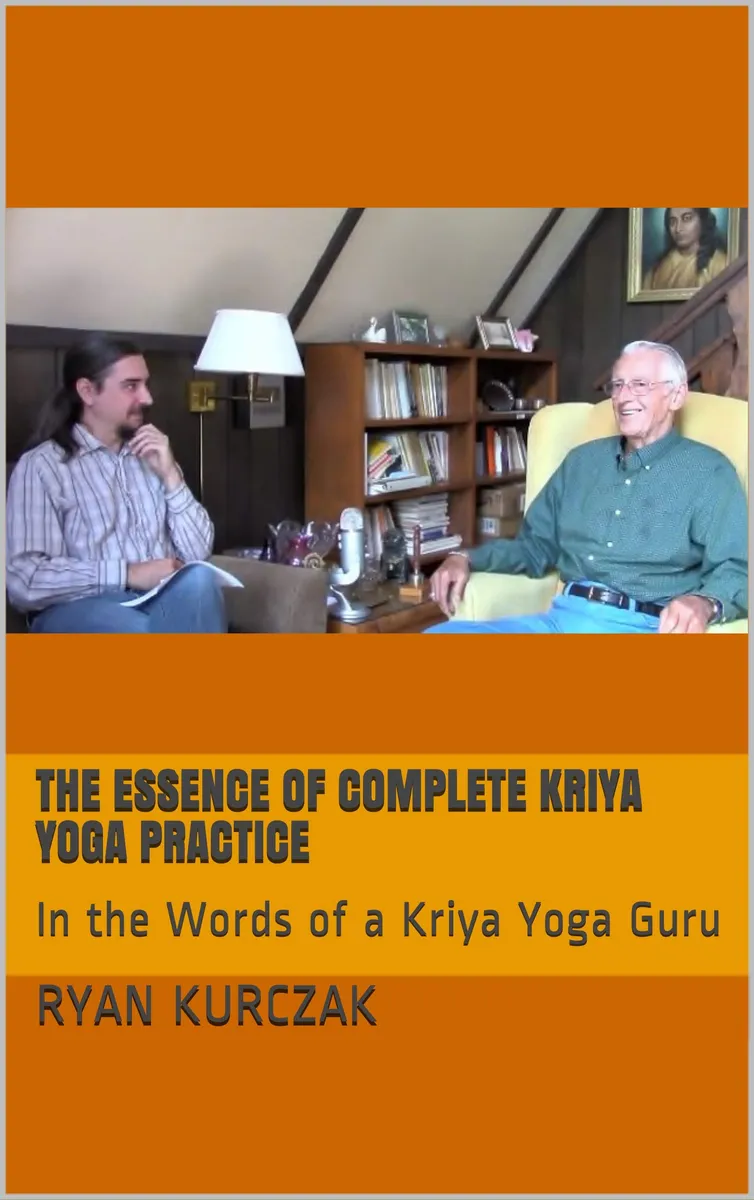
(The living presence of a realized teacher)
RD: Whenever I was with him, I felt a sense of omnipresence. I was aware of omnipresence and a deep inner strength, a spiritual power. Although outwardly his demeanor and relationship with people on a private basis was very quiet and very reserved, you could feel that presence of his consciousness. You’d just feel it.
Kriya simply means action or process. And yoga, the precise definition is bringing together of attention and awareness with our essence of being. Sometimes, simplistically, you read definitions of yoga as union with God and so forth, but really the definition is very similar to that of the word samadhi, bringing together the attention and awareness with our essence of being. The result is realization, direct experience and knowledge of what we are. That is a culmination of right yogic practice.
One aspect is Absolute or pure and without characteristics or attributes. It just is. It is just pure existence, pure being. Has always been and always will be what it is. But there’s an aspect of that Reality which has characteristics, energetic influences, and in Sanskrit, they are called gunas which mean threads. And these vibrations, really threads of vibrations, produce universes.
Yoga is really the result of the nirodha or the turning back and quieting of the vrittis, the fluctuations and movements in mind and awareness. Chitta is the field of awareness in which there is mind, sense of I-ness or ego-awareness, intellect, and ourselves as the observer. But when the waves of the mind or the wavelike movements in mind and awareness are stopped and we remain conscious, then our awareness is clear, and we have an opportunity to experience our true nature as it is. So, the third sutra simply was written: “Then the seer, the observer, the experiencer abides in itself.” That is, when you get the debris out of the way and the mind is clear and the emotions are settled and awareness is clear, there is only Self-awareness, Self-knowing, Self-experience. And then the next sutra: “Otherwise, attention and awareness are inclined to again identify with external conditions.”
But it’s important to progress beyond that and get to the place where we are always inwardly aware of our true nature when we are not meditating. So, we don’t have to be reclusive or off in a monastery or hidden off in a cave someplace in the woods to be successful on our spiritual awakening path.
The word samadhi, if you go to the prefix sam, means together. Yoga means unification. So, both yoga and samadhi refer to unification of attention and awareness with our essence of being, or Self-realization.
(Renunciation as immediate choice, not prolonged struggle)
For instance, we can renounce guilt and regret and envy and jealousy and egotism, an inflated sense of self-importance. We can renounce all of that stuff by just seeing how foolish it is to hold on to it. No one is making us hold on to it. We’re holding on to it ourselves. We choose to hold on to it. So, you say, “Well, I don’t want that anymore,” and you just let it go. You don’t have to struggle to overcome. You don’t have to spend weeks and months in recovery in various therapies. All you have to do is just dump it. Get rid of it. You don’t need it. Some will say, “Oh, well, that’s just easier said than done.” Well, that’s because they don’t want to do it. They just want to hold on to it for some reason or another.
And if we have some habits that are debilitating, such as procrastination (not doing what we know we should do on time and in the right way), we can let that go. We can stop procrastinating. And if we tend to run ourselves down mentally or verbally with self-talk or verbal conversation and diminish ourselves and say, “I’m no good. I’m helpless. And I’ve made a lot of mistakes. And no one loves me. And God doesn’t love me,” and so forth, stop that talk. Stop that self/mental talk and certainly stop that audible talk. Don’t ever say anything like that.
Patanjali wrote in the first chapter that there is this… we call it, in Western metaphysical terminology, the oversoul or the cosmic soul. Patanjali used the Sanskrit word Ishvara, meaning the ruler or regulator of the cosmos.
And go beyond that to the Absolute or the pure stage or aspect of ultimate Reality, which is experience of transcendence (what yogis call kaivalya, the Great Aloneness).
“Well, what if I experience transcendence and don’t come back?” Well, that’s not gonna happen. “But I want to be me.” Well, again, that’s the problem, isn’t it? “I want to be the little me.”
He owned two insurance companies and was invested in other projects. But he said that, until he met Yogananda, he was not completely happy and he was nervous all the time—literally fidgety. But after he met Yogananda, he learned how to eat right and think right and practice yoga and meditate, and his life changed. The inner life changed. He still continued to be very successful in business because he enjoyed business and he was good at it. But he was really a yogi, and he spent early morning hours and evening hours in deep meditation.
was a combination of what Yogananda referred to as “Western practicality and Eastern spirituality.”
possibility. Consequently, all of my early life, I was highly resolved, and I purposefully did not talk about my spiritual aspirations with anyone. Even when I was at the Self-Realization Fellowship, I didn’t talk with the other fellows about my spiritual aspirations. I didn’t discuss my inner experiences.
You see, the subconscious level of your mind doesn’t know the difference between the memory that is the result of imagination and actual experience. It doesn’t know the difference. Subconscious mind doesn’t discern. It simply records impressions of perceptions.
(Meditation, samskaras, and the path to superconsciousness)
Basic Meditation Procedures Meditation clears the mind of conditioning and elevates awareness above the influence of samskaras (mental impressions with the potential to influence experiences). Samskaras are like impurities in glass. The more impurities in our consciousness, the harder it is to understand the world and our relationship to it correctly. Kriya Yoga practice is concerned with understanding higher realities to the same degree that it is concerned with living effectively in our current incarnation. When meditation is practiced intelligently, we gain understanding of higher realities and can relate better to the situations around us.
Consistently practice the techniques until you can be superconscious. We know we are superconscious when we are no longer unduly disturbed by thoughts or distractions. We can sit quietly and calmly, yet alert and awake, when in a superconscious state.
When the inhalation is complete, the pranic current will be in the crown chakra. Hold your breath for a second, and then exhale easily and without force while noting the descending flow of the current. Let the breath exhale of its own accord. Do not force the breath out. Let the energetic current flow back down your spine like water.