(The last words of Thrice-Great Hermes)
THE LAST WORDS OF THRICE-GREAT HERMES ‘Wise words, although written by my decaying hand, remain imperishable through time; Imbued with the medicine of immortality by the All-Master. Be unseen and undiscovered by all those who will come and go, wandering the wastelands of life. Be hidden, until an older heaven births human beings who are worthy of your wisdom.’
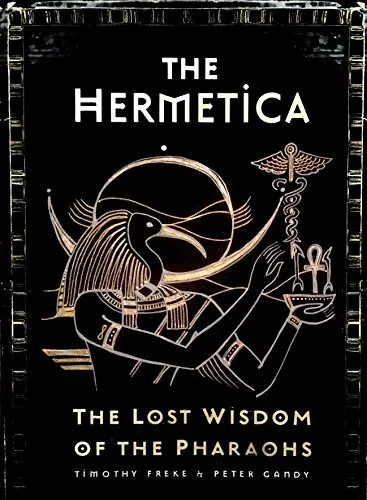
The Hermetica is a collection of writings attributed to Thoth — a mythical ancient Egyptian sage whose wisdom is said to have transformed him into a god. Thoth, who was venerated in Egypt from at least 3000 BCE, is credited with the invention of sacred hieroglyphic writing, and his figure, portrayed as a scribe with the head of an ibis, can be seen in many temples and tombs. He is the dispatcher of divine messages and recorder of all human deeds.
To distinguish the Egyptian Hermes from their own, they gave him the title ‘Trismegistus’, meaning ‘Thrice-Great’, to honour his sublime wisdom. The books attributed to him became collectively known as the ‘Hermetica’.
The list of people who have acknowledged a debt to the Hermetica reads like a ‘Who’s Who’ of the greatest philosophers, scientists and artists that the West has produced — Leonardo da Vinci, Durer, Botticelli, Roger Bacon, Paracelsus, Thomas More, William Blake, Kepler, Copernicus, Isaac Newton, Sir Walter Raleigh, Milton, Ben Johnson, Daniel Defoe, Shelley and his wife Mary, Victor Hugo and Carl Jung. It heavily influenced Shakespeare, John Donne, John Dee and all the poet-philosophers who surrounded the court of Queen Elizabeth I, as well as the founding scientists of the Royal Society in London, and even the leaders who inspired the Protestant Reformation in Europe.
(Alexandria, the Medici, and the lineage of the Hermetica)
The Alexandrians were renowned for their thirst for knowledge, and under the enlightened Greek ruler Ptolemy I a library and museum were founded where human beings first systematically collected the wisdom of the world. At its height, the library of Alexandria housed some half a million scrolls.
In 415 CE, Hypatia, one of the last great scientists and Pagan philosophers working at the library of Alexandria, was seized by a mob of Christians, who removed her flesh with scallop shells and burnt her remains.
Another unorthodox group within the Islamic empire who also traced their ancestry back to Thrice-Great Hermes were the poets and mystics known as the Sufis.
The ruler of Florence, the philanthropist and scholar Cosimo de’ Medici, established a New Platonic Academy — a group of intellectuals and mystics who found their inspiration in the ancient Pagan philosophy. It profoundly influenced great names like Leonardo da Vinci, Michelangelo, Botticelli and Raphael, who began painting pictures of the ancient Pagan gods.
The Florentines, already reeling from the discovery that an ancient civilisation of immense sophistication had risen and fallen nearly 2000 years before them, now believed they had in their hands the words of the most ancient sage of them all. Cosimo ordered his young Greek scholar Marsilio Ficino to cease his work on translating Plato and to begin immediately on this new Egyptian text. Ficino had it ready in time to read to Cosimo just before his death.
To help us do this, Hermes narrates a dramatic story of how God creates and maintains the cosmos. It is through appreciating the awesome beauty of the cosmos and understanding the fundamental laws by which it functions, that we can come to know the Mind of God.
In the ancient Egyptian language the sound of a word had a magical power which complemented its meaning — a view of language which we unconsciously retain when we talk of ‘spelling’ a word. Translation inevitably means that we have lost this original power and clarity.
Pure philosophy has been replaced by the teachings of clever intellectuals with no mystical understanding of life. People have ceased to see the universe as a source of wonder, and no longer revere it as the work of God. Spirituality has come to be dismissed by science as primitive superstition.
(Dual nature: immortal mind enclosed in mortal body)
Human beings are the meeting place of spirit and matter. We have, therefore, a dual nature. We are Mind enclosed by a physical body. The human mind is an image of God’s Mind — it is immortal, eternal, divine and free. The human body, on the other hand, is mortal and controlled by the laws of Destiny which are governed by the stars.
KNOWLEDGE OF ATUM To know Atum you must share his identity — for only like can truly know like. Leave behind the material world, and imagine yourself immeasurably expansive. Rise out of time to eternity. Believe that for you nothing is impossible.
Those that bathe themselves in Mind find True Knowledge and become complete. Yet, they are not pleasing to the mass of men. They are thought mad and laughed at.
The inexorable working of destiny, imposed on man by the turning of the Zodiac, subjects all human beings to the pain of birth and death. Man’s problem is that in his ignorance he believes himself to be just a body, one that will grow old, suffer and eventually die. His sense of injustice at the inevitability of this fate leads him to hurt himself and others, either through lust for more life or fear of approaching death.
Rebirth is the Knowledge of our own immortality.
(Rebirth as knowledge and the road to becoming all-mind)
It is a hard road to follow whilst incarnate in a physical body, because we must struggle to master ourselves. Right understanding purifies us of all the vices that torment us and awakens our immortal soul. One who is thus reborn communes with God. But this only happens when we stop talking about it and allow it to occur naturally in the silence and tranquillity of deep contemplation. An enlightened being no longer believes he is a body. The body belongs to Nature, not to him, and so its fate is of no importance. He is One with everything. He sees Goodness everywhere. He is bathed in divine Light. He has become All-Mind.
For a man with vision, all things are good, even if other people see them as evil. His knowledge of God gives him the ability to see Goodness at work even when he is mistreated by others. Those who are reborn are already living in the kingdom of heaven.
But by Atum’s mercy, they may all depart and be replaced by understanding. This is the nature of rebirth. This is the only road to reality.
The one seeking to unite and the other seeking to divide. He who is reborn communes with the All-Father who is Light and Life.
He who knows the beauty of Primal Goodness perceives nothing else. He doesn’t listen to anything. He cannot move his body at all. He forgets all physical sensations and is still, while the beauty of Goodness bathes his mind in Light and draws his soul out of his body — making him One with eternal Being.
A man may only seek to know Atum by controlling his passions and letting Destiny deal as she wills with his body, which is no more than clay that belongs to Nature and not to him. He should not attempt to improve his life by magic or oppose his fate using force, but allow Necessity to follow its course.
For the man of vision, all things are good, even if they appear evil to others. When men devise mischief against him, he sees it in the light of his knowledge of Atum, and he — and only he — transforms evil into Goodness.
God is like a musician who creates the harmonies of the Cosmos and gives each individual his own particular theme to play. If the music of life seems discordant to us, we should not blame the Master Musician, but ourselves. We are the out-of-tune instrument which mars the beauty of his composition. Hermes reflects that when we devote ourselves to the spiritual path, we mysteriously become perfectly tuned. Hermes is aware of his own personal weaknesses, but God still makes him a perfect vehicle for his divine will, and can do the same for us if we are prepared to let him.
which if gazed upon with the eyes of your heart will lead you to the upward path. The vision itself will be your guide, for it has this power, peculiar to itself, that it takes possession of those who have seen it and draws them out,
just as a magnet draws iron from the black earth.
Speed towards this Knowledge, for although it is hard to let go of the familiar and return to the old home from which we originated, Atum’s grace never fails and there is no end to his bounty.
I confess my weaknesses, but by Atum’s power my music is made good, and he will likewise make your music perfect.
(Hymn to the One who gives everything and lacks nothing)
He abandons himself in ecstatic rapture to a personal experience of God. He sings the praises of God who is One and All; who loves us like a Father and is the Mother of everything; the eternal constancy which causes the whole universe to change; the Goodness all around us. We can only thank God for his many blessings by learning to know his greatness.
He is no longer a body. He is All-Mind. He is the presence which is present everywhere in everything. He knows the One.
What offering can I bring you? For you are all things. You give everything and receive nothing. There is nothing that you lack. For what shall I praise you? For the things you manifest, or the things you conceal? How shall I sing to you? Am I my own? Have I anything which is mine? Am I other than you? You are all that I am. You are all that I do. You are all that I say. You are all that happens. You are all that has not occurred. You are Mind in your thinking. You are Father in your creating. You are Atum who does everything. You are Primal Goodness everywhere. You have revealed your Being, and I am overcome.
I have found the source of the power of all powers that has no beginning. I see a fountain bubbling with Life. I am Mind! I have seen! I have found that which I seek. I know peace in your purpose. By your will, I am born again. Language is inadequate. The gods sing a hymn of silence, and I am silently singing.