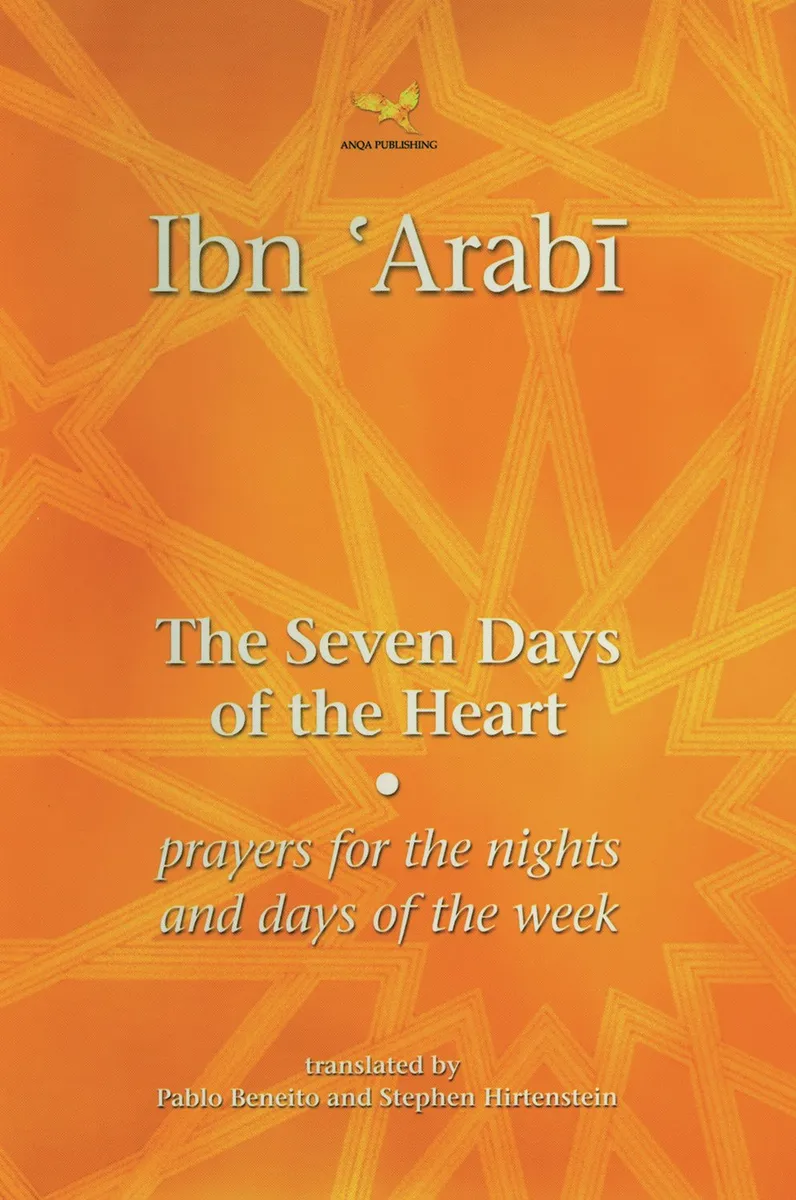
Introduction The Prayers of Ibn ʿArabī
(Ibn Arabi’s prayers as a window into Sufi practice)
He views the world according to a fundamental harmony, in which all things are intricately interconnected and the human being is given a place of immeasurable dignity.
Striking to the heart of essential human questions, they illuminate and challenge our view of mankind and the world.
Despite this growing interest in his works, the many prayers that are attributed to Ibn ʿArabī remain little-known. By virtue of their intimate nature, they provide a precious glimpse into the real practice of the spiritual life in the Sufi tradition. Their rich devotional content makes a striking contrast to his prose and poetry. This is the first time that some of these prayers have been published in English, although they have had wide circulation in the Arabic original.
There are fourteen prayers, each one devoted to a particular night or day of the week. The term wird (pl. awrād) is difficult to translate into English: the Arabic root carries connotations of arriving, reaching, appearing or being received.
These are supererogatory acts, in addition to the five prayers prescribed for the Muslim community.
Unlike the above, Ibn ʿArabī’s ‘Prayers for the Week’ are neither devotional in any ordinary sense, nor do they appear to be intended as prayers for communal recitation. On the contrary, they seem to be more private and intimate affairs, where the requests imply a high degree of understanding and self-knowledge. In reading them, one is immediately struck by the precision and depth of their formulation, which is consecrated primarily to the clarification and celebration of Union (tawḥīd).
They are founded upon the detailed exposition of spiritual Union, expressing the most intimate of converse with the Divine Beloved, and situating the one who prays as the true adorer. Here the reciter and the one recited to are understood to be two sides of the same reality. What is recited is that which ‘arrives in the heart’ (wārid) and is ‘received’ by the adorer, on the one hand, and the request that reaches the Real (al-ḥaqq) and is responded to, on the other. For the one who reads them, these prayers are as much educational as devotional.
Here the reciter and the one recited to are understood to be two sides of the same reality. What is recited is that which ‘arrives in the heart’ (wārid) and is ‘received’ by the adorer, on the one hand, and the request that reaches the Real (al-ḥaqq) and is responded to, on the other. For the one who reads them, these prayers are as much educational as devotional.
The Divine Work: request and response Whosoever is in the heavens and the earth is in request of Him; every day He is at work.
For Ibn ʿArabī, this Quranic verse expresses a central issue of existence. At every moment each being, from the greatest galaxy to the smallest particle, is requesting and receiving its nourishment, physically and spiritually.
Ultimately in reality, according to Ibn ʿArabī, it is always God Himself who is being asked for, since there is no other than He. However, from a limited point of view this quickly becomes obscured by the innumerable forms of manifestation. Hence there are different degrees of knowledge in the asking.
(Prayer as theophanic conversation between the two sides of one reality)
The Awrād of Ibn ʿArabī are a most wonderful example of the possibility of theophanic prayer. Underlying the specific requests, there is a primary aim: to see things as they are from the perspective of the Real.
but consciously acknowledging the Presence of God, opening up to the full force of the Divine Revelation and savouring its manifold ‘tastes’.
We have chosen to call these prayers ‘The Seven Days of the Heart’ to emphasise the intimacy of this relationship. They are a dialogue with the Unseen, a private communion where only one side of the discourse can be visible.
(The heart as the mirror capable of turning toward the divine)
This is a re-turning to Reality, a ‘conversion’ (tawba) that requires constant reiteration. All spiritual traditions emphasise that this is not to be achieved through the normal intellectual processes but only in the deepest centre of the self, referred to as the heart (qalb). It is the heart which is capable of acting as a mirror to the Divine revelation, ‘turning’ or ‘being turned’ (taqallub, from the same root as qalb) according to the way He makes Himself known.
The capacity of the heart to ‘see’ is precisely what transforms prayer from a repetitive act into meaningful conversation.
Real prayer takes place in this isthmus between the visible and invisible worlds.
To enter into converse with God is to step from apparent absence into His Presence. This renders the absent One (‘He’) into the One present (‘You’), so that He may be addressed.
Nonetheless, within the ultimate mystery of Union, the ‘You’ who listens is not other than the ‘I’ who speaks. God is thus simultaneously present and absent, I/You and He. As Ibn ʿArabī says in speaking of the Divine Names and Attributes: ‘… and amongst them are the personal pronouns of the first, second and third persons.’
‘He’ (in Arabic Hū), the third person singular, denotes ‘the Unseen which cannot be contemplated. He is neither manifest nor a place of manifestation, but He is the Sought which the tongue seeks to elucidate.’ It refers directly to the Essence Itself, without in any way qualifying It, even as unqualifiable.
Although indicated as ‘unseen’ or ‘absent’, this He-ness or Ipseity (huwiyya) runs through everything: ‘Nothing becomes manifest in the adorer and the adored except His Ipseity … He alone adores and is adored.’ Many formulations in the Awrād are based upon this recognition. For example: ‘O You, who is the Unlimited ‘He’, while I am the limited ‘He’! O ‘He’, apart from whom there is no other!’
(The seven-day cycle as a sacred map of all being)
The structure of the Awrād At first sight it might seem as if the prayers have been arranged somewhat simply: fourteen prayers, one for each night and day of the week. Is there perhaps a deeper structure? While there is no explicit explanation as to why the individual prayers have been set out in this way, we can find many clues in other parts of Ibn ʿArabī’s work which enable us to discern a most remarkable underlying pattern. First of all, Ibn ʿArabī considers the weekly cycle as sacred. It is a Divine Sign, which points to the reality of Being. The seven days and nights express aspects of Being or spiritual realities, which, when taken together, form a complete whole and encompass all of existence.
We may also view 14 as a doubling of 7: this recalls the 7 verses of the Fātiḥa (the opening chapter of the Quran) which are known as the ‘seven repeated’ (sabʿ mathānī), or the seven heavens and seven earths of Islamic cosmology, which include all the worlds of manifestation from the highest to the lowest.
The spiritual dimension of the physical order is shown in the tradition of Muhammad’s night-journey (isrāʾ) or heavenly ascension (miʿrāj): when he ascended through the seven heavens, he passed through each sphere and there met the prophet appropriate to it.
In the Judaic and Islamic traditions each day begins not at sunrise but at sunset. The precedence of the night is already attested in the fifth verse of Genesis, when the first ‘day’ of creation is being described: ‘And God called the light Day and the darkness He called Night: and the evening and the morning were the first day.’
Above all else they are prayers, whether they be understood in the sense of acts of devotion that can be performed before or after other actions, or seen as the unceasing prayer of the heart in contemplation. They appear as the natural expression of a heart completely given up to God. They explicitly and implicitly refer to the true reality of Man, created in the Divine Likeness, who recognises his Origin and acts in total conscious conformity to his Lord, thus realising pure servanthood.
How am I to aspire to You when You are behind every aspiration? How am I to seek You when seeking [itself] signifies being distanced? Can One who is ever-close, ever-present, be sought? Can One for whom aspiration implies being lost and confused be aspired to? Seeking does not reach You; aspiring does not apply to You.
The relation between the One and the two is beautifully described in the following passage: ‘The utmost purpose of the servant is that he praises his own Self which he beholds in the [Divine] Mirror, since there is no aptitude for the originated to bear the Pre-Existent.’ (Fut.I:112, translated in Praise, p.86.)
Tuesday Morning Prayer IN THE NAME OF GOD, THE ALL-COMPASSIONATE AND MOST MERCIFUL
O my Lord, immerse me in the fathomless ocean of Your Uniqueness and in the open waters of the sea of Your Oneness, and fortify me with the sovereign power and authority of Your Singularity. Thus may I emerge into the vast expanse of Your Compassion, with my face illuminated by the lightning-flashes of Closeness, which are among the marks of Your Compassion.
The Quranic citations (Q.) are based on Arthur Arberry’s translation, The Koran Interpreted, Oxford, 1964.
Burckhardt, Titus, Mystical Astrology according to Ibn ʿArabi, Aldsworth, Glos., 1977.
The Self-Disclosure of God: Principles of Ibn al-ʿArabī’s Cosmology, Albany, NY, 1998. Chodkiewicz, Michel, An Ocean without Shore, Albany, NY, 1993.