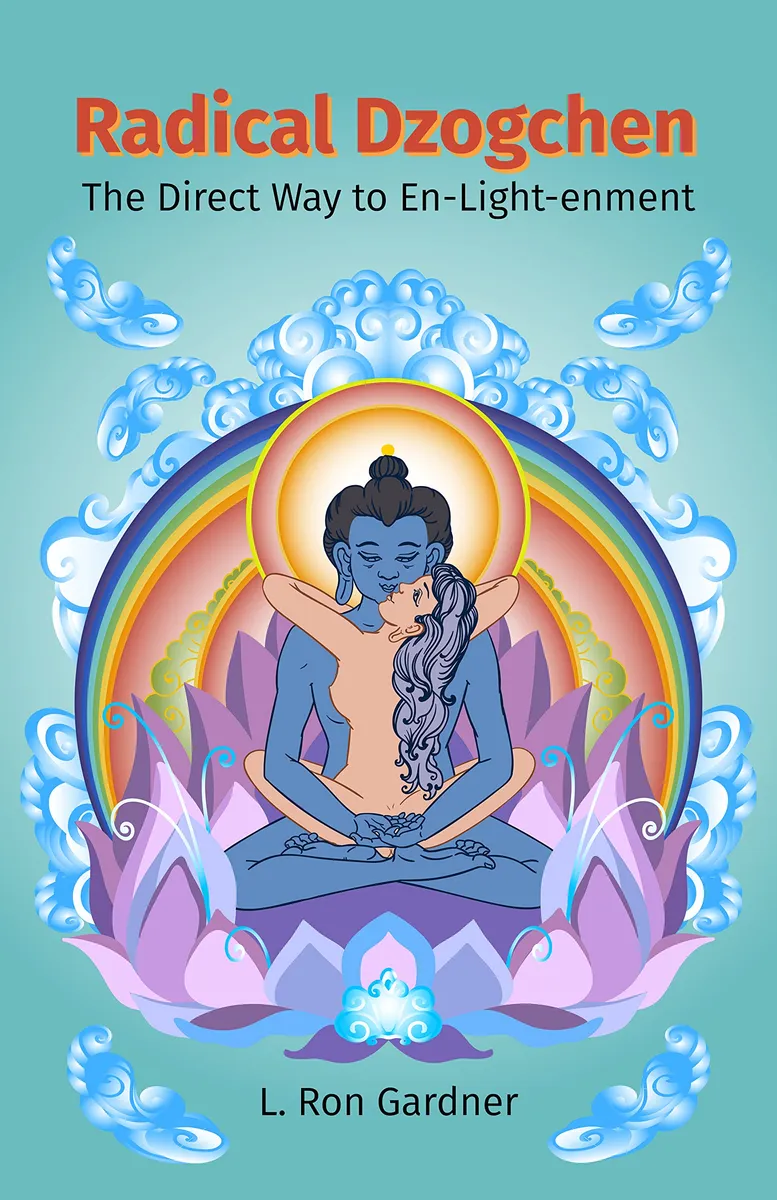
When a yogi is directly and immediately present, the pressure of his (consciously “plugged-in”) presence generates a force that wants to move. When this force is experienced in its “higher” form as descending (or “crashing-down”) Energy, then he has awakened to the Sambhogakaya in the form of Divine Power, or Clear-Light Energy.
wherein the yogi, applying his conscious presence like a diamond-cutter, attempts to cut through spiritual materialism (meaning all that is not Spirit) to get to the “Other Side,” which is Spirit, the Sambhogakaya. Togal is the “conductivity” aspect of rigpa, wherein the yogi, who is connected to Spirit, channels, or conducts, its radiant Light-Energy current.
Anything that isn’t Spirit, meaning anything that is created, becomes “spiritual materialism” when one’s consciousness, through grasping, becomes bound by it. Whether the object (of one’s attention) is “gross” (meaning physically present) or “subtle” (meaning a mind form),
The Bible says the same thing when God enjoins us to “put no idols before Me.” In other words, any object that “steals” our attention from the Divine becomes a “false idol.” Trekcho is the spiritual practice of breaking through, or free, of these “false idols” (meaning objects of fascination, distraction, and consolation) to get to the “Other Side,” the Sambhogakaya.
The Sambhogakaya is the Dharmakaya, the Divine, in its dimension as Clear-Light Energy, or Spirit-Power. It is the Dharmakaya in its objectified form as perceivable, receivable Radiance. But in order to realize the Dharmakaya in its fullness, as the Trikaya, one must unite one’s consciousness (or citta, or “soul”) with the Sambhogakaya, which is the same Body, or Hypostasis, as Hindu Shakti and the Christian Holy Spirit.
To do this, the yogi must transform his consciousness into a “cutting tool” that penetrates through spiritual materialism. And he does this by assuming and maintaining the asana, or “position,” of direct, immediate presence. Direct, immediate presence is a synonym for rigpa; hence trekcho is simply rigpa applied as a cutting tool.
One way to understand it is as awareness-oneness. In other words, the yogi isn’t just aware, he’s also plugged in to the abstract whole, at-one with existence. Think of it this way: Awareness is like turning a lamp on, but without plugging it in, there is no light or power.
A second way to explain presence is to understand it as relationship. In other words, plugged-in presence is relationship. To be directly, immediately present is to be in, and as, relationship. And to be unqualifiedly related is to be consciousness. Although relationship implies dualism, when it is direct and unobstructed, it spontaneously morphs into nondual being-consciousness.
“Relationship is the discipline.”
Everything and anything. Relationship can be to the abstract whole, to empty space, or to objects (gross or subtle) arising or abiding within space, including one’s body and mind. Ultimately, one cuts through all these and encounters the ultimate Object, Spirit itself. And when one’s consciousness unites with Spirit, relationship morphs into nondual Being-Awareness.
First, it functions as a mirror that reflects your activity back to you. In the context of relationship to empty space, you can clearly and objectively view your thoughts. Most importantly, you can see and feel them as formations of consciousness that contract the field of open awareness into enclosed states of self-constriction. When you can see and feel this, your response should be to let go of the grasping mind-forms that generate the self-contraction, the “clenched fist of consciousness” that is suffering. Second, empty space functions as a doorway to Spirit, the Sambhogakaya. When empty space begins to “dance,” to come alive as “gift waves” of Shakti, this Blessing Power, or Clear-Light Energy, literally en-Lightens you, outshining your thought-forms.
The Akasha, or ether, is the primal ethereal “substance” that underlies and pervades the cosmos. It is the root element from which the four gross elements (fire, earth, air, and water) derive.
In Dzogchen, three different ways of thoughts self-liberating themselves are described. What can you say about this? First off, thoughts don’t self-liberate because thoughts aren’t bound and in need of liberation. Liberation pertains to the self, meaning the individual or yogi.
The second of the three ways is that of indirectly vanishing thoughts by neither accepting nor rejecting them.
The third, or effortless, way, is that of Self-liberation itself. When one is rested in the Self, or Buddha-nature, superfluous thoughts are incinerated in the radiant Intensity of the Clear Light, and functional thoughts are spontaneously un-done as soon as they have done their work. This…
Besides the mind (conscious and sub-conscious), the obstacles, or sheaths, of spiritual materialism that one must cut through include the gross, or physical, body, the subtle, or individual pranic (etheric), body, and, ultimately, Spirit, or the Sambhogakaya, itself, because when it is objectified as a Dimension or Body separate from Being-Consciousness, the Dharmakaya, it functions as a sheath that veils the Vision of Dharmata, the True Nature of existence. How is one to cut through these sheaths? Simply by practicing trekcho, which means being directly and immediately present to, and through, whatever…
The first sheath (annamaya kosha) is one’s gross, or “meat,” body. This physical “vehicle” can be viewed negatively (as a temporarily animated carcass) or positively (as a temple of the Divine). Regardless of how one views the body, it has to be “cut through,” or penetrated (and interpenetrated), by the “diamond” of consciousness. The second sheath (pranamaya kosha) is one’s vital, or subtle-energetic, body. This sheath is reflected in one’s nadis, chakras, and aura. When a yogi begins to cut through the sheaths, Kundalini (coiled…
(as a temple of the Divine). Regardless of how one views the body, it has to be “cut through,” or penetrated (and interpenetrated), by the “diamond” of consciousness. The second
The practice of pranayama—consciously focusing on one’s breathing cycle—intensifies the pressure and movement of this subtle, or etheric, energy. There can be no en-Light-enment without this cosmic-etheric energy cutting the knots in one’s subtle body. But the subtle body should not be confused with the causal body, the true Spirit Body/Energy, which severs the yogi’s causal (or Heart)-knot The third sheath (manomaya kosha) is one’s “lower” mind, one’s mental habit-energies, or psychical proclivities, which generate entanglement with, and bondage to, “gross” phenomena (e.g., money, food, and sex) and “subtle” phenomena (e.g., one’s judgments, memories, and emotions). When one’s mind (citta functioning as manas) dwells upon and grasps hold of objects, gross or subtle, then one’s consciousness has contracted into the activity called “lower mind.” But when one’s consciousness (citta) begins to function as Cit (pure Consciousness itself) rather than as manas (mental formations), then one begins to cut through, or transcend, the “spiritual materialism” generated by this sheath. The fourth sheath (vijnana kosha, a.k.a. buddhi) is one’s “higher” mind, or ascertaining intelligence, which enables one to perceive the self-contracting nature of his mind (manas). The “higher mind” not only enables a yogi to recognize the binding nature of his mental activity, it also instigates his transcendence of the mind by informing him to live from the “position” of Consciousness Itself (Cit) rather than to be enmeshed in self-entangling mind-forms. The fifth, and final, sheath (anandamaya kosha) is the causal body, which, in and of itself, is not a sheath, but pure Spirit, the Energetic Dimension of the Absolute, a.k.a. the Sambhogakaya. But because the yogi cannot transcend subject-Object entanglement with this Light, or Bliss, Body until this Body itself, functioning as Blessing Power, or Grace (Anugraha-Shakti), severs his Heart-knot (Hridaya-granthi), it is considered a sheath from the viewpoint of the path. Can you summarize what you’…
This is the case because thoughts tend to dissolve when one “stares into space.” And as the pranically charged ether, the void serves as a direct portal to Spirit. A recommended adjunct practice is to consciously breathe (or inhale and exhale) the empty space, which, in an “initiated” yogi, suffuses his body with prana and intensifies his connection to space and Spirit.
The truth is, Rabjam has it backwards: True trekcho, the practice of presence, involves conscious effort, whereas true togal, the practice of conducting the Clear-Light continuum, is quasi-effortless.
The Golden Letters, wherein he writes, “In fact, this directly penetrating Awareness represents in itself the unification of view, the meditation, the conduct, and the fruit of the natural Great Perfection.” In order to transform one’s awareness into a penetrating “cutting tool,” one must be whole-bodily present to what arises. Consciously assuming and maintaining this asana of “plugged-in” presence, or relationship, is a discipline that takes some effort. This asana of presence generates a force or pressure that wants to move. To allow it to move, or flow, one must let go (or self-empty); hence trekcho can be described as a dialectic of presence/absence, wherein presence is the thesis, absence is the
Prior to the Instruction Series, Dzogchen yogis just practiced rigpa, direct immediate presence, which, in its mature, or empowered, stage morphs into Clear-Light conductivity. But in order to explain the differences between the empowered and the pre-empowered stages of rigpa, Dzogchen masters divided them into two distinct practices: togal and trekcho.
Isn’t your description of togal dualistic, contrary to the nondual Dzogchen approach? Complain to Longchen Rabjam! He describes Dzogchen as “the union of the ultimate sphere and intrinsic awareness,” which implies two distinct dimensions of Reality. The fact is, Di-“vine” yoga, which involves the union of the “vine” of consciousness (or awareness) and the “vine” of Spirit (or Clear-Light Energy), is a nondual practice. This is so because intrinsic awareness and Light-Energy are only apparently separate. But from the perspective of a Maya-enmeshed yogi, who must, literally, cut through the sheaths that prevent his nondual realization of intrinsic awareness and the Clear Light, this separation is an ontic reality.
As Norbu’s description makes clear, there aren’t four separate visions; there is a single “vision” that intensifies or matures until it culminates in the realization, or “Vision,” of Dharmata, universal Suchness, or Beingness.
This is so because the unborn, immaculate Clear Light is “Purity” itself, while disciplines and practices that don’t involve Clear-Light Energy are considered “impure.” When the descent of the Dharmamegha (or Dharma Cloud) into the spiritual Heart-center (Tathagatagarbha in Mahayana, Hridayam in Hinduism) is “full-blown,” meaning that the Heart-knot has been cut (called the Heart-release by the Buddha), then Bodhicitta is attained. Bodhicitta means Conscious Light, or En-Light-ened Consciousness, and signifies the permanent union of one’s consciousness (citta) with Clear-Light Energy,
“resting in the continuum of the radiance of Awareness.” This is tantamount to a Christian mystic channeling the Holy Spirit, a Jewish mystic receiving the Supernal Influx, and a Hindu yogi conducting the Shakti-current.
In some Yogacara schemas, the seventh to tenth stages of the ten stages of a bodhisattva’s en-Light-enment are simply the progressive intensification of the descent of the Dharmamegha (or Dharma Cloud). The full descent of the Dharmamegha (or downpoured Sambhogakaya) into the Tathagatagarbha (or Sacred Heart-center), yields Bodhicitta, or Tathata (which is the same Divine Condition as Dharmata).
Can you describe togal practice in more detail? As I see it, there are three variations of togal practice: one yin, one yang, and one neutral. The yin practice is that of being an empty container that consciously receives, and is filled, to one degree or another, with the Blessing/Blissing Light-Energy of the downpoured Sambhogakaya. The yang practice is that of consciously converging with the Sambhogakaya. And the neutral practice is that of resting in the Light-Energy continuum. In a single meditation session, an advanced practitioner can, more than once, cycle between these three variations. Because spiritual contemplation is an art, the yogi, employing “skillful means,” must determine which variation(s) of togal he should emphasize in a given session.
Anyone who believes that there are syllables present within the energy channels is delusional.
When the void begins to “shine,” it is experienced as Divine Presence. When the Power of the Presence pours down upon you, then “emptiness” has morphed into Spirit, and your “gaze into space” has transmuted into empowered Divine Communion. 4) Randomly focus your attention on your breath by being in direct relationship to your breathing cycle. When the breath “comes alive” as prana-shakti, or palpable intensified life-energy, simply remain present to it. Your communion with the breath cycle will transmute into true, or infused, Divine Communion when the prana-shakti morphs into the Sambhogakaya—Anugraha-Shakti poured down from above. 5) Totally relax your body (including your head) and utterly let go of your mind. Once you are able to connect to the Shakti, you will directly experience that letting go intensifies the force-flow (or pressure) of the Spirit-current. Be an empty cup, ready to be filled with Holy Water from above. When you experience the Benediction, the Divine downpour, remain motivelessly present to it. Your searchless beholding of the Shakti will enable you to spontaneously merge with it.
The greatest Realizers, including Buddha, Ramana Maharshi, and Milarepa, all had to practice forms of conscious focusing in addition to utter letting go. And even utter letting go doesn’t amount to effortlessness, because one has to exert an effort to remain alert in order to remind oneself to resume “declutching” as soon one notices oneself grasping.
In other words, the essence of Mahamudra is not effortlessness, but the practice of what I call Plugged-in Presence. This practice generates maximal consciousness-force (or “voltage”), and if it is understood as a synonym for Mahamudra, then there is no need to supplement low-energy, or “effortless,” Mahamudra with tantric practices.
Mahamudra. Because effortlessness, or non-meditation, alone is insufficient as a sadhana, Mahamudra developed into a four-phase practice: one-pointedness, simplicity, one taste, and non-meditation. From an “electrical-spiritual” perspective, one-pointedness is a match for voltage, and non-meditation for (maximal) ohm’s reduction. Simplicity (non-judging) and one taste (seeing all phenomena as empty) are “in-between” practices that involve degrees of one-pointedness (or focused attention) and non-meditation (or effortlessness).
The Mother Light—really Mother Light-Energy, or Sambhogakaya—is the Spirit-current (amperage). So, from an “electrical-spiritual” perspective, one-pointedness (voltage) is the thesis, non-meditation (ohms reduction) is the antithesis, and the Mother Light-Energy, which subsumes the Son Light (the yogi’s consciousness), is the synthesis, which “produces” En-Light-enment, realization of the Dharmakaya.
Chapter Eight Christian Dzogchen: The Mystical Eucharist
The Dzogchen Trikaya also mirrors the Christian Trinity. The Dharmakaya is the “Father,” meaning the Supreme Source, or Divine Being, personified as Samantabhadra, or Adi Buddha. The Sambhogakaya is the Holy Spirit, Blessing/Blissing Clear-Light Energy. And the Nirmanakaya is the Son, or Christ, the immanent, or embodied, Dharmakaya, or Father.
Spontaneous (or direct and immediate) presence plus oneness equaled plugged-in presence (or voltage); openness equated with poverty (or ohms reduction); and ineffability referred to the unspeakable, indefinable nature of all phenomena, including the “dynamic energy” (Rabjam’s term), or power (or amperage), that naturally accompanies awakened awareness or presence.
Can you talk about the Three Sacred Vows of a Christian monk from a Dzogchen perspective? The Three Sacred Vows—Obedience, Poverty, and Chastity—fit right in with Dzogchen. Obedience is an analogue for trekcho, Poverty equals effortlessness, and Chastity equates to togal. Obedience means not avoiding the discipline or practice that connects (or attempts to connect) one to the Holy Spirit, or Sambhogakaya. It means devotedly practicing Holy Communion, or trekcho. Poverty means being self-empty, letting go of all effort or resistance. When a mystic is directly present, his presence generates a pressure, or force, that wants to move, and the proper response for him is to yield to it, to let go and let flow. Presence and poverty are a dialectic, with presence being the thesis and poverty the antithesis. And the synthesis is Power, meaning the Holy Spirit, or Sambhogakaya, the chaste, or pure, Clear-Light continuum. Chastity is a synonym for the virgin Spirit, the stainless Clear-Light continuum. It is by converging with the Blessing/Blissing Clear-Light continuum that a yogi becomes en-Light-ened.
Chapter Nine Daist Dzogchen: Radical Understanding
Here is an excerpt from The Knee of Listening that sounds just like a rigpa teaching: Understanding is simply to be present, whatever arises, whatever the conditions of cognition or experience, in any world or form. It is to be in relationship, actively, consciously, without implication, prior to the forms of identification, differentiation, and desire that are the products of avoidance. It is to live as the Heart or real action in the midst of these forms, directly consciously, in truth, as enjoyment, in the humor of reality. One who is thus present is the Heart, and he knows it.
In short, marigpa (ignorance) is the avoidance of relationship, and rigpa (understanding) is relationship, which, when unqualified, spontaneously morphs into nondual Being-Awareness, or Dharmata.
Real meditation, which is a synonym for understanding (or rigpa), is, as Da makes clear, a radical (or gone-to-the-root) activity; and it culminates in Sahaja Samadhi, continual realization of one’s True State (Dharmata). Da writes: Real meditation doesn’t do anything for you. It has no purpose. When a person begins some form of seeking, he immediately turns to an effective, remedial technique that will get him quickly to his goal. But real life, the way of understanding, is not another form of seeking. For the man of understanding, meditation is not adopted for the sake of something else. He does not pursue understanding or reality or any kind of experience through meditation. Real meditation is already a radical activity. It is understanding. There are various forms of dhyana, or meditation. But perfect, absolute radical understanding is the most intense, the endless or eternal Form of meditation. When this meditation is itself perfect, radical, absolute, when re-cognition has become total, when everything has been re-cognized, so that nothing arises in consciousness that is not at the very same instant already re-cognized, when regardless of the condition that arises, regardless of the activity that is performed, when one is sitting as if in meditation, or walking, or performing ordinary activity, the Real Form is only obvious, when re-cognition is constant, that is the fundamental state. This is true Samadhi, Sahaja Samadhi, constant realization of one’s true state prior to all conditions in the worlds. This true Samadhi or realization is not itself an experience, a kind of trance or any kind of “yogic” state. It is only the enjoyment of and as that Reality which one has always been and which all things are. One who simply enjoys and lives this enjoyment is to be called a “man of understanding.” Dzogchen doesn’t acknowledge a Self, so how do you reconcile its teachings with Adi Da’s? Dzogchen “smuggles” in a Self under the guise of the Nirmanakaya. The Nirmanakaya is the immanent, or indwelling, Dharmakaya, which is absolute Awareness, or Consciousness. The Self, per the Hindus, is absolute Consciousness; so, whether one refers to this Body, or Dimension, as Self, or Nirmanakaya, or Buddha-nature, the reference
There was not a single element or change that could be added to make my State Complete. I sat with my eyes open. I was not having an experience of any kind. Then, suddenly, I understood most perfectly. I Realized that I had Realized. The “Thing” about the “Bright” became Obvious. I Am Complete. I Am the One Who Is Complete. In That instant, I understood and Realized (inherently, and most perfectly) What and Who I Am. It was a tacit Realization, a direct Knowledge in Consciousness. It was Consciousness Itself, without the addition of a Communication from any “Other” Source. There Is no “Other” Source. I simply sat there and Knew What and Who I Am. I was Being What I Am, Who I Am. I Am Being What I Am, Who I Am.
It is identified with no body, no functional sheath, no conditional realm, and no conditional experience, but It is the inherently perfect, unqualified, Absolute Reality. I saw that there is nothing to which this Ultimate Self-Nature can be compared, or from which It can be differentiated, or by which It can be epitomized. It does not stand out. It is not the equivalent of any specialized, exclusive, or separate Spiritual state. It cannot be accomplished, acquired, discovered, remembered, or perfected—since It is inherently perfect, and It is always already the case.
Yes. Siva and the Dharmakaya are Consciousness Itself, while Shakti and the Sambhogakaya are Bright, or Clear-Light, Energy.
consciousness, which Buddhists call citta. The Bright Light of Shakti, the Sambhogakaya, illuminates and awakens citta, engendering the State (or non-state) of Bodhicitta. It could be said that citta is the contracted Nirmanakaya and that Bodhicitta is the de-contracted Nirmanakaya.
A yidam, or personal meditation deity, can also serve as a doorway to the recognition of one’s Buddha-nature, for when, in the act of communion with the image of the deity, the image falls away, one’s Buddha-nature stands out.
The Rainbow Body, like the Mahasukhakaya and the Vajrakaya, is not a distinct Body, but yet another description of the post-Enlightenment Sambhogakaya. The Sambhogakaya itself is the Body of Pure, or Clear, Light, and when it is affixed to a human form body, that body, like a prism, can refract the Clear Light into colors and rainbows.