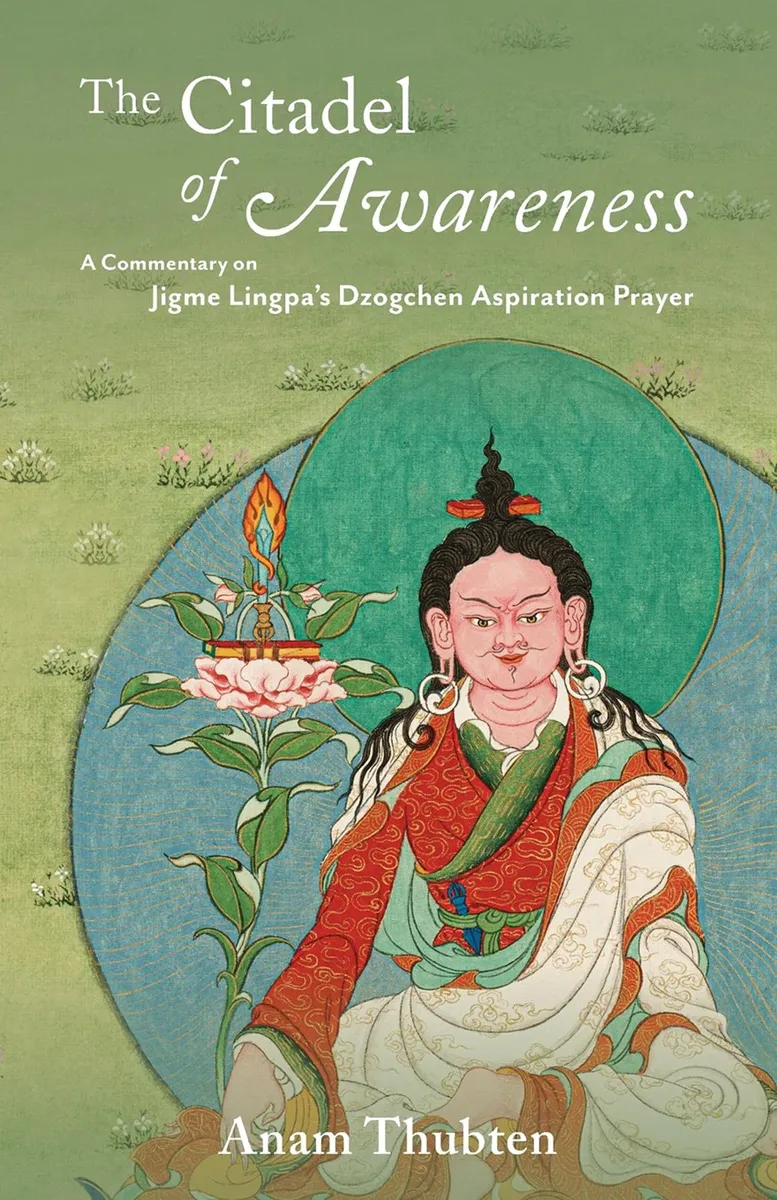
Author’S Preface
Another reason is that people are really longing for liberation and are secretly tired of endless spiritual practice. They just want to wake up right now.
This doha, or song of realization, is regarded as one of the sacred texts in the Nyingma tradition. Usually one would not casually write a commentary on this doha unless there was a very compelling reason, because it is so sacred. Not to write a commentary on it is a way of respecting it and treating it as sacred.
He was known for being very mindful of whatever he said. He was famous for saying things with great carefulness. He came to the West only one time.
Dzogchen is a system that emphasizes the direct awakening to nature of mind, or rigpa (W. rig pa). It is not any kind of creed or some particular doctrine that we can hold onto or define. Rigpa, or awareness, is the most important theme in all of Dzogchen. Rigpa is described as the unconditioned, the buddha mind, or the highest state of awakening.
They may have a sense that the journey itself has become the very realm from which they want to be free. They want to drop the inner burdens completely, to drop anything that binds them, and to experience the highest freedom, a freedom that was tasted by all the great beings, such as Buddha. They might want to experience the profound awakening that Siddhartha experienced under the bodhi tree.
There were many people who felt they were not good enough, not ready to practice Dzogchen, because it requires a kind of divine chutzpah to drop all the struggles on the spiritual journey and experience the highest freedom here and now.
there is “me,” the seeker; enlightenment is over there; there is the path that “I” am going to travel; and “I” will go through karmic purification using various means to reach enlightenment. Paths other than Dzogchen often try to capture the ultimate truth in logic, theories, and concepts, yet the ultimate transcends everything. The ultimate truth can never be fully captured in words and concepts. Dzogchen transcends all the doctrines, spiritual practices, and disciplines.
The three conditions are meeting with an awakened master, a lineage with a blessing, and a disciple with devotion. It is like having the ideal conditions. Imagine that such awakening is like a beautiful flower. With the right temperature, soil, water, and so on, the flower can blossom.
Most of the disciples felt that they had realized awareness, buddha mind, rigpa. But there was one student who didn’t get it, no matter how much his master tried to point it out to him. He didn’t give up, because he was sincere and full of devotion. One day, the lama said, “Pick up a bag of barley from my house and run to the top of the mountain without looking back or taking a break.” The student was so respectful to his master that he was willing to do this. No doubt he was very intelligent, so he knew his master was trustworthy. He didn’t have blind faith. He listened to his master’s advice, even though it was totally weird. He picked up a bag of barley from his master’s house and started running at the fastest speed. At one point running up
the mountain, he lost his breath and fell down, totally exhausted. All his thoughts of past, present, and future, all reference points, every notion of reality completely dissolved. In that moment, there were no more concepts, and he realized what his teacher was trying to tell him. He had a direct experience of rigpa. He was so happy he wanted to report it to his master, and with childlike joy, he started running to his teacher’s house with the greatest speed. He finally got back to his master’s house and shouted, “Now I saw it. I realized it.” The master said, “I don’t care if you are awakened or not. Where is my bag of barley?”
“Where are you from, and where are you going?”
Yet when there is the right moment, often the student can directly experience rigpa, or nature of mind, which is the non-egoic state of consciousness.
The term great expanse can have many meanings. It can refer to the notion of the great, limitless, enlightened mind, which can be compared to an inexhaustible treasure of wisdom that abruptly poured out from the consciousness of Jigme Lingpa and was revealed in the profound teachings that he wrote.
They say Buddha Samantabhadra never meditated, never went through karmic purification, and never carried out any wholesome conduct. This is quite radical, because in many sacred traditions, these are the activities that spiritual people perform in order to become enlightened. But it is another way of telling us that Buddha Samantabhadra is not an entity in the world but a pure expression of spiritual awakening itself that can happen to anybody. There is no time, place, or characteristic that defines the awakening.
The first kaya is dharmakaya, the body of Dharma or the body of the truth. This is the enlightened nature of a buddha that goes beyond any limitations. It has no form, no shape, no size; it has no physical form at all.
Awareness, or rigpa, is not some sublime, altered, spiritual state of our mind. It can be revealed or pointed out at any given moment. Often Dzogchen masters
say that if you just relax and don’t do anything—don’t meditate, don’t follow your thoughts—what remains is a very alert, present awareness that is not bound by your thoughts or emotions. This is considered rigpa. It is so shockingly simple.
The very essence of that awareness—empty, no form, no color, no shape, no limitations—is the dharmakaya. Its nature is luminous; it is not blank nor dead; it is aware of itself, alert. That nature is the sambhogakaya. The dynamic energy from which thoughts, perceptions, and experiences arise is the nirmanakaya. The three kayas are described by the terms essence, nature, and compassion.
Luminosity means something is vivid and alive, not dead nor blank, and is also pure. Luminosity is more than a mind empty of limitations; it is an awareness that is alive and fully present.
VERSE 3 - INCONCEIVABLE GROUND Inconceivable and free from all conceptual exaggerations, The reference point to existent or nonexistent collapses. Even Buddha’s tongue struggles to describe this truth. It has no beginning, no end, and no middle. It is a space of deep, profound clarity. May I realize the true nature of the ground of Dzogchen.
Without the relative truth, the ultimate truth can be a dangerous concept, leading to nihilism and outright rejection of the obvious reality. So what is the difference between the relative truth and the ultimate truth? The difference is that relative truth is a version of reality that is agreed upon by everyone. It is the version of reality that allows us to have a sense of right, wrong, good, bad, as well as practical matters.
“I don’t debate with the world; the world debates with me.”
“The reference point to existent or nonexistent collapses.” Since ground is inexpressible, in the realm of the ultimate truth, ground is also neither existent nor nonexistent.
“It has no beginning, no end, and no middle. It is a space of deep, profound clarity.” In general, everything that exists physically and in our mental world can fall under the category of either conditioned or unconditioned. Almost every reality we live out is part of the conditioned. If you look around, everything you see or believe is conditioned.
When we say “no beginning, no end,” it’s easy for the mind to think that ground is some supreme or eternal thing, because often the term ground or ultimate truth creates an image in our mind of something transcendental, heavenly, or divine.
Many of the New Age movements also have nothing to do with negation but rather believe in some kind of “thing”—higher consciousness, chakras, etc. So it is really easy for people to turn zhi into something eternal.
But here, we are asked to let go of the propensity of the brain, to let go of an evolutionary habit. We are not being asked to drop a small habit like nail-biting. The tendency to reify things is a huge evolutionary habit in our DNA, in our genes. The Dzogchen tradition is asking people to drop this deeply rooted neurological habit and go into another state of consciousness to experience reality with a new vision, a new perception, where language no longer applies, where intellect is not useful, where words are not necessary, where everything you believe to be true starts collapsing and turns out to be just a bunch of stories.
Dzogchen uses meditation and pointing-out instructions so we can step back from the old brain to experience a reality that has no limitation, no reference point, no duality between self and other. A reality that has nothing to achieve, nothing to purify, and that has no past and no future. Then this verse says that such reality, this ground, is “a space of deep, profound clarity.”
VERSE 4 - THE PATHLESS PATH OF DZOGCHEN In the unborn, original purity, which is pristine in itself, The radiance of the spontaneously present unconditioned shines, Yet not held as something other, the great union of awareness and emptiness. The understanding of primordial ground culminates through this realization. May there be no pitfalls concerning the vital points of the path.
VERSE 4 - THE PATHLESS PATH OF DZOGCHEN In the unborn, original purity, which is pristine in itself, The radiance of the spontaneously present unconditioned shines, Yet not held as something other, the great union of awareness and emptiness. The understanding of primordial ground culminates through this realization. May there not be pitfalls concerning the vital point of the path.
This may sound too easy. How does karmic purification take place without engaging in all the spiritual practices to purify one’s karma? Yet in such awakening, without even trying to purify your own karma, it is naturally purified.
The logic behind this is that both nirvana and samsara are two states of mind. Not only that, samsara itself as well as karma and suffering originate not from outside in the ultimate sense but from inside, from our own consciousness, from not being able to awaken to rigpa within.
Traditionally, the three portions are regarded as the discursive thoughts of past, present, and future. They represent categories that include all the possible kleshas that can arise in our consciousness. The fourth portion is nonconceptual thought.
also heard another way it can be interpreted: if our consciousness is divided into four portions, three might be the three kleshas—greed, hatred, and ignorance. What remains is awareness, or rigpa. This means if you remove those three kleshas, mind is already pure awareness.
The sutras describe the bodhisattva going through a heroic journey to cultivate the two sambharas. Some of the Jataka tales are mind-blowing—a bodhisattva might give away everything he or she owns, or go through physical hardships, sickness, pain, austerities, and courageous acts practicing the six paramitas. It sounds heroic but extremely arduous and effortful.
One has to study and learn the details, techniques, and systems of chakras, prana, bindu, and the mandala of the deities. The two stages involve a lot of practices, visualizations, and mantra recitation. It is a path that sounds rather elaborate. Yet all the paths have the same goal, which is simple: to transform our consciousness.
Traditionally, the three portions are regarded as the discursive thoughts of past, present, and future. They represent categories that include all the possible kleshas that can rise in our consciousness. The fourth portion is nonconceptual thought.
The Nine Yanas
The term yana is used mainly in the Mahayana and Tantric Buddhist traditions. It means vehicle. It could refer to the hierarchical capacity of the spiritual mind.
Out of these three, the first two are called the hinayana, or lower vehicle, because the individuals who are on that path are lacking in bodhichitta, the awakened heart, the desire to awaken all beings. They are doing all the spiritual practices with one motivation—to become enlightened themselves in order not to suffer any more. But they would not have the heroic motivation to stay in the world as long as all sentient beings exist, in order to help them.
The third yana is the bodhisattva-yana. The bodhisattva is someone who has a huge heart, someone whose very intention for being on the spiritual journey is not to discover inner liberation for his or her self but to help all beings and assist them in finding inner freedom. The bodhisattva’s commitment is to stay in the world and to help everybody become enlightened. The bodhisattva path is the essence of Mahayana, or the Great Vehicle. The bodhisattva’s awakening to absolute reality is much more developed than the first two, the shravaka and the pratyekabuddha.
In the Mahayana tradition, samsara is a state of mind. You can still be in existence while being in an enlightened state of mind. The bodhisattva’s motive for being on the spiritual path is not from the ego. Its root is in altruism, bodhichitta, the enlightened heart. From bearing witness to the suffering of the world, he or she has the heroic courage to be in the world in order to help others.
The true bodhisattva is called an Arya Bodhisattva, exalted bodhisattva—one who is not only driven by a higher aspiration but also has awakened to mahashunyata, great emptiness, and sees the world as illusion.
One could compare Vajrayana to Sutrayana with the analogy that Vajrayana is like riding balaha, the magical horse, but Sutrayana is like riding an ox. Vajrayana is more advanced than any of the Sutrayana levels. The awakening as a result of Vajrayana is much more developed than the awakening in the first three yanas.
Those who practice Vajrayana are not only able to be in the world without a need to reject or escape from it, but they are able to hold the world with a sacred attitude, seeing no fundamental duality between the transcendent and mundane, seeing that it is all sublime and pure.
He or she celebrates existence as a sacred mandala, or sacred world. The path allows individuals not to reject but to enjoy the delights of life and existence without getting caught up in them. One can stay liberated and enjoy life.
These verses about Vajrayana indicate that it is pointless to torture oneself in the name of enlightenment; it is just not a smart thing to do. The verses hint that you can enjoy all the senses and delights of life, not feel bad about them, and still become enlightened by practicing the Vajrayana path. Sometimes if you try to go against the delights of life, not only will you have unnecessary struggles, you may miss the final point of the path and experience hurdles that prevent you from becoming fully liberated.
Path of Dzogchen Then there is Dzogchen. The path of Dzogchen transcends the inferior motivation of hinayana as well as the hardships of the bodhisattva, who takes many eons to become enlightened. Dzogchen also transcends all the complex methods of Vajrayana. It transcends all of them and goes to the heart of the matter; it is in sync with the truth, primordial ground, original purity, in which there is no path. In that sense, the Dzogchen path can be described as the pathless path.
In the end, the focal point of Dzogchen revolves around rigpa, or pure awareness. The path is all about realizing rigpa and learning to stabilize that in one’s
consciousness, becoming grounded in that realization. Not merely having a moment of such awakening but establishing that awakening in one’s consciousness and incorporating it in everyday life. The Dzogchen path is not completely free from challenges, because even after having an authentic awakening, which could have been brought about by a catalyst such as ngotrod from a master, it is easy to lose such an awakening when encountering external circumstances.
“In the unborn, original purity, which is pristine in itself…” This verse illuminates the idiosyncrasies of rigpa, or awareness. The very essence of rigpa has nothing to do with any conditions that we can imagine. Therefore, it has never been born and will never die.
If we think of rigpa like the pure sky, kleshas are like the clouds, which are not the sky. They can obscure the sky but can drift away. A traditional metaphor says that kleshas are like dust on a royal mirror. The royal mirror has always been a royal mirror, whether it is covered by dust or not.
In the same way, even when our consciousness is gripped or shrouded in the kleshas or inner poisons, its nature is always rigpa—pure and enlightened. Remember that rigpa is not an altered state of mind or some kind of exalted state of consciousness. It is simply the nature of consciousness.
Meditation Guidance Longchenpa offers meditation guidance on how to be awakened to rigpa: Do not manipulate, do not manipulate your mind. Do not grasp, do not grasp at your mind. The more we manipulate it, the more pollution will occur. Contrived mind will obscure the essential meaning.
All meditation techniques often try to manipulate or transcend ordinary experience, or exalt our consciousness to a higher level, to feel bliss, and so forth. There is a motive involved in such meditation. Here Longchenpa says to let go of all the motives and preconceived notions of what you are supposed to be experiencing. In Longchenpa’s meditation instructions, you don’t try to manipulate your experiences. Just leave your mind alone as it is. Then whatever experiences arrive, either good or bad, do not grasp at them. They could be some pleasant thoughts or something unpleasant; something wholesome like love, compassion, or joy; or on the other hand, something unwholesome, like confusion or anger. “Do not grasp at them” means do not follow any of them. He is also asking us not to reject them.
Liberation comes when you realize all phenomena are natural expressions of rigpa. Everything we are experiencing—our own kleshas, thoughts, feelings, emotions, joy, sorrow, good, bad—and everything we are perceiving is the natural expression of radiance or the display of rigpa itself. If you recognize this as the natural expression or display of rigpa itself and don’t perceive it as other than rigpa, then there is awakening, true liberation.
In that extraordinary liberation, our mind is no longer bound by concepts and ideas, and our heart is no longer imprisoned by unhealthy emotions. Such liberation is hard to believe, but it can happen to a human being under any circumstance. True liberation does not only happen when life is smooth—it can happen to us regardless of how difficult the external conditions might be.
Life does what it does, and it doesn’t disappear just because you are a great yogi or meditator. You have no idea what is in store for you or anybody else. Life is unbelievably unpredictable. Illness, accidents, loss, and all sorts of tragedies can happen to anyone. If you have illness, you still may have physical pain even if you are meditating on the nature of mind. However, the reaction that our ego puts on pain, which intensifies and creates another level of suffering, would not be there. The possibility of this unconditional freedom is not even on most people’s mental radar. Yet this is perhaps the most wonderful thing that can happen to a human being. “Yet not held as something other, the great union of awareness and emptiness.”
It is said that true awakening happens by directly experiencing what is called the “union of awareness and emptiness.”
union of bliss-emptiness, union of appearance-emptiness, and so forth. This term is expressing a complete, perfect awakening in which the ultimate truth of emptiness, or dharmadhatu, is no longer some kind of object to be observed or known, and the enlightened mind is the knower. Instead, in such awakening, the duality between knower and known is completely transcended.
“The understanding of primordial ground culminates through this realization. May there be no pitfalls concerning the vital points of the path.” The last lines of this verse make the aspiration that one would be able to realize awareness, or rigpa. Through that, one directly realizes the truth of primordial ground, the ineffable.
One pitfall, for example, is that one could fall into the trap of eternalism or nihilism in relation to ground, rigpa, dharmakaya, the unborn. And there are others. Ultimately, this verse is reminding us that this path is direct, because what we are seeking is already in each of us. The ultimate truth, one’s true nature, one’s original face, is already in each of us. It is the nature of the mind. There is no need to search for it anywhere. No need to create anything. With this radical, nondual understanding, simply by resting and relaxing in the uncontrived natural state of your own mind, the most profound awakening will come to you. This is the path of Dzogchen.
VERSE 5 - VIEW, MEDITATION, AND CONDUCT From the beginning, it is already pure, and the term “view” does not even exist. By awareness realizing its own nature, it pulls itself from the sheath of meditation. Because there are no reference points, it is freed from the chains of conduct. In this womb of the unconditioned nature, naked and free from conceptual elaborations, May there be no pitfalls concerning the vital points of the path.
“The understanding of primordial ground culminates through this realization. May there not be pitfalls concerning the vital point of the path.” The last lines of this verse make the aspiration that one would be able to realize awareness, or rigpa. Through that, one directly realizes the truth of primordial ground, the ineffable.
VERSE 5 - VIEW, MEDITATION, AND CONDUCT From the beginning, it is already pure, and the term “view” does not even exist. By awareness realizing its own nature, it pulls itself from the sheath of meditation. Because there are no reference points, it is freed from the chains of conduct. In this womb of the unconditioned nature, naked and free from conceptual elaborations, May there not be pitfalls concerning the vital point of the path.
But one has to bear in mind that all views come from the conceptual mind. They are mental creations. Since they are all built on the conceptual mind, they always have cracks and faults and often don’t capture the vast or the infinite nature
of all things. This is why Nagarjuna said he has no views; he has no assertions. He realized that whatever views you come up with have some kind of flaw, because they are all the offspring of the conceptual mind.
Yet everybody is very attached to their view. There’s no doubt that some views are closer to the truth or more benevolent, more profound, or more rational than others. But they are all workings of the conceptual mind and have cracks in their system.
This is a direct and obvious statement that the Dzogchen view is freedom from all views.
View means there is something for the mind to understand, like self, no-self, and so forth. But this verse says that in the realm of pure ground—the nature of reality that is not touched by our thinking mind, our conceptual mind—there is nothing to view, nothing to see, nothing to contemplate, and nothing to be understood.
View often implies some kind of understanding that is built upon words and concepts.
That’s what this verse is saying. Rigpa is not an effect of any cause or means of manipulation. When the mind is no longer bound by anything, neither meditation nor grasping and rejecting experiences, when the mind is freed from all its effort, then awareness sees its own nature, pure, pristine, luminous, free, and spacious. One experiences that as the reality.
The idea is that if one doesn’t do anything—does not try to create a special state of mind, does not try to get something —and just lets the mind relax in the natural state, that is all that is required. No need to analyze; no need to reject one’s experiences, hold onto them, or manipulate them. Once all the mind’s tricks are gone, then rigpa or awareness is just revealed by itself. “Because there are no reference points, it is freed from the chains of conduct.”
The idea is that if one doesn’t do anything—does not try to create a special state of mind, does not try to get something—and just lets the mind relax in the natural state, that is all that is required. No need to analyze; no need to reject one’s experiences, hold onto them, or manipulate them. Once all the mind’s tricks are gone, then rigpa or awareness is just revealed by itself. “Because there are no reference points, it is freed from the chains of conduct.”
Experiencing the Nature of Mind The whole goal of Dzogchen practice is to remove all the inner veils and to experience direct awakening to the nature of mind. The nature of mind is always present; it is always there.
You will be able to feel that this existence is amazing, unbelievably beautiful, and exquisite. It may sound lofty, but there are many moments after meditating, sitting in silence, and relaxing into your body when you can feel life is an indescribable dance of something bigger than your ego.
But if you are in the right state of mind, life is intrinsically beautiful. It is full of magic. This is what life is. So nature of mind is a state of consciousness that is not bound by our habits, our thoughts, our emotional patterns, and all our subconscious tendencies. Nature of mind is the depth of our consciousness, pure, already liberated, already here, already present within each of us.
VERSE 6 - AVOIDING PITFALLS ON THE PATH Not falling into the partiality of good and bad thoughts, And not wandering in an undifferentiated state, Within the limitless vast expanse, whatever arises is liberated. By understanding the nature of reality in which all accepting and rejecting are intrinsically exhausted, May there be no pitfalls concerning the vital points of the path.
In Dzogchen meditation, one is supposed to open one’s mind and heart to all phenomena, both the display of the outer world—colors, sounds, sights, patterns—and the inner world of thoughts, moods, feelings, and physical sensations. One does not try to manipulate one’s experience in order to only be in a virtuous state of mind and reject the state of mind that is regarded as non-virtuous. Instead, you welcome all thoughts and emotions into your awareness. You do not label them or judge them but let them all flow through you. Through that, you become pure awareness, which is already free, already liberated. One can even experience what is called shar drol (W. shar grol), which means whatever arises is liberated as it arises. When one is abiding or grounded in such awareness, whatever arises doesn’t really matter. It doesn’t matter whether it is a wholesome or unwholesome thought. Nothing binds awareness, because awareness is not attached to anything. Dzogchen masters often use the analogy of dark clouds and white clouds that equally obscure the sun. A golden chain and an iron chain can equally bind one’s hands. The golden chain can be used as an analogy for positive spiritual experiences, and the iron chain is an analogy for ordinary or unwholesome experiences.
VERSE 6 - AVOIDING PITFALLS ON THE PATH Not falling into the partiality of good and bad thoughts, And not wandering in an undifferentiated state, Within the limitless vast expanse, whatever arises is liberated. By understanding the nature of reality in which all accepting and rejecting are intrinsically exhausted, May there not be pitfalls concerning the vital point of the path.
one should not grasp at it by judging it or thinking, “This is good. I’m going to cultivate it,” or “This is bad and I’m going to reject it.” One realizes that the whole effort to cultivate and reject is just part of the ego and does not exist in the realm of primordial ground or the nature of reality.
In Dzogchen meditation, one is supposed to open one’s mind and heart to all phenomena, both the display of the outer world—colors, sounds, sights, patterns—and the inner world of thoughts, moods, feelings, and physical sensations. One does not try to manipulate one’s experience in order to only be in a virtuous state of mind and reject the state of the mind that is regarded as non-virtuous. Instead, you welcome all thoughts and emotions into your awareness. You do not label them or judge them but let them all flow through you. Through that, you become pure awareness, which is already free, already liberated. One can even experience what is called shar drol (W. shar grol), which means whatever arises is liberated as it arises. When one is abiding or grounded in such awareness, whatever arises doesn’t really matter. It doesn’t matter whether it is a wholesome or unwholesome thought. Nothing binds awareness, because awareness is not attached to anything. Dzogchen masters often use the analogy of dark clouds and white clouds that equally obscure the sun. A golden chain and an iron chain can equally bind one’s hands. The golden chain can be used as an analogy for positive spiritual experiences, and the iron chain is an analogy for ordinary or unwholesome experiences.
am doing a Dzogchen retreat for the next two weeks, and if it is an emergency, here’s who to contact.” But what you are doing is just zoning out. Your whole brain becomes very slow, and your whole system relaxes, because the world is not invading you. But there is not so much awareness, and this can be regarded as similar to alaya. You are zoning out. Whereas the real meditation has an intelligence, an awareness that comes with so much insight, so much wisdom. It has the power to undo the conglomeration of your karmic patterns. Even energetically, all your channels open, and creativity and love arise naturally. That can be called the dharmakaya mind. So don’t zone out when you are meditating, and remember to be fully present. Then you already know the essential demarcation.
Calm Abiding, Clear Seeing In general, there are two all-encompassing categories into which all meditation practices can fall. This is true for the Dzogchen system as well. These are known as shamata and vipashyana. Shamata is calm abiding, and vipashyana is direct seeing.
In Dzogchen, rigpa is the union of calm abiding and direct seeing. Rigpa is a state of mind that is calm and still. But it is not just that—it has the quality of vipashyana, direct seeing, or prajna, insight, which is the direct awakening to the true nature of reality, or the nature of one’s own mind. That direct seeing of the true nature of all things has the potency to bring about absolute liberation, which no favorable physical conditions can produce.
Such meditation would be comfortable and may be beneficial, but it would not bring about the ultimate liberation, moksha, or nirvana. This is the attitude held in the Dzogchen tradition.
Né cha means the state or aspect of the meditation experience that is calm, relaxed, and still. Sel cha, or clarity, describes the state of meditation where awareness is fully present. It is open to all the sense impressions from outside and all experiences from inside. It is a wide-open, spacious awareness where all experiences are welcomed. It is not some single-pointed concentration on an object where you shut down all sensory experiences. This is why sometimes Dzogchen teachers encourage people to open their eyes while meditating.
“May there be no pitfalls concerning the vital points of the path.”
Often it is said that one can be attached to the three nyam that happen during meditation: bliss, dé (W. bde); clarity, sel (W. gsal); and no-thought, mi tog pa (W. mi rtog pa). These three experiences are supposed to be very pleasant and transcendental, like some kind of religious, oceanic experience.
Because of that, a meditator tries to create an abnormal experience and gets disappointed when what arises is ordinary. Whereas in Dzogchen meditation, rigpa, or awareness, welcomes all experiences, whether ordinary or extramundane, without the slightest grasping to them. The great masters of Dzogchen often advise us to be mindful and not get attached to these three states. Patrul Rinpoche wrote in his most synthesized text on Dzogchen, Three Words of Prahevarja, “Again and again, destroy stillness, bliss, and clarity.” When he says destroy them, he doesn’t mean to literally destroy them. He means don’t try to sustain them.
They are not hindrances at all in themselves. It’s not that they are intrinsically obstacles that we should avoid. When they arise, it is an indication that you are immersed in meditation and that meditation is having some powerful impact on your consciousness. The experiences can be regarded as a sign that your old mental habits are being challenged, and your consciousness is beginning to crack open.
The first is bliss. This does not refer to the ordinary bliss that we experience from eating delicious food or from sensual pleasure. When there is good weather or when we hear music that we love, we experience bliss. The first nyam is more than that bliss. It is feeling that there is no more suffering in your…
“May there not be pitfalls concerning the vital point of the path.”
It is said that this bliss or joy is not ordinary joy but is like swimming in the divine sea of transcendence where all human suffering is gone. Clarity, or sel wa, does not only mean that your mind is alert, able to see and hear forms, colors, and sounds. Instead, it is a state of mind that is free from drowsiness and dullness. You feel that your awareness is utterly pristine, clear, and alert. It is like hyper-clarity, an extramundane experience that one does not ordinarily have in daily life. The third nyam, no-thought, or mi tog pa, does not refer to some state of mind…
Also, the Dzogchen masters are saying that the real spiritual realization and insight is not bliss or other experiences but pure awareness. If one is attached to these tempting experiences, then one is no longer in pure awareness. It is said that your awareness is interrupted by the attachment and has descended into the samsaric mind, the unenlightened mind. Buddhism identifies three samsaric realms, which are known as the realm of desire, the realm of form, and the realm of formlessness. By being attached to bliss, one’s consciousness has descended into the state of consciousness of the realm of desire. By being attached to clarity, one’s consciousness has descended into the state of…
here, Dzogchen is saying the highest state of meditative consciousness or meditative experience is ordinary. Since rigpa is the nature of mind, one doesn’t need to seek it anywhere, or wait for it to happen, or employ any techniques or methodology to experience it. Rigpa is always here, always present.
It could be said that the view is the authentic understanding of rigpa, dharmakaya mind, or nature of mind. Meditation is to experientially realize it. Conduct is to live that realization in everyday life. Conduct is about truly integrating the wisdom of Dzogchen into all activities, so it doesn’t just become some lofty intellectual idea or some pleasant meditative experience. Instead, Dzogchen becomes a living and breathing Dharma. In that sense, conduct is reminding ourselves to live in rigpa in all the activities of life, while eating, lying down, sitting, or going.
They thought that resting or abiding in nonconceptual awareness was “idiot’s meditation,” as they called it, and it was lacking in vipashyana or prajna. They did not appreciate the Dzogchen idea that all the good and bad thoughts were like chains that bind us. They thought this was some form of subtle nihilism.
Dharmata (nature of reality) is free from all conceptual elaborations. So let your mind rest in that which is free from conceptual elaborations.
Shantideva is saying that unless the truth is seen, moksha, or liberation, is not found. This definition of liberation is quite specific in Buddhism and is not some flowery idea.
So the way to attain liberation is not by manufacturing liberation through methods or religious purification but by undoing or dismantling the entire development of samsara all the way back to its genesis. This is why it is so important to see the truth in Buddhism. Whenever such seeing or insight occurs, liberation happens right there on the spot.
Shabkar’s words can be quite radical. The lamp here refers to awareness, seeing the true nature of reality, prajna. He is also referring to some really unenlightened consciousness filled with all the inner poisons, depicted by a cave facing north over eons of darkness. But in a single moment, liberation happens.
No doubt there are lots of pitfalls, and one can easily mistake some pseudo-awakening or spiritual experience as true awakening. This is why the Dzogchen tradition says it is important to have a wise and skillful master, one who can lead the practitioner on the right path and who will make sure the practitioner does not fall into those traps. This verse definitely invites us to be aware that the path is not always straight but can zig-zag quite a lot, and there can be gol sa (W. gol sa), or pitfalls, misunderstandings that can trap us. This verse invites us to hold the aspiration that we will see the pitfalls, avoid them, and succeed at experiencing true awakening.
It teaches that in the true fruition there is nothing to achieve and nothing not to achieve.
The Dzogchen Tantras say when Buddha Samantabhadra becomes awakened, awareness goes back into what they call the womb of precious, spontaneous presence, lundrup rinpoche bup (W. lhun grub rin po che’i sbubs).
But awakening is alive, a dynamic state of consciousness that is not lost in the realm of duality. It is fully present, aware, and full of love and compassion. One of the ways to gauge if awakening is authentic or not is whether there is love or compassion in it. If these two things are missing, then one’s awakening is not authentic but just the mind playing a trick on itself.
Nothing is separate from dharmata, nature of reality, or ground. This is why it is said to be “shining to itself.” Therefore, from the very beginning, there has never been any duality. The duality that our egoic mind often experiences as reality is an illusion. It is like a big dream.
This image of the citadel conveys the image of an awakening that is like a fortress so well-built and fortified that no enemies can attack or destroy it. One can live there happily, enjoying a feast.
VERSE 8 - FRUITION BEYOND EFFORT To Samantabhadra, the primordial self-aware awareness, All the notions of attainment dissolve into space. The nature of Ati Yoga goes beyond effort and mind. In the expansive womb of Samantabhadri, the union of space and awareness, May I reach the citadel of the king of all fruitions.
The word dharmadhatu is constructed from two Sanskrit words, dharma and dhatu. The word dharma in Sanskrit sometimes has two meanings. One meaning is Dharma as the path. The other meaning is dharma as all phenomena. In the case of dharmadhatu, dharma means everything, all phenomena. The word dhatu here means source. So dharmadhatu is the source from which everything arises. It is not a mental construct that someone invented hundreds of years ago, but it is also not something you can point to. It is not a material object nor is it a concept.
This requires some clarification. When Dzogchen or Vajrayana state that the nature of mind is already enlightened, it is not the same enlightenment that is gained through traveling the path of karmic purification and cultivating virtue. It means that the nature of mind, or dharmadhatu, doesn’t have any intrinsic flaw; it is not conditioned by karma or delusion. From that point of view, it can be regarded as a kind of primordial enlightenment.
So dharmadhatu can be interpreted as the fundamental ground from which everything arises and everything dissolves, yet itself is always infinite, ineffable, complete, and perfect. Within it, there is no samsara, no path, and there is no fruition to be attained.
Dharmadhatu is always present as the basic ground even though it is not some kind of thing. Yet it is not eternity either, since it is not a thing. One of the mistakes that can be made about dharmadhatu is to interpret it as some type of eternity.
unreal. Yet during meditation, sometimes our mind is much clearer and freed from all its mental veils. Then we can tap directly into this extraordinary and liberating reality.
when you read works by Longchenpa, he is definitely talking about something he experienced and is so familiar with. It is like a virtuoso talking about her musical instrument. She is a complete expert at playing it.
This requires some clarification. When Dzogchen or Vajrayana states that the nature of mind is already enlightened, it is not the same enlightenment that is gained through traveling the path of karmic purification and cultivating virtue. It means that the nature of mind, or dharmadhatu, doesn’t have any intrinsic flaw; it is not conditioned by karma or delusion. From that point of view, it can be regarded as a kind of primordial enlightenment.
In Shabkar’s verse, “happy” is not happiness in the ordinary sense. It means that one is grounded in such spiritual realization, and there is deep equanimity; the outer conditions and inner experiences have no more power to throw one off balance.
“All the notions of attainment dissolve into space. The nature of Ati Yoga goes beyond effort and mind.”
They are twelve statements that end with the sound of laughter, “Ha! Ha!,” symbolizing amazement as well as great bliss from seeing such a reality. In other words, it is like having an “aha” moment with total rapture. Because these twelve vajra laughters are considered radical, there is a warning that people can misunderstand them easily.
In some sense, enlightenment does not just arise by itself. It is often a fruition of a noble effort. But this is only true in the context of relative truth. In the ultimate truth, even cause and effect are illusions.
Often the Dzogchen masters say if you have the right state of mind and readiness, then you don’t need to be a great meditator or someone who is well-learned.
One begins to see the big reality, one that is bigger than one’s thoughts, opinions, beliefs, or concepts; a reality that is also transcendental and not bound by any limitations. This is what silence is for.
Madhyamaka, literally Middle Way, means the truth that does not fall into any ta (W. mtha’), conceptual extremes.
Usually in Buddhist philosophy, eternalism is believing in a theistic creator, and nihilism is denying law of cause and effect.
One method that can help us to see how easily all our concepts and beliefs fall into the two extremes is to divide nihilism into gross and subtle nihilism, and eternalism into gross and subtle eternalism. Gross means it is easy to figure out, and subtle means it is hard to figure out. The example used for gross nihilism is denial of cause and effect. That’s easy to understand, because it is a blunt rejection of reality. But there is also subtle nihilism. If someone rejects emptiness, that is a subtle form of nihilism, because nihilism means rejecting something that is true.
You can use an axe if you chop a tree, but if you want to cut a flower for your vase, you need a finer tool.
Samadhi Raja Sutra,
… the intelligent ones let go of all conceptual extremes. They do not even reside in the middle.
But sometimes a dreadful tragedy happens, which is that a person sees a finger pointing to the moon, but the person ends up thinking that the finger is what is being pointed out. This kind of unfortunate philosophical tragedy happens more often than we think.
Instead, the true meditation on Madhyamaka is when there is no more reference point, not even Madhyamaka, and you are no longer using your mind to comprehend it. You are experiencing reality not through the thinking mind but by letting your whole being naturally experience reality on its own. Basically, the meditation
is letting go of the entire structure of “me” and “my mind” trying to figure or understand something, trying to unravel some puzzle. The whole effort stops.
Just like that, Mahamudra means no phenomena can go beyond the great seal of the ultimate truth. Metaphorically speaking, everything is ruled by the great seal of the ultimate truth, everything is permeated by the ultimate truth, or the truth of Mahamudra.
“The vital point of Dzogchen—liberation from extremes and expansive.” Here, this verse is once again saying that the heart of Dzogchen, which is the ultimate truth or rigpa, is trö drel, freedom from all conceptual elaborations. In general, Dzogchen describes the ultimate truth, or dharmadhatu, as having two qualities. The first quality is freedom from all extremes, which is nonduality, similar to the state of Madhyamaka that we talked about earlier. One thing to bear in mind is that freedom from extremes is not just a philosophical assertion but is the transcendence of all conceptual reference points.
However, our mind cannot see it, so there is samsara, suffering, duality, and so forth. But the truth, or dharmadhatu, itself is already free from the very beginning. This is what the second term, expansive, points out.
It is not sufficient to merely understand the ground, path, and fruition of Dzogchen philosophically, otherwise they can remain as just intellectual information in one’s head. The main point is to actually live it. That is also the message of this prayer. If you look at the text, you see that each verse ends with a prayer, an aspiration to embody and live the message of Dzogchen in the realm of now, in daily life.
In the matrix of duality, there is “me” who is separate from the totality. There is “my” life, and other people “I” either like or dislike, and “I” have all these goals for achievement, wanting love, approval, comfort and so forth. There is “me” who is competing with other people to get ahead of the game. There is fear with all that—not achieving what I want, fear of rejection and failure, and all kinds of ideas of right and wrong to get attached to. All the time, this sense of “me” or “I” is always striving towards something, holding this life together, and always fighting, even unconsciously, to control reality, to mold it into “my” preference. It is always happening. Even if we do spiritual practices, we are operating in that matrix. There is a “me” who is a spiritual being wanting to get somewhere, chasing after the big nirvana, and carrying guilt and pride. At the same time, no matter how powerful the matrix is, it can be interrupted by returning to rigpa, which is the ground of our consciousness.
We let go of the whole thing, which results in an unbelievable sense of being free and liberated, with the realization that the truth has been there all along, regardless of what we call it—primordial ground, dharmakaya.
just rest in the primordial ground of all things, where we experience a state of mind that is not the show of the ego, but something that is much more spacious or profound—rigpa, or dharmakaya mind.
But either on retreat or in everyday life, let the matrix collapse so you feel the extraordinary freedom that is already there. Then all your struggles go away naturally. By doing this, eventually our whole consciousness becomes more in tune with rigpa rather than with the matrix of duality.
“The sun of happiness shines from within.”