When the king had regained his senses, Guru Rinpoché spoke: “Listen, your majesty.
In general, all worldly pursuits are like dreams. The mark of composite things is that they are like magical illusions. Your kingdom itself is like last night’s dream. Your wealth and subjects are like dew drops on a blade of grass. This fleeting life is like bubbles upon water. All composite things will perish. All meetings end in parting. All composite things are like this. There is not one thing that is stable and lasting. Don’t cling to the impermanent as if it were permanent. Train in the nonarising nature of dharmakaya.
In the experience of yogins who do not perceive things dualistically, the fact that things manifest without truly existing is so amazing they burst into laughter. —LONGCHENPAa
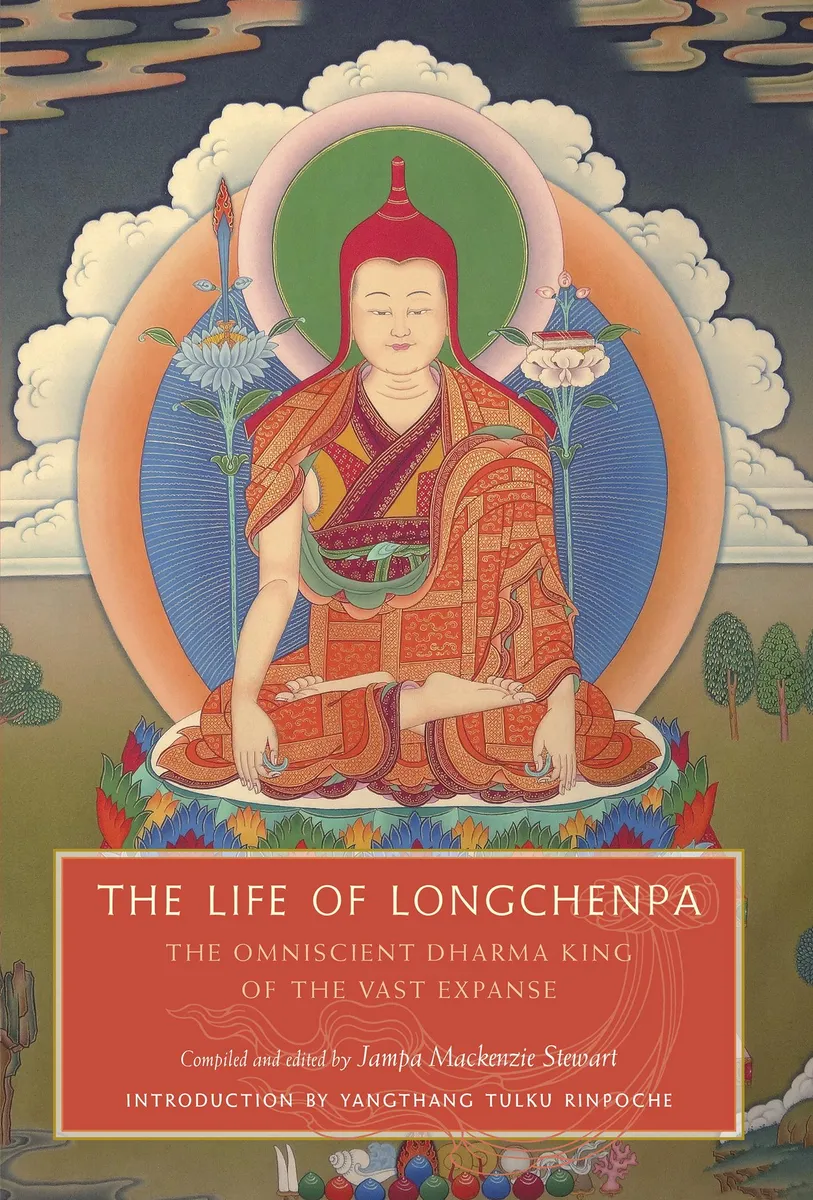
As soon as he could speak Dorjé Gyaltsen would describe things with amazing clarity, as though recalling previous lifetimes. When he was still quite young his family moved to a place close to Khamsum Metokdrol in the area of Samyé Monastery. Blessed as he was with very powerful faith, compassion, and intelligence, by the age of five Dorjé Gyaltsen knew how to read and write as soon as the texts were shown to him, without any study at all. At the age of seven, Dorjé Gyaltsen began studying with his father, receiving the empowerments, explanatory commentaries, pith instructions, and traditional practice methods for the Eight Commands cycle entitled The Gathering of Sugatas, and cycles focusing on Hayagriva, Vajrakila, and The Peaceful and Wrathful Forms of Guru Rinpoché. In addition, his father, Lopön Tenpa Sung, trained him in medicine, astrology, and other fields of learning. At Tsongdu in Drachi Valley, when he was nine, he memorized and understood the meaning of all the words in the sutras the Prajnaparamita in Twenty-five Thousand Lines and the Prajnaparamita in Eight Thousand Lines by reciting these texts aloud one hundred times each.
It was at this time that his mother, Dromza Sönam Gyen, died. Just three years later, when Longchenpa had reached the age of twelve,7 his father, Tenpa Sung, died.
Now an orphan, the young Dorjé Gyaltsen went to the great monastery at nearby Samyé and requested ordination as a novice monk, which he received from the abbot, Samdrup Rinchen, and the preceptor, Kunga Özer. He was given the name Tsultrim Lodrö.8
3. His Early Teachers And Training
Although sensory appearances do not exist, they manifest in all their variety. Although emptiness does not exist, it extends infinitely, reaching everywhere. —LONGCHENPAa
He received all the teachings and transmissions of both the old and new tantras of the various lineages that were taught in Tibet at that time. His fame as a supreme scholar resounded like a great drum in all directions; his degree of learning was undisputed and unparalleled, and he was conferred the title “Longchen Rabjampa” (Infinitely Great Learned One Who Is Like the Vast Expanse of Space).8 Henceforth he was known by this title. He also became known as “Samyé Lungmangpa” (Samyé’s Recipient of Many Transmissions).
With the great Sakya master Lama Dampa Sönam Gyaltsen13 Longchenpa studied the Great Awakening of Motivation as well as all of the instructions of The Three Continua.
4. Leaving Sangphu And Dark Retreat
Below rocky cliffs, a vivid sense of impermanence and disenchantment dawns, clear and inspired, helping us to achieve the union of calm abiding and penetrating insight. —LONGCHENPAa
WHILE STILL at Sangphu, in general he felt boundless sorrow and disillusionment with the condition of the world of samsara, and the urge to live in solitude dawned in him. In particular, Longchenpa began to feel distaste for the rough and discourteous nature of some of the monks from the Kham province of eastern Tibet that were living at Sangphu. Jealous of his accomplishment, they passed up no opportunity to make his life difficult, and actually threw him out of his rooms seven times!
Longchenpa replied, “Here, I want you to have this,” and gave the monk a copy of a poem he had composed about his difficulties with the Khampas entitled “Saddened by My Circumstances,” a poem based on the order of the Tibetan alphabet,2 which his friend then went and attached to the throne in the teaching court. Later that day, when the Khampas saw it, they removed the letter from sight, but the thirty-line poem, beginning with the line “Like the ogres who roam in Kalinga…” eventually circulated over all the kingdom.
In the village Longchenpa performed a ritual for the stillborn child of a lay tantric practitioner. Taking the small offering that he received in exchange, he spent the next eight months in the cave of Chokla in complete, continual darkness, day and night. At dawn, between his meditation sessions, he would pass along the teachings of the six paramitas of the bodhisattva to the scholar Töntsül. Otherwise, he remained in meditative absorption.
5. Meeting The Guru Kumaradza
You must serve, in the best possible way, a noble teacher and purify your mind through study, reflection, and meditation. In particular, you should spend your days and nights diligently applying yourself to the essential instructions of the oral lineage. —LONGCHENPAa
To encourage detachment from worldly things in the hearts of his students, the awareness holder Kumaradza had no fixed home. That spring and summer, while Longchenpa was receiving teachings from Kumaradza, the camp moved nine times, from one deserted valley to another. Just as he got settled, the time would come to move again, giving him no opportunity to obtain food or clothing. So exhausted was Longchenpa’s body from the penetrating cold and the icy terrain, and so worn his clothing, that even the young monks and watchdogs spurned him. In these and other ways he endured inconceivable hardship for the sake of the Dharma. The next year Kumaradza and Longchenpa, teacher and student, traveled together to Shampo Glacier. There the guru gave Longchenpa many empowerments and instructions, and especially the teachings of the unsurpassable secret: the outer, inner, secret, and innermost secret cycles of the Dzogchen approach of clear light; the four volumes of profound pith instructions; and the seventeen tantras, such as the Reverberation of Sound Tantra, the most kingly of all tantras, together with the 119 pith instructions.
All this time Longchenpa had very few provisions. He sustained himself on several pounds of barley flour and about twenty-one pills of mercury. When snow fell, he would wrap himself in a sack and use it as both a bed and a robe. It was under these circumstances of great privation that he received all of Kumaradza’s spiritual instructions, including the Vima Nyingthig teachings and other Nyingthig instructions, like water poured from one vessel into another. By practicing night and day, he realized the same attainment as his teacher.
- VISIONS AND RETREATS As a beginner, it is most important that you secure your own well-being, guarding your mind in solitude, abandoning distractions and busyness, avoiding unfavorable situations, and subduing the mental afflictions with appropriate antidotes. —LONGCHENPAa
While he stayed at Gegong he had a vision of a peaceful form of Guru Rinpoché. He also journeyed to the pure realm of Khechara, where he experienced numerous marvels. In one instance he taught the Dharma to the dakinis there. They cast flowers of auspicious blessings on him, and escorted him for a short distance when he left, offering him the permission blessings of the Nyingthig teachings. He was continually immersed in such pure visions. At Ge-ur he had visions of bodies of light—standing forms of Red Vajravarahi, Vajrasattva, Hayagriva, Tara, and Amitayus. Then, as he practiced in a charnel ground, deities revealed their forms to him and undertook to carry out his enlightened activities.
Longchenpa described his attainments by writing: “There is no more attachment to samsara in me. I am liberated from the chains of hope and fear. I always abide in the view and meditation of absolute Dzogpa Chenpo.”1
- TURNING THE DHARMA WHEEL The welfare of others cannot be accomplished without the higher faculties of perception, so strive diligently for your own well-being while mentally considering the welfare of others. —LONGCHENPAa
Just like someone moving from one building to another, his consciousness had moved from one body into another one.
During the main part of the empowerment she sang a song about the view and meditation that are free of conceptual speculation: Though the mind that is free of meditation may be enjoyable, Oh, how happy is the meditation that is free of the mind!
Inspired, the gathered students danced and sang with joy, experiencing a one-pointed and utterly lucid state of mind. In this state, they actually saw the ephemeral forms of dakas, dakinis, and Dharma protectors.
Many other such inconceivable miraculous events took place that night. One of the yogis present was terrified and said, “Tonight heaven and earth have changed places! No doubt these beings are bent on having our flesh and blood!”
“If I practice intensively in solitude, will I attain the body of light? Or, if I work to serve others instead, of how much benefit will that be? And how long can I live?” She replied, “Even if you attain the body of light, you must help other sentient beings. Definitely serve others, and you will live for another thirty years.”
“So people won’t think me a charlatan or hypocrite?” he asked. “What’s the point of paying attention to slander and gossip? I myself will gather the worthy recipients to assemble and meet you. Anyway, those who are unfortunate would slander even the Buddha.”
In the midst of all this, the guru Longchenpa rose from his seat and sang this vajra song: O yogis, how happy and joyous it is! Tonight, in the Unexcelled Pure Land,11 In one’s own body, the palace of the peaceful and wrathful deities, The mandala of buddhas, the union of clarity and emptiness flourishes. The Buddha is not somewhere else outside, But within us!… This is due to the kindness of the Lama. The Lama is not outside, But within us; The Lama of primordial purity and spontaneous presence Dwells in the state of clarity and emptiness, free from apprehensions… O meditators, you who hold your minds one-pointedly, Do not hold your mind at one place, but let it go at ease. As the mind is emptiness, openness, whether it goes or stays. Whatever arises is the play of wisdom. By knowing the process of the inner five lights, The outer lights of sun and moon have arisen continuously;
By ending inner thoughts at their foundation, Good and bad outer circumstances have arisen as great bliss. By increasing the inner bindus, The clouds of outer dakinis have amassed. By freeing the inner knots of the light channels, The outer knots of perceiver and perceived are freed. I go to the state of clarity and great bliss. O vajra brothers and sisters, how happy and joyous it is!
The guardian deities then uttered prophecies, saying, “Because these teachings are so sacred, their power could present obstacles to your longevity; it would be best if you taught them sparingly.”
- TERMA REVELATIONS AND MIRACULOUS EVENTS Through the union of bliss, clarity, and nonconceptuality you will achieve clairvoyance, extraordinary powers of perception, and boundless qualities, and ultimately you will achieve the wish-fulfilling three kayas and all the qualities of the victorious ones, spontaneously bringing about your own and others’ welfare. —LONGCHENPAa
One can scarcely even hint at his experience with words that are normally used to point out the inner radiance. That night he knew the meditative clarity of resting in the state of the expanse of primordial purity, the dharmakaya; the sambhogakaya arose as its manifest expression of power; and the nirmanakaya and the six realms of samsaric existence arose separately as its outer radiance. In this way the dakinis blessed Longchenpa to nakedly see what was introduced.
- WHITE SKULL SNOW MOUNTAIN High among the mountains the mind grows clear and expansive, the perfect place to bring freshness when dull and to practice the generation stage. Snowclad regions help make samadhi clear and awareness bright and lucid, ideal for cultivating insight and where obstacles are few. —LONGCHENPAa
From among the numerous termas concealed within the cupola of the Zha Lhakhang temple, he extracted a full chest of gold from the back of the upper shrine, and many sadhanas of the twelve Tenma goddesses, Dorjé Legpa, and other deities. When the earth was cleared away from the foundations, many evil skulls of different kinds were discovered; skulls had previously been placed there during a suppression ritual. Longchenpa reburied these, but as he began the suppression ritual demonic manifestations arose. Earth and stones hailed down violently, a fierce wind blew, and a gloomy darkness fell like nightfall. His retinue was upset and dumbfounded; the experience was so frightening that some of his students just fainted on the spot, but Longchenpa himself chanted mantras wrathfully and assumed a menacing posture.
- SELF-EXILE IN BHUTAN Whoever towards me generates anger or faith or whoever hurts, praises, or follows me, may I lead them all swiftly to enlightenment. —LONGCHENPAa
Within a mass of radiant light above the statue’s head he saw the seven generations of buddhas, Bhaishajyaguru, the white and blue forms of Tara, Chakrasamvara, Hevajra, Avalokiteshvara (the form promulgated by King Songtsen Gampo), the thousand-armed, thousand-eyed form of Avalokiteshvara, and the deity Jinasagara. In their midst stood the glorious protective deity Bernakchen,5 the great guardian kings of the four directions, the Lion-Headed Dakini who protects against maras, and the glorious protector goddess Shri Devi. He beheld all of these in the space before him.
He subjugated malevolent nonhuman spirits—Chungdu, Dongzur Menmo, and others—and bound them to his service. Even today, the amazing deeds of the one remembered as Lama-la Ngawang Drimé Özer are recounted and held in the highest regard.
11. Return To Tibet
The main practice is the recognition of the natural state. Through meditation involving bliss, clarity, and nonconceptuality, the clear light primordial wisdom free from conceptual elaboration arises as the fundamental innate mind. —LONGCHENPAa
12. Final Days And Parinirvana
Life is impermanent like autumn clouds, youth is impermanent like the flowers of spring, the body is impermanent like borrowed property; the lord of death, like the shadow of the western mountain, will not delay. —LONGCHENPAa
Profound spiritual advice, like healing nectar, is the most excellent cure for the disease of negative emotions, so please rely on it in your life and cultivate it thoroughly, gaining mastery from now on.
Mind, by nature, is the basic space of phenomena, which is like the sky. Space, by nature, is the ultimate meaning of the genuine nature of mind. The supreme state is perfectly uniform, ultimately nondual, so please realize it with certainty from now on.
Phenomena in all their variety are like reflections in a mirror. They are apparent yet empty, with “emptiness” not to be found elsewhere. In a cheerful frame of mind, without labeling phenomena as identical or separate, please know this with certainty from now on.
Grasping at the objects you reify is like being in a dream. Truth is nondual, for dualistic perceptions are caused by habit patterns and are only labels applied by ordinary consciousness, empty by virtue of their very essence. Please be aware of nonduality from now on.
Please purify subject, object, and their interrelation from now on.
Alertness is like a fine, undistracted watchman who does not provide the thief, nonvirtue, any opportunity but undertakes to guard the wealth of virtue. Please rely on alertness with certainty from now on.
Heedfulness is like a surrounding wall and moat, preventing the marauding hordes of negative emotions from invading and marshaling the forces that emerge victorious over the enemy, karma. Please strive to guard your mind from now on.
Wealth is unreliable, like clouds in the autumn. Good fortune will, by nature, decline; there is no true essence at its very core. Please realize this truth with certainty from now on.
13. His Legacy
May my happiness be experienced by all beings, May the sufferings of living beings be transferred to me. Until samsara is emptied, May I lead living beings. —LONGCHENPAa
His Prophesied Rebirths
Gyalsé Tulku Drakpa Özer LONGCHENPA’S FIRST REBIRTH appeared while he was still alive, manifesting as his own son, Gyalsé Tulku Drakpa Özer.
Pema Lingpa (1450–1521) Longchenpa’s next rebirth was as Pema Lingpa, recognized as the fourth of the five “tertön kings,” or treasure-finders. He was the last of the five pure incarnations of King Trisong Detsen’s daughter, the royal princess Pemasal.
As a child he had a commanding and confident presence, and chose his course in life early on. Even at play he would sit on a throne and act as if he were giving teachings and empowerments to his playmates; he would gather an entourage, chant mantras, perform sacred dances, and enter into meditative absorption.
By the age of nine all fields of learning became effortless for him, whether it was reading and writing or ironwork and carpentry. In this way he mastered various texts, crafts, and much else without needing instruction.
When he was still very young Drakpa Özer felt the qualities of someone holy awaken within him. He sang songs of advice to his mother, and would explain the meaning of the Dharma to all who came near. At this time, many people saw the great mantra protectress Ekajati holding him in her lap and the seer Rahula guarding him. Throughout his life Tulku Drakpa Özer was boundlessly dedicated to maintaining, preserving, and propagating the scriptures of his father, Longchenpa, in Tibet and Bhutan, where he illuminated the path to liberation with the torch of Dharma, including the teachings of the vajra heart essence of clear light.